

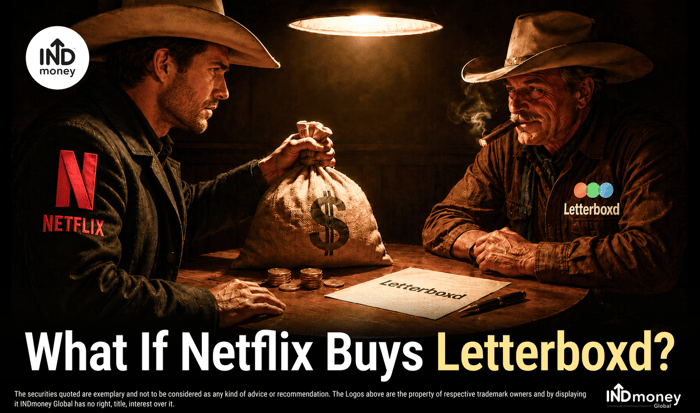
- What Is Letterboxd and Why Does Netflix Want to Buy It?
- Letterboxd Valuation: Why Is the Platform Worth $250 Million?
- What Would This Actually Cost Netflix?
- Why Netflix Wants Letterboxd: Data, Recommendations and Advertising
- 5 Ways Netflix Could Use Letterboxd to Grow Its Business
- Key Risk: Could Netflix Ownership Damage Letterboxd’s Independence?
- How Could the Letterboxd Deal Affect Netflix Stock Price?
- Our Take
Reports published this week by Puck and confirmed by Variety reveal that Netflix is among several major players, including Sony Pictures, Paramount Skydance, private equity firms TPG and RedBird, and even Reddit co-founder Alexis Ohanian, all in early talks to acquire Letterboxd, the social platform where 30 million film lovers (myself included) log, rate, and obsess over movies.
Investment bank LionTree is running the sale process and has floated a valuation of approximately $250 million. For a company with Netflix's financial scale, that number barely registers as a line item. But what Netflix could actually do with Letterboxd after writing that check? That is where the real story is.
Let's break down what Letterboxd is, what this deal would cost Netflix in real terms, the five distinct strategic plays Netflix could run with this acquisition, and what all of it means for NFLX investors paying attention from the sidelines.
What Is Letterboxd and Why Does Netflix Want to Buy It?
Letterboxd launched in 2011 out of Auckland, New Zealand, built by two web designers, Matthew Buchanan and Karl von Randow. For most of its early life it was a beloved but niche product. Then the pandemic hit. People stuck at home were watching everything, and they wanted somewhere to actually talk about it with people who cared. Letterboxd's user count went from roughly 2 million in 2020 to over 30 million members globally as of June 2026, adding 10 million new users in just the past year alone, as per Variety.
Think of Letterboxd as the Goodreads of cinema, but with sharper taste and a more devoted community. Users log the films they have watched, rate them on a five-star scale, write reviews, curate lists ("films that broke me," "every Scorsese, ranked"), follow friends' activity, and as of December 2025, even rent movies directly through the platform's newly launched Video Store. That last part matters and we will come back to it.
The demographics are what make this genuinely valuable in a business sense. Half of Letterboxd's audience is under 35 years old, and of that group, more than half are between 16 and 24. This is exactly the segment every media company is desperately chasing and consistently struggling to retain. And these are not passive consumers scrolling through a feed. Letterboxd users deliberately log what they watch, articulate their opinions, build watchlists, and let those preferences drive real viewing decisions. That behavioral profile is rare and commercially valuable.
Letterboxd is majority-owned by Canadian holding company Tiny, which acquired a 60% stake in Letterboxd in 2023 at a valuation of $50 million to $60 million. The other 40% remains with co-founders Matthew Buchanan and Karl von Randow. Buchanan reportedly holds veto rights over any buyer, as per Inc., meaning whoever acquires Letterboxd will need to convince not just Tiny but also the man who built it that the platform will be in good hands.
Letterboxd Valuation: Why Is the Platform Worth $250 Million?
The Letterboxd sales process is being handled by investment and merchant bank LionTree, which has been floating a rich $250 million valuation. That is approximately a 4 to 5x jump from where Tiny bought in just three years ago.
| Metric | Detail |
| Members globally (June 2026) | 30 million+ |
| Member growth in one year | +10 million |
| 2023 valuation (Tiny acquisition) | $50-60 million |
| 2026 floated valuation | ~$250 million |
| Implied cost per user | ~$8.30 |
| Estimated annual revenue | ~$7-8 million (unaudited, directional only) |
| Implied revenue multiple | ~31-35x revenue |
Sources: Variety, Puck, RocketReach estimate (revenue figure unconfirmed)
At 31 to 35 times estimated revenue, the price looks steep by traditional SaaS or media metrics. But Letterboxd's value is not in its current revenue. It is in the community, the data quality, and the demographic trust it has built. Amazon acquired IMDb in 1998 as the centerpiece of a three-company deal totaling approximately $55 million, as per SEC filings. IMDb is now the number one movie website in the world, with more than 200 million monthly visitors, and has iOS and Android apps downloaded hundreds of millions of times. Amazon did not buy IMDb for its income. It bought it for the data and the film-intent signal it gave over millions of users. This is that exact playbook, in the streaming era.
What Would This Actually Cost Netflix?
This is where the conversation shifts entirely. Netflix’s revenue scaled from $33.7 billion in 2023 to $39.0 billion in 2024 and $45.2 billion in 2025, and full-year 2026 guidance of $50.7 to $51.7 billion points to a third consecutive year of double-digit growth. Netflix also received a $2.8 billion termination fee from Paramount Skydance after the Warner Bros. Discovery merger talks fell apart, recorded in Q1 2026.
| Netflix Financial Metric | Figure |
| Q1 2026 revenue | $12.25 billion |
| Full-year 2025 revenue | $45.2 billion |
| 2026 revenue guidance | $50.7-51.7 billion |
| Market cap (July 2026) | ~$310 billion |
| Annual content spend (approx.) | ~$17 billion |
| 2026 ad revenue target | ~$3 billion |
| $250M as % of market cap | 0.08% |
| $250M as % of 2025 annual revenue | ~0.55% |
| $250M as % of annual content spend | ~1.5% |
Sources: Netflix Q1 2026 shareholder letter, Yahoo Finance (July 2026), Variety
Here is one way to think about the proportionality: at 0.55% of Netflix's annual revenue, paying $250 million for Letterboxd is roughly equivalent to a family earning Rs 1 crore a year spending Rs 55,000. It barely registers as a financial decision. The real debate is not whether Netflix can write the check. The debate is what the check actually buys.
Why Netflix Wants Letterboxd: Data, Recommendations and Advertising
Netflix already has one of the most sophisticated content recommendation systems in the world. It tracks what you watch, when you pause, how far you get before abandoning a show, whether you switch to subtitles. All of that is behavioral data, what you might call implicit preference data. You watched 40% of a thriller at midnight and never returned. Netflix logged it. But it does not know if you disliked the film, got interrupted by a phone call, or simply fell asleep. The signal is there, but it is ambiguous.
Letterboxd's data is fundamentally different. It is explicit, deliberate, taste-based preference data. When someone logs a film on Letterboxd, gives it 4.5 stars, and writes a review about why the cinematography reminded them of Tarkovsky, they are articulating their taste with full intention. There is no ambiguity in that signal. This distinction matters enormously for both recommendation and advertising.
Think of it this way: the difference between Netflix's behavioral data and Letterboxd's review data is like the difference between tracking how long someone stands in front of a dish at a restaurant buffet versus having them fill out a card saying exactly which dishes they loved and which they hated, and why. Both give you information. The card gives you far more reliable information, because the user chose to share it deliberately.
This is what separates Letterboxd's data from what Netflix already has. Netflix knows what you watched. Letterboxd knows what you think about what you watched. For recommendation engines and targeted advertising, the second kind of data is worth significantly more.
5 Ways Netflix Could Use Letterboxd to Grow Its Business
This is where the analysis moves over and beyond, because there is not one playbook here. There are at least five ways in which Netflix could use Letterboxd, and each leads to a meaningfully different business outcome.
Scenario 1: The IMDb Play, Letterboxd as Netflix's Data Layer
The simplest use case is also likely the most valuable over the long term. Netflix integrates Letterboxd's explicit taste data into its core recommendation engine. A Letterboxd profile with 400 logged films, 200 ratings, and curated lists tells Netflix far more about your preferences than viewing history alone. Netflix could prompt new and existing subscribers to link their Letterboxd accounts, immediately enriching its recommendation model. Watchlists on Letterboxd map almost directly onto the concept of "what I want to watch next," which is the most important piece of intent data any streaming platform can have. Amazon built this logic with IMDb. Amazon recognized the value of collecting and analyzing user information. IMDb provided a massive and constantly growing dataset on consumer preferences related to movies and television, used to personalize recommendations, target marketing campaigns, and ultimately understand what customers wanted. Netflix would be doing the same in 2026, at full streaming scale, with a user base that did not exist when Amazon made that bet.
Scenario 2: The Social Layer, The Feature Netflix Has Never Cracked
Netflix has attempted social features before. The ability to see friends' activity, share viewing habits, build a social graph around film taste. None of it worked at scale, primarily because Netflix's viewing experience has always been private by default and because no one's Netflix friend list is made up of people they actually trust for film recommendations. Letterboxd has already built exactly what Netflix failed to build: a social network where film taste is the organizing principle, and where people follow accounts because they genuinely trust those recommendations. If Netflix acquires Letterboxd and builds a light integration, something like a "what your Letterboxd connections are watching on Netflix" feed, it creates a word-of-mouth discovery mechanism that no streaming competitor can easily replicate. Word-of-mouth from trusted sources drives streaming decisions more powerfully than any algorithmic recommendation. Letterboxd already has the social graph. This is Netflix's chance to borrow it.
Scenario 3: The Gen Z Acquisition Machine
Gen Z is the hardest demographic to retain on subscription platforms. Price-sensitive, quick to cancel, deeply skeptical of corporate product decisions, and fiercely loyal to communities they actually believe in. As of July 2026, Letterboxd had more than 30million users, with the number growing by 10 million in just the past year. The community's appeal to young film lovers is not manufactured. It is organic and built on actual trust in the platform's independence. The ad plan at $8.99 per month accounted for over 60% of all new sign-ups in Q1 2026 in countries where it is available. If Netflix creates a Letterboxd-integrated subscription bundle, where new subscribers get full Letterboxd Pro features bundled with their Netflix plan, it gives the platform a compelling acquisition hook specifically among the Gen Z segment. The cost to acquire each incremental subscriber through this channel would likely be far lower than conventional digital marketing spend, which is the metric that matters for Netflix's long-term unit economics.
Scenario 4: The Advertising Intelligence Layer
Netflix's advertising business does not operate in a single market. As of early 2026, the ad-supported tier is live in 12 countries. Research firm Omdia projects Netflix will reach $8 billion in annual advertising revenue by 2030. The core pitch Netflix makes to advertisers is its 325 million subscriber base combined with first-party behavioral data. Letterboxd adds an entirely new targeting dimension to that pitch: verified film genre preference, explicitly stated. An advertiser for a premium whisky brand wanting to reach known arthouse film enthusiasts, or a camera brand targeting people who watch every new A24 release, currently has to rely on crude demographic proxies to find that audience. With Letterboxd's review and rating data integrated, Netflix could offer "genre-interest targeting" backed by millions of deliberate declarations of taste. That pushes CPM rates higher. Industry guides cite Netflix CPMs landing roughly in the $25-$65 neighborhood, depending on ad format, targeting specificity, and buying method. Richer and more reliable audience data is how you move those CPMs toward the higher end of the range and attract premium advertising budgets that are still largely sitting with linear television.
Scenario 5: The Video Store Angle, Netflix's Arthouse Lane
This is the most speculative but also the most creatively interesting play. Letterboxd's Video Store functions as a TVOD model with no subscription required. It is available across 23 countries, with rental prices and title availability varying by country, and in the US, films at launch are priced between $3.99 and $19.99. The selection is built around arthouse films, festival titles, and films that struggle to find conventional streaming distribution. Netflix, as the owner, could significantly expand this vertical. Netflix has historically struggled with the economics of arthouse and festival content, not because the films are not good but because acquiring full streaming rights for niche titles does not always justify the cost on a mass platform. The Video Store model, where films earn per-rental revenue, solves this without requiring full licensing commitments. Under Netflix ownership, the Video Store could become a genuine third lane of the business, a Criterion Channel equivalent built on top of a 30-million-strong community that already validates the films being sold. It would also give Netflix something it quietly needs right now: credibility with the filmmaking community that has grown increasingly skeptical of how the platform treats non-blockbuster cinema.
Key Risk: Could Netflix Ownership Damage Letterboxd’s Independence?
This is the part the film community is loudly and rightfully worried about. Rotten Tomatoes, the most widely used film aggregator in the world, was owned by Fandango, which was in turn majority-owned by NBCUniversal for years. IMDb is owned by Amazon. Both arrangements have faced persistent accusations of algorithmic bias, whether or not actual bias existed. The perception problem is real and self-sustaining.
If Netflix buys Letterboxd, every time a Netflix original rates highly on the platform, someone will raise the question. The Letterboxd community is extraordinarily protective of the platform's editorial independence, and co-founder Matthew Buchanan's veto rights over any buyer are a signal that he understands what is at stake. Any acquiring company will need to commit credibly to keeping Letterboxd independent, which is easier to promise in a press release than to deliver over five years of ownership.
This is the real risk in the deal, not the $250 million price tag. The asset that makes Letterboxd worth $250 million is the trust of its 30 million users. Mismanage the community and that trust evaporates quickly. A platform where users no longer believe the ratings are honest is worth nothing.
How Could the Letterboxd Deal Affect Netflix Stock Price?
To be clear about scale: a $250 million acquisition will not move NFLX stock in any material way on its own. At a market cap of roughly $310 billion as of early July 2026, this represents 0.08% of Netflix's total market value. On announcement day, our read is that the stock could generate a modest positive reaction, likely in the range of 0.5% to 1.5%, driven by the narrative of Netflix deepening its data capabilities. This estimate is our analytical view and not a price prediction or recommendation.
The more interesting stock story is not about the $250 million check. It is about narrative shift. Netflix is currently priced primarily as a subscription and advertising business. If the Letterboxd acquisition helps Netflix position itself as a data ecosystem for entertainment, the company that knows not just what you watch but what you actually think about what you watch, that is a structurally different story that can support a higher multiple. It is too early to call Letterboxd a transformation driver for NFLX at this stage. But the direction of the strategic intent is worth noting for investors with a multi-year lens.
Our Take
At $250 million, this would be a rounding error on Netflix's income statement. That is not a criticism. It is what makes the deal attractive.
The Letterboxd acquisition makes most sense if Netflix manages it the way Amazon managed IMDb: give it resources to keep doing what it does, integrate the data layer quietly without disrupting the product experience, and let the community trust compound as an asset over time. Amazon used IMDb data for personalized recommendations and targeted advertising, while allowing IMDb to maintain its core functionality and user interface. That discipline is the reason IMDb still works 28 years later.
The worst outcome, and it is not hypothetical, is a Netflix that acquires Letterboxd, retrofits it to look like every other Netflix product page, erodes the community trust that is the entire source of value, and ends up three years later with a dormant platform. That has happened before with acquired film communities.
The most bullish case is that Netflix uses Letterboxd's data to sharpen its recommendation engine, builds a social discovery feature that meaningfully reduces churn among its most engaged subscribers, and unlocks an advertising targeting advantage that rivals cannot replicate without building the same community from scratch. All three outcomes are real. None of them would show up in Netflix's numbers immediately. This is a two to three year bet, not a quarterly catalyst.
A personal note, as a film lover watching this unfold: Letterboxd is one of the few corners of the internet that still feels designed for people who genuinely care about cinema rather than for the algorithm's convenience. There is real value in that, and it is not the kind of value that shows up in a revenue table. The best version of this deal is one where Netflix is wise enough to mostly leave that part alone. The Letterboxd experience, at its core, works precisely because it does not feel like a product trying to sell you something. The moment it does, the 30 million people who care about it will notice immediately, and they will leave.
Whether you hold NFLX, the Letterboxd acquisition news, if it progresses beyond early talks to an actual deal, is unlikely to change your investment thesis in isolation. What it does signal is that Netflix understands its next growth frontier is not simply about adding more subscribers. It is about building a richer, more reliable understanding of what those 325 million subscribers actually want to watch, and why they pick one title over another on a Tuesday night. That understanding, built carefully over time, has compounding value. Letterboxd, at $250 million, is one of the cheaper ways to build it.