

- From Late Fees to Streaming Dominance
- Going Global Changed Everything For Netflix
- New Business Models and Constant Reinvention
- So, Just How Big Is Netflix? Numbers That Stop Conversations
- What This Means for the Future
Netflix is one of those rare businesses where sheer scale stops you in your tracks. Today it boasts a market cap larger than legendary media giants such as Walt Disney and Sony combined. Its over 325 million paid users globally exceed the populations of entire countries like Japan and Thailand. Its annual profits dwarf the combined revenues of India’s listed media companies. And its market value tops the GDP of nations such as Sri Lanka, Nepal and Iceland combined together.
That’s not a chart you glance at. It’s a reality that forces you to rethink what Netflix really is: not just a streaming service, but one of the most significant entertainment and media empires the world has ever seen.
So, let’s look beyond the numbers and into how Netflix became this big, why its growth matters, and what lessons its journey holds.
From Late Fees to Streaming Dominance
The Netflix story starts in the late 1990s, long before binge-watching and Netflix Originals were household terms. In 1997, co-founders Reed Hastings and Marc Randolph launched Netflix as a DVD-by-mail rental service, born from a simple irritation: Hastings was charged a late fee for a Blockbuster rental. In the age of dial-up internet and VHS tapes, Netflix’s model was novel but unproven: order a DVD online and have it delivered, with no late fees.
Soon, the company shifted from pay-per-rental to a subscription model, letting members rent as many DVDs as they wanted for a flat monthly fee. This early pivot planted the seeds of Netflix’s future: move from owning physical inventory to locking in recurring revenue. By 2000, Netflix was rapidly expanding its DVD library and refining systems like recommendations which turned out to be the backbone of its future digital success.
But the real turning point came in 2007, when Netflix launched streaming. Suddenly, content wasn’t in envelopes and mailboxes, it was online, instantly accessible. This shift wasn’t just technical; it was cultural. It changed how people consumed entertainment. Viewers could watch what they wanted, when they wanted. Netflix became synonymous with “on-demand.”
Going Global Changed Everything For Netflix
Netflix didn’t stop at technology. It saw an almost limitless horizon beyond the United States.
In 2010, it began its international expansion with Canada, quickly adding millions of subscribers and proving streaming could cross borders. Over the next decade, it rolled out services across Latin America, Europe, Asia and eventually over 190 countries worldwide. What had been a Silicon Valley curiosity became a global entertainment service.
Unlike traditional media companies that focused on local markets first, Netflix built its scale by thinking global from day one. It wasn’t just about reaching new subscribers; it was about understanding regional tastes. Shows like Money Heist from Spain and Squid Game from South Korea became international sensations, showing that non-English content could break global charts too, something competitors initially underestimated.
Localization became a core strategy, allowing Netflix to tap deep into diverse markets and avoid the plateau many domestic competitors hit. This global mindset is one reason Netflix now counts more users than the populations of Japan and several other nations combined.
New Business Models and Constant Reinvention
Scale doesn’t come from a single breakthrough. It comes from constant reinvention.
As subscriber growth slowed in mature markets, Netflix introduced an ad-supported tier that significantly expanded its reach, especially in price-sensitive regions. Today, tens of millions of users opt for this plan, helping Netflix drive engagement even where competition is fierce.
Netflix also experimented with cracking down on password sharing, turning passive viewers into paid subscribers and diversified its offerings with gaming and live sports content. In recent years it has streamed NFL games and big sporting events, challenging traditional broadcast channels, and it struck a landmark deal to stream WWE content into the mid-2030s.
The most seismic shift came with its attempted acquisition of Warner Bros. Discovery’s studio assets in a deal valued at $82.7B, a move that would further consolidate Netflix’s content ownership and distribution power. The acquisition highlights Netflix’s evolution from content licensor to content owner, an important strategic leap.
So, Just How Big Is Netflix? Numbers That Stop Conversations
Looking at today’s numbers helps explain why Netflix is more than a streaming platform.
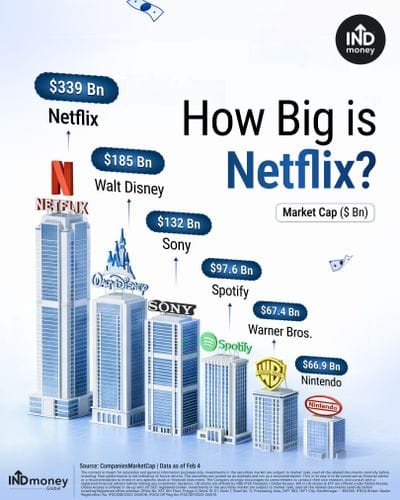
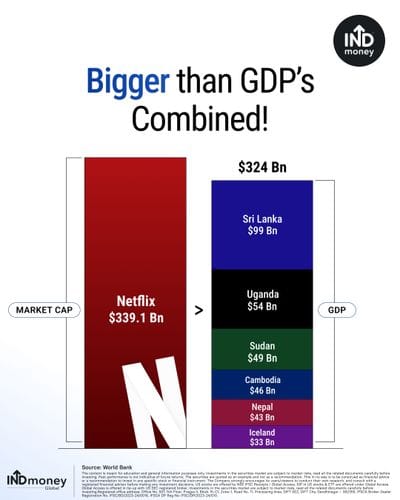
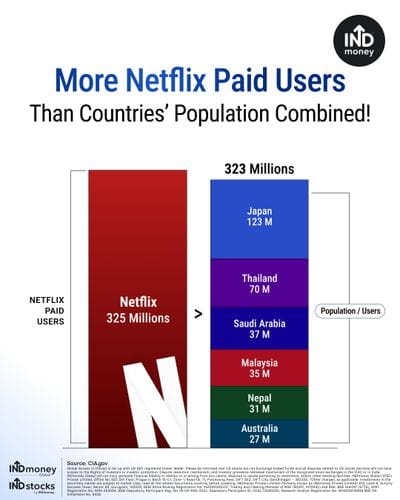
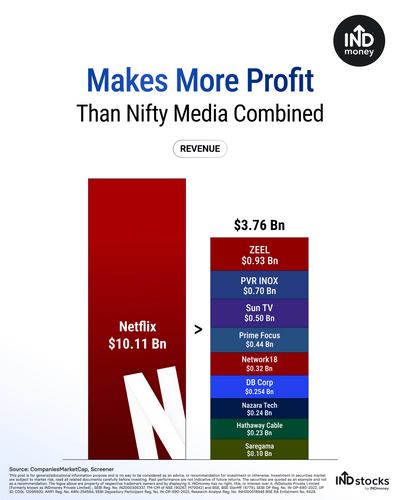
These figures matter because they show depth as well as breadth. Netflix isn’t just big in one market; it is big everywhere. Its scales rival industries and economies. That’s why comparing its profit to entire segments of the Indian media industry is no stretch.
What This Means for the Future
Netflix’s ascent teaches two broad lessons for businesses and investors alike.
- Adaptation beats inertia. Netflix didn’t stick with one model forever. It evolved from DVD rentals to streaming, from subscriptions to ad-supported plans, from licensed content to originals and acquisitions.
- Global scale unlocks resilience. Reaching billions of people across cultures diversifies risk and creates opportunity. Growth isn’t linear, but global exposure gave Netflix flexibility most local businesses can only dream of.
Netflix remains at a strategic inflection point. Growth in its core streaming business shows signs of slowing in developed markets, but new products, sports content, and strategic acquisitions show it still has levers left to pull.
Looking at Netflix purely as a tech or media company misses the point. Its journey from a DVD mail-order idea to a market cap that rivals countries reflects not just innovation, but a confident, long-term view of entertainment itself. Whether you’re an investor, creator, or curious reader, Netflix’s story is as much about how the world watches as it is about what we watch.
Disclaimer:
The content is meant for education and general information purposes only. Investments in the securities market are subject to market risks, read all the related documents carefully before investing. Past performance is not indicative of future returns. The securities quoted are exemplary and are not a recommendation. This in no way is to be construed as financial advice or a recommendation to invest in any specific stock or financial instrument. Readers are encouraged to verify the exact numbers and financial data from official sources such as company filings, earnings reports, and financial news platforms and to conduct their own research, and consult with a registered financial advisor before making any investment decisions. All disputes in relation to the content would not have access to an exchange investor redressal forum or arbitration mechanism. INDmoney Global (IFSC) Private Limited,Registered office address: Office No. 507, 5th Floor, Pragya II, Block 15-C1, Zone-1, Road No. 11, Processing Area, GIFT SEZ, GIFT City, Gandhinagar – 382355.