

- Why Netflix Entered the Room in the First Place
- Paramount’s Move Changed the Game
- The Quiet Power of a Bidding War
- The Trump-Ellison Factor No One Says Out Loud
- Why Losing Could Still Mean Winning for Netflix
- Who Actually Benefits from This Twisted Hollywood Triangle
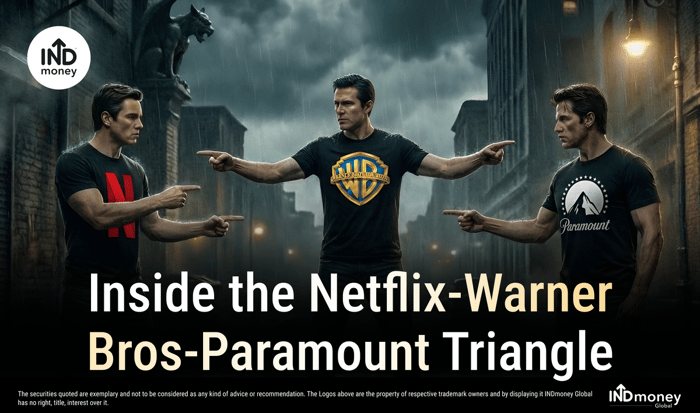
In Hollywood, the most interesting scenes often happen off camera. The bidding war around Warner Bros is one of them. On the surface, it looks like a straightforward corporate tussle: Netflix wants scale, Paramount wants survival, and Warner Bros shareholders want the highest price. But underneath the press releases and dollar figures is a quieter, more strategic story about leverage, politics, and why losing a deal can sometimes be just as powerful as winning one.
This is not just about who buys Warner Bros. It is about who controls the narrative, who absorbs the risk, and who walks away with optionality intact.
Let’s break down with this blog how the Netflix-Warner Bros-Paramount triangle actually works, why the bidding itself may already be serving Netflix’s interests, and how politics has quietly entered what looks like a pure media deal.
Why Netflix Entered the Room in the First Place
For Netflix, Warner Bros was never about owning everything. It was about owning the right things.
In early December 2025, Netflix agreed to acquire Warner Bros.’ streaming and studio assets in a historic deal valued at approximately $82.7 billion in enterprise value. Netflix’s vision was simple: secure HBO, DC, and decades of iconic film and TV content under one roof, globally and forever to solve Netflix’s only long-term problem: defensibility. Originals scale well, but franchises age better. Warner’s catalogue brings permanence in a world where licensing costs keep rising.
But Netflix has also been clear historically. It prefers building over buying. This bid already marks a strategic departure. Which makes one thing worth noting: Netflix does not need this deal to survive. It wants it, but on its own terms.
That distinction matters.
Paramount’s Move Changed the Game
When Paramount Global, backed by Skydance and the Ellison family, launched a hostile bid to buy the entire Warner Bros Discovery for more than $108 billion, the market read it as escalation. A higher price, a louder offer, and a more aggressive posture.
But structurally, Paramount’s bid comes with heavier leverage, more integration risk, and far greater dependence on political and regulatory goodwill. It is a bet on consolidation as a necessity rather than an option.
For Netflix, that changes the calculus entirely.
Once a hostile bidder enters, the deal stops being about price alone. It becomes about who absorbs the downside.
The Quiet Power of a Bidding War
Here is where Netflix’s position gets interesting.
By stepping into the process early and anchoring valuation, Netflix has effectively forced any rival bidder to overextend. Paramount now has to justify not just a higher price, but a more complex balance sheet and a harder regulatory path.
If Paramount wins, Netflix avoids:
- Taking on legacy cable assets it does not want
- Navigating multi-year antitrust scrutiny
- Integrating a legacy studio culture at global scale
If Paramount loses, Netflix gets Warner Bros on terms that already reflect competitive pressure. Either way, Netflix has shaped the outcome.
This is why some analysts see Netflix’s move less as desperation and more as strategic pressure. Even walking away does not weaken Netflix. It weakens everyone else’s margin for error.
The Trump-Ellison Factor No One Says Out Loud
There is another layer to this story that has little to do with streaming strategy and everything to do with politics.
Larry Ellison, whose family backs Skydance and by extension Paramount’s bid, is one of Donald Trump’s most prominent billionaire allies. Trump, in turn, has been openly hostile toward big tech platforms, particularly those perceived as culturally or politically adversarial.
A Paramount-Warner combination backed by Ellison fits neatly into a political narrative Trump has leaned into before: counterbalancing Silicon Valley dominance with “friendly” corporate power centres.
Netflix, despite being an entertainment company, is still viewed in Washington as big tech-adjacent. That perception matters if regulatory discretion tightens.
This does not mean Paramount automatically gets a green light. But it does mean the political temperature around the deal is not neutral. For Netflix, stepping back while others lean into political risk may be the more rational move.
Why Losing Could Still Mean Winning for Netflix
Netflix’s core strength is not content ownership alone. It is global distribution, pricing power, and cash generation at scale.
If it loses Warner Bros:
- It preserves capital for originals, sports rights, and regional expansion
- It avoids being the face of media consolidation in an election-heavy regulatory cycle
- It lets competitors absorb integration pain and political scrutiny
Meanwhile, Netflix continues to license selectively, produce globally, and grow margins.
In that sense, Netflix has already achieved something valuable. It forced the industry to reveal its hand.
Who Actually Benefits from This Twisted Hollywood Triangle
Warner Bros shareholders benefit from a price floor Netflix helped establish.
Paramount benefits if it wins, but only if execution and regulation align perfectly.
Consumers may not benefit much either way, as consolidation rarely leads to lower prices.
Netflix benefits in both scenarios: either by acquiring prized assets or by watching rivals stretch themselves thin.
Sometimes the smartest play in Hollywood is not the loudest one. It is knowing when to exit the frame while the spotlight stays elsewhere. And that may be the most Netflix move of all.
Disclaimer:
The content is meant for education and general information purposes only. Investments in the securities market are subject to market risks, read all the related documents carefully before investing. Past performance is not indicative of future returns. The securities quoted are exemplary and are not a recommendation. This in no way is to be construed as financial advice or a recommendation to invest in any specific stock or financial instrument. Readers are encouraged to verify the exact numbers and financial data from official sources such as company filings, earnings reports, and financial news platforms and to conduct their own research, and consult with a registered financial advisor before making any investment decisions. All disputes in relation to the content would not have access to an exchange investor redressal forum or arbitration mechanism. INDmoney Global (IFSC) Private Limited,Registered office address: Office No. 507, 5th Floor, Pragya II, Block 15-C1, Zone-1, Road No. 11, Processing Area, GIFT SEZ, GIFT City, Gandhinagar – 382355.