

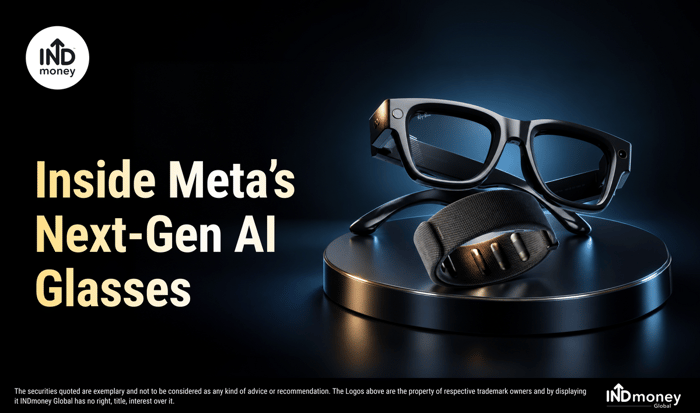
- What did Meta announce in its new AI glasses lineup?
- Why does everyday use matter more than the number of glasses Meta sells?
- How could Muse turn Meta AI glasses into a recurring-revenue business?
- What do Meta’s latest earnings reveal about the cost of its AI ambitions?
- How much could AI glasses contribute to Meta’s business?
- What do the new AI glasses mean for Meta stock’s valuation?
- What could prevent Meta AI glasses from becoming a mass-market business?
- What should Indian investors watch in Meta’s AI glasses strategy?
Meta’s next growth opportunity may depend on a surprisingly ordinary question: will people want to wear its glasses every day? Its latest lineup broadens the appeal of wearable AI, but the investment case requires more than attractive frames. For shareholders, the real opportunity is a lasting relationship with an AI assistant that can generate recurring income. The challenge is building that business without letting its costs outrun its value.
Let’s break down the new Meta AI glasses, their business potential and the earnings expectations that matter for Meta Platforms stock.
What did Meta announce in its new AI glasses lineup?
At Connect on September 23, Meta announced Ray-Ban Meta Audio, Ray-Ban Meta Gen 3 and additions to its Meta Glasses collection. The products address different needs rather than offering a single upgrade for everyone.
| Product | US starting price | Main distinction | Announced availability |
| Ray-Ban Meta Audio | $349 | Audio and AI; up to 12 hours of battery life | Pre-orders open; shipping October 13 |
| Ray-Ban Meta Gen 3 | $449 | Camera glasses; up to nine hours of battery life | Available September 23 |
| Meta Adventurer with plug-in case | $249 | Lower entry price | Pre-orders open; on sale October 23 |
| Meta Glasses LISA editions | $399 | Adventurer and Capri designs | Announced at Connect |
Source: Meta Newsroom, “Introducing Ray-Ban Meta Audio and More AI Glasses Styles,” September 23, 2026. Prices are US starting prices; configurations and local availability vary. Battery figures are manufacturer claims.
The commercial logic is clear: broaden the audience by varying price, style and functionality. Someone seeking convenient calls and music may value a different product from someone who wants hands-free photography.
Gen 3 includes a 12-megapixel camera, 3K video and a customizable action button. These improvements make the product easier to use, but they do not by themselves prove that customers will wear it more often or replace it regularly.
Meta also announced updates to the existing Meta Ray-Ban Display, including cycling and public-transit navigation, an Explore app and a voice-driven digital likeness for calls. These are distinct from the standard camera-glasses lineup. Some features are scheduled for later rollout or early access, so the announcement should not be read as universal availability today.
Why does everyday use matter more than the number of glasses Meta sells?
The first purchase answers whether people are curious. Continued use answers whether Meta has built something valuable.
An occasional-use camera accessory and an everyday AI device have different business potential. The former earns money mainly when hardware changes hands. The latter could support paid services, encourage repeat purchases and become a preferred way to access software.
This makes comfort and convenience financially relevant. A device that performs impressive tasks but stays in its charging case has limited scope to generate recurring revenue. A less ambitious device that solves small problems throughout the day may build a stronger customer relationship.
The most useful adoption measure would therefore combine three things: how many people buy the glasses, how many remain active and how frequently they use AI features. Shipment growth alone cannot establish the latter two.
There is evidence that the category is gaining traction. EssilorLuxottica said AI-glasses sales almost doubled year on year in the second quarter of 2026. It also reported improved wearable-product profitability as a contributor to its first-half gross-margin performance.
That supports the case for an expanding category. It does not establish Meta’s own hardware margin, active-user retention or eventual return on investment. Those are separate questions and an investor should resist treating one encouraging sales statistic as the answer to all of them.
How could Muse turn Meta AI glasses into a recurring-revenue business?
Meta introduced Muse on September 8 and announced its connection to AI glasses at Connect. An AI agent is software designed to carry out tasks as well as answer questions. Meta positions Muse around helping people manage everyday activities and longer-term goals.
The potential advantage of glasses is immediacy. Speaking a request while walking or cooking can be more convenient than unlocking a phone and navigating several screens. However, that advantage only matters if the assistant understands the request and completes it reliably.
Consider a hypothetical restaurant booking. The software must interpret preferences, find a suitable option, access a booking service and obtain any required approval. A smooth demonstration is promising; consistent performance across unfamiliar services is the harder commercial test.
Three possible revenue routes deserve different treatment:
| Potential route | How value could arise | Evidence investors would need |
| Hardware | Income from devices and upgrades | Meta’s recognized revenue and product economics |
| Paid AI services | Customers pay for useful recurring assistance | Paid conversion, retention and cost per user |
| Commercial integrations | Partners pay for services or transactions | Disclosed agreements and revenue terms |
Subscriptions would be attractive only if revenue exceeds the cost of serving users. An assistant that performs lengthy tasks can consume computing resources repeatedly. More engagement could therefore lift both income and costs, making contribution profit more informative than downloads or registered accounts.
Advertising assumptions also need restraint. Meta says Muse does not share users’ conversations or data in their virtual machine with its advertising systems. It describes user controls over connected services and approval before sensitive actions.
It would consequently be wrong to assume that everything a wearer says automatically becomes a new advertising signal. The stronger investment argument is that useful services may earn money directly and strengthen customer loyalty, subject to the actual product terms and economics.
What do Meta’s latest earnings reveal about the cost of its AI ambitions?
The financial starting point is a large advertising business funding expensive expansion. Q2 2026 illustrates why new products must eventually demonstrate returns.
| Metric | Q2 2026 | Q2 2025 |
| Revenue | $60.801 billion | $47.516 billion |
| Operating profit | $18.775 billion | $20.441 billion |
| Operating margin, reported | 31% | 43% |
| Reality Labs revenue | $431 million | $370 million |
| Reality Labs operating loss | $4.619 billion | $4.530 billion |
| Free cash flow | $784 million | $8.549 billion |
Source: Meta Q2 2026 earnings release and financial tables. Reality Labs includes a broader range of hardware, software and content; its results are not glasses-only figures.
The tension is visible: higher sales did not translate into higher operating profit. Legal charges of $2.40 billion and severance expenses of $1.18 billion affected the quarter. Meta’s capital-expenditure outlook was $130 billion–$145 billion for 2026, including finance-lease principal payments.
Investors should keep operating spending and capital spending separate. Product research, staff and many running costs affect operating earnings as incurred. Infrastructure investment consumes cash upfront and generally affects earnings over time through depreciation. A business can therefore report substantial accounting profit while retaining much less cash after investment.
This distinction matters when judging an AI launch. A new revenue stream can look attractive before accounting for the infrastructure needed to support it. The useful question is how much cash remains after the business has paid to deliver the service and sustain its capacity.
Nor should the entire Reality Labs loss be assigned to smart glasses. Without a dedicated product profit-and-loss statement, neither “glasses are highly profitable” nor “every pair loses money” is established by segment reporting. The division’s losses are a funding hurdle, not a disclosed per-device cost.
How much could AI glasses contribute to Meta’s business?
A simple model helps distinguish a successful consumer product from a development large enough to reshape Meta’s finances. The assumptions below are deliberately illustrative and are not management guidance or shipment forecasts.
Assume an average retail selling price of $400. For a separate subscription calculation, assume an average active installed base, a proportion paying for a service and a hypothetical $10 monthly fee.
| Illustrative annual measure | Early scale | Broader adoption | Large ecosystem |
| Devices sold during the year | 5 million | 10 million | 20 million |
| Average retail price, assumed | $400 | $400 | $400 |
| Gross retail hardware sales | $2 billion | $4 billion | $8 billion |
| Average active installed base, assumed | 5 million | 15 million | 40 million |
| Paying share, assumed | 10% | 20% | 25% |
| Average paying users | 0.5 million | 3 million | 10 million |
| Subscription revenue at $10 a month | $60 million | $360 million | $1.2 billion |
The active installed base is different from annual shipments: it can include people using devices purchased in earlier years. Using an average active base also avoids assuming that every new buyer pays for a full year immediately.
Most importantly, gross retail sales are not Meta’s reported revenue. Distribution arrangements, partner economics, taxes, returns and accounting treatment can make the amount recognized by Meta materially different. Adding the two revenue rows together and calling the result “Meta glasses revenue” would be misleading.
Even the large-ecosystem scenario needs a demanding combination of adoption and willingness to pay. Forty million average active users and a quarter of them paying every month would represent substantial execution, rather than a natural consequence of launching more frames.
Now add a hypothetical 30% subscription operating margin after all allocated operating costs. The scenarios would produce annual operating profit of $18 million, $108 million and $360 million respectively, before tax. Those are meaningful businesses in isolation, but they show why subscription revenue alone would not immediately resolve a multibillion-dollar quarterly segment loss.
The model leaves room for hardware profit and other services. It also shows why higher revenue per user, much larger scale or a better cost structure would be needed for glasses to transform group earnings. That is the financial hurdle behind the product excitement.
What do the new AI glasses mean for Meta stock’s valuation?
| Market measure | September 23, 2026 reference |
| Regular-session closing price | $744.10 |
| Trailing earnings per share | $26.55 |
| Trailing price-to-earnings ratio | 28.03 times |
| Market capitalization | Approximately $1.89 trillion |
Sources: The Wall Street Journal market-data page, close at 4:00 p.m. EDT on September 23, 2026; closing price cross-checked against StatMuse daily history. Valuation fields use the same WSJ snapshot.
At roughly 28 times trailing earnings, investors are paying about $28 for each dollar of reported annual earnings. That ratio does not establish whether the shares are attractive by itself. Its justification depends on future growth, the cash needed to produce that growth and the durability of the underlying business.
A sensitivity table makes the expectations easier to understand. The following figures are hypothetical valuation combinations, not analyst targets or a price forecast.
| Assumed annual EPS | At 25 times earnings | At 30 times earnings | At 35 times earnings |
| $25 | $625 | $750 | $875 |
| $30 | $750 | $900 | $1,050 |
| $35 | $875 | $1,050 | $1,225 |
Source: Author’s calculations. Illustrative share value = assumed annual EPS × assumed earnings multiple. No probability or investment recommendation is attached to these outcomes.
The table separates two forces often mixed together in an AI rally. Shares can rise because earnings improve or because investors accept a higher price for the same earnings. A product announcement can influence the latter immediately; the former needs commercial evidence.
For example, $30 of earnings valued at 25 times produces $750, close to the reference market price. The same earnings at 30 times produces $900. That difference comes entirely from investor expectations, not an extra dollar of profit.
Our assessment is that glasses can strengthen Meta’s long-term growth case, but they do not yet provide a self-contained justification for a substantially higher group valuation. Investors need to examine whether the existing business supports the price before assigning additional value to a wearable-AI opportunity whose standalone economics remain unclear.
Reported earnings also require context. Unusual tax effects, legal expenses and restructuring can affect comparisons. A valuation based on sustainable earnings and future cash generation is more useful than mechanically multiplying one quarter’s profit by four.
What could prevent Meta AI glasses from becoming a mass-market business?
Privacy is a commercial issue as well as a product-design issue. If wearers cannot comfortably use glasses at work, in social settings or while travelling, the available hours of use shrink. Less use reduces the chance that an AI subscription becomes indispensable.
Reliability creates another constraint. A wrong answer is frustrating; an incorrectly completed transaction can cost money. As assistants gain the ability to act, permission controls and error recovery become part of the product’s value rather than optional extras.
Competition should be assessed across the full customer experience. Among businesses in the broader US technology sector, the relevant advantages include software distribution, device integration and service access. Meta could produce appealing glasses while a competing assistant becomes the software customers prefer.
The EssilorLuxottica relationship addresses a different challenge: eyewear must fit, look appealing and work with the customer’s needs. That makes optical expertise and retail execution strategically useful. It also means investors must understand partnership economics instead of assuming Meta keeps the entire retail value.
Lower prices create a further trade-off. They can widen adoption, but additional buyers must compensate for lower revenue or profit per device. A larger user base creates value only when it supports profitable hardware sales, recurring services or another measurable economic benefit.
Finally, a crowded range brings operational demands. Forecasting demand across styles, lenses and price points can leave stock in the wrong configuration. Product variety is valuable when it raises customer conversion enough to justify the added complexity.
What should Indian investors watch in Meta’s AI glasses strategy?
India is relevant both as a consumer market and as the home of investors following US equities. EssilorLuxottica’s Q2 commentary cited strong Indian demand for AI glasses, alongside growth in its wider local business.
However, demand for existing products does not confirm Indian launch dates or prices for every model announced at Connect. The US prices above should not be converted into rupees and described as official Indian prices. Local configurations, taxes, distribution and service availability affect the actual offer.
For the consumer opportunity, the practical questions are prescription compatibility, language support, dependable local services and after-sales support. These determine whether the product solves everyday problems at a price customers will accept.
For the investment case, local enthusiasm is useful evidence but remains only one part of a global business. An investor’s outcome will depend on Meta’s group earnings, valuation and the exchange rate relevant to their investment, rather than Indian glasses demand alone.
The most useful monitoring framework is short:
| What to monitor | Why it matters |
| Active use and retention | Distinguishes lasting utility from launch curiosity |
| Paid conversion and subscription renewals | Tests customers’ willingness to pay repeatedly |
| Revenue and profit per customer | Shows whether engagement creates economic value |
| Hardware economics and partner disclosures | Clarifies how retail demand reaches Meta’s accounts |
| Reality Labs results and group cash flow | Tests whether expansion is becoming financially sustainable |
Our view is that Meta has a credible opportunity to make AI assistance part of everyday eyewear. The more demanding claim, that glasses will become a major earnings engine, still needs evidence of sustained use and profitable monetization. The milestone that would strengthen the investment case most is a growing base of repeat users that also improves cash generation.