

- The LinkedIn Numbers First
- So, If LinkedIn’s Revenue Is Up, Why Cut Jobs At All?
- What LinkedIn Is NOT Saying Out Loud
- The Bigger Trend Investors Should Not Miss
- What Does This Mean For Microsoft Investors?
- The Takeaway For Investors
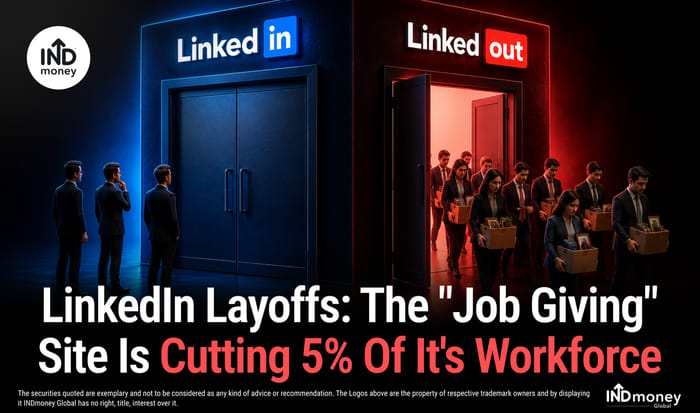
The platform where millions of Indians and professionals around the world log in every morning to see "We regret to inform you…" posts is now writing one of its own. On May 13, 2026, LinkedIn, owned by Microsoft, quietly told roughly 875 employees they no longer have a job. That is about 5% of its 17,500 strong global workforce. The twist that makes this story genuinely strange: LinkedIn just posted 12% revenue growth year-on-year, and earlier this year it crossed $5 billion in a single quarter for the very first time.
Let's break down why a company growing at double digits is still showing people the door and what it actually signals for Microsoft, tech investors, and anyone watching the AI wave reshape Big Tech from the inside.
The LinkedIn Numbers First
According to Reuters and Bloomberg, the cuts hit teams across LinkedIn's Global Business Organization, marketing, engineering, and product divisions. CEO Daniel Shapero, who took charge of the company only last month after years as its Chief Operating Officer, sent an internal memo at 7 a.m. Pacific time on May 13 outlining the changes.
LinkedIn is also shutting its office in Graz, Austria, as part of a broader move to cut down on what Shapero called "underutilized office space." The company has not disputed the 5% figure publicly.
A company spokesperson's official line? "As part of our regular business planning, we've implemented organizational changes to best position ourselves for future success."
That is corporate speak for: we are reorganizing, and some of you are not part of the new plan.
So, If LinkedIn’s Revenue Is Up, Why Cut Jobs At All?
This is the question worth sitting with.
LinkedIn's revenue climbed to $4.83 billion in Q1 2026, up 12% compared to a year earlier, according to Microsoft's latest earnings report. LinkedIn's annual revenue is also growing at 12% year-on-year, which is not a company in distress. That's a company running hot.
So why cut the jobs? Think of it like a cricket team that just won five matches in a row but decides to drop two senior players anyway, not because they played badly, but because the team's strategy has fundamentally changed. You need faster runners at the boundary now, not just reliable batsmen.
That's exactly what's happening here. Shapero's memo made it clear: LinkedIn is scaling back investments in marketing campaigns, vendor spend, customer events, and office space, not because money is short, but because the money needs to go somewhere more productive. Specifically, toward infrastructure and high-impact priorities that deliver better returns.
This is not a layoff of survival. It's a layoff of strategy.
What LinkedIn Is NOT Saying Out Loud
Here is where it gets interesting for investors.
One source who spoke to Reuters confirmed that AI is not explicitly being cited as the reason for these cuts. LinkedIn is among a rare few tech firms in 2026 that have not used AI as the headline justification for job cuts. Unlike Cloudflare, which this very same week cut 1,100 jobs citing the "agentic AI era," LinkedIn's official position is that this is routine restructuring.
But look at the timing and you start to see the real picture.
LinkedIn's parent, Microsoft, has committed to spending $190 billion in capital expenditure in 2026 which is a staggering jump from earlier estimates. Nearly all of it is going into AI infrastructure: GPUs, data centres, computing power, and talent for next-generation products. The Productivity and Business Processes segment, which houses LinkedIn, brought in $35 billion in revenue for Microsoft's Q3 FY2026, up 17% year-on-year.
When a parent company is redirecting capital at that scale, every business unit inside it has to justify its cost base. LinkedIn is not cutting because it is struggling. It is cutting because every rupee or dollar spent on events, extra office leases, and bloated teams is a rupee not going into the infrastructure Microsoft has bet its future on.
The Bigger Trend Investors Should Not Miss
LinkedIn's cuts did not happen in isolation. This is the backdrop:
According to Layoffs.fyi, more than 103,000 tech workers have lost their jobs globally in 2026 so far, approaching the total for all of 2025. Statista estimates Q1 alone saw roughly 81,700 layoffs, the highest quarterly figure since early 2023.
Meanwhile, Amazon, Microsoft, Alphabet, and Meta are collectively spending roughly $725 billion on AI infrastructure in 2026. That is not a coincidence. That is the trade-off: fewer people, more machines and the machines are getting very expensive.
Meta is cutting 8,000 jobs on May 20. Oracle has eliminated up to 30,000 positions (about 20% of its global workforce). Cloudflare cut over 1,100 people this week.
Big Tech is not retreating. It is concentrating firepower. And headcount is being sacrificed at the altar of AI capex.
What Does This Mean For Microsoft Investors?
If you hold Microsoft stock or are watching it as a potential buy, here is what matters.
LinkedIn is a meaningful revenue contributor inside Microsoft's Productivity and Business Processes segment. With annual revenue growing at 12% and a brand that touches nearly every working professional on the planet, it is not going anywhere. The restructuring is expected to improve operating margins inside that segment by cutting costs that are not driving proportional returns.
More importantly, Microsoft as a whole beat analyst expectations in Q3 FY2026. Revenue hit $82.89 billion, up 18% year-on-year. Net income jumped to $31.78 billion from $25.82 billion a year ago. Wall Street's consensus on MSFT, according to Barchart, is "Strong Buy," with a mean price target of approximately $555, implying roughly 37% upside from where the stock sits today around $405.
As per INDmoney’s analyst recommendation data as well, based on 66 analysts, 93.94% of analysts recommend a ‘BUY’ rating for Microsoft with an average target price of $561.56.
The forward P/E is below 25x, well under Microsoft's five-year median of around 34x. Put simply, the market may be undervaluing a company that is growing revenue at nearly 20%, investing heavily in AI, and trimming costs at the same time.
The LinkedIn restructuring is one piece of that cost discipline story.
The Takeaway For Investors
LinkedIn's 875 layoffs are uncomfortable, especially coming from a platform built around professional opportunity. But the headline number misses the actual story.
This is not a company in decline. Revenue is growing at 12%. Quarterly revenue has crossed $5 billion for the first time. A new CEO has arrived with a mandate to refocus.
What is happening is a recalibration: LinkedIn, like the rest of Big Tech, is shifting spend from people in offices to infrastructure for AI. The old playbook of hiring aggressively, expanding everywhere, is being replaced by a new one: invest deeply where it compounds, cut ruthlessly where it doesn't.
For investors in Microsoft, the message is straightforward. Microsoft is a business that is growing revenue fast, investing in AI at scale, cutting costs where needed, and trading below its historical valuation multiples. The LinkedIn restructuring is a sign of operational discipline, not distress.
And for the rest of us? Perhaps the most honest takeaway is that it is a little ironic that the platform many of us use to find our next job is the one now creating the need for it.