

- What is the latest news on Intel, Musk and Terafab?
- What is Terafab and why does Musk want it?
- How could Intel make money from Terafab?
- Can Terafab challenge TSMC's manufacturing advantage?
- Why manufacturing yield matters more than a factory announcement
- What returns would justify Terafab's investment?
- Intel versus TSMC valuation: How much recovery is already expected?
- What should investors watch as the Terafab plan develops?
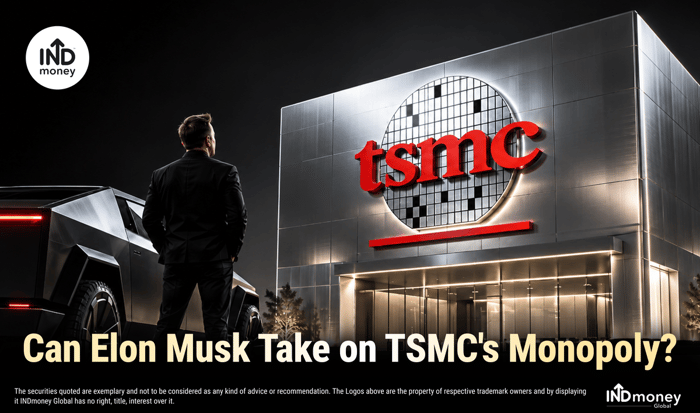
Elon Musk's Terafab plan could give Intel something almost as valuable as a large chip order: evidence that an ambitious outside customer trusts its manufacturing technology. But the latest dispute over TSMC's possible involvement highlights the gap between joining a project and earning predictable profits from it. Our assessment is that Terafab matters more immediately to Intel's credibility than to TSMC's competitive position.
Let's break down the latest Terafab developments, how Intel could benefit and what Musk must prove before his AI chip plan becomes a serious financial challenge to TSMC.
What is the latest news on Intel, Musk and Terafab?
The latest development is Musk's October 7 clarification about who would control the planned factory. After acknowledging discussions with TSMC earlier in October, he said his companies would build and operate Terafab. He described a possible TSMC role as subleasing part of the facility, rather than taking over the project.
| Development | What it establishes | What it does not establish |
| Musk acknowledged TSMC discussions in early October | Talks were taking place | A completed partnership |
| Musk clarified ownership and operation on October 7 | His stated intention is for Tesla and SpaceX to build and run Terafab | A signed TSMC sublease |
| Intel CEO Lip-Bu Tan reaffirmed involvement, as reported on October 7 | Intel remains engaged | Exclusive manufacturing rights or guaranteed orders |
Sources: Investor's Business Daily, MarketWatch and Barron's reporting dated October 7, 2026.
This is why the story should not be framed as TSMC replacing Intel or Intel becoming the confirmed operator of the entire complex. Musk's clarification addresses his intended operating control. It does not disclose how Intel's technology contribution will be priced or how production responsibilities will be divided.
The market reaction reflects those uncertainties. Intel closed October 7 at $113.12, up 0.55%, while TSMC's US-listed ADR closed at $472.20, down 2.09%. Those moves occurred alongside broader market developments and cannot be attributed entirely to Terafab.
For investors, the more useful question is what each company can earn under the eventual arrangements. A statement about participation answers only part of that question.
What is Terafab and why does Musk want it?
Terafab is a planned semiconductor manufacturing project associated with Tesla and SpaceX, including SpaceX's AI operations. Its proposed architecture combines logic chips, memory and advanced packaging. The official project website identifies AI5 and AI6 for Tesla applications and D3 for space applications.
Logic chips perform calculations. Memory supplies the information those processors need. Advanced packaging connects chips and components into a usable system. Bringing these activities together is intended to give Musk's companies more control over the hardware behind their AI ambitions.
The business objective is supply security as much as manufacturing independence. SpaceX's June offering materials describe a hybrid strategy that combines internally manufactured chips with processors obtained from outside suppliers. Owning capacity could reduce shortages and improve costs without eliminating every existing supplier.
That distinction changes how to assess the project. A factory supplying Musk's own businesses can be commercially useful without attracting hundreds of unrelated customers. However, competing with TSMC as a broad contract manufacturer would require proving that other customers also want its technology, service and economics.
The project's stated ambition of producing hardware representing one terawatt of compute capacity annually also needs interpretation. A terawatt is a unit of power, not a standardized measure of AI performance. It cannot by itself establish chip quantities, revenue, manufacturing capacity or processing capability. Those depend on the devices produced and how efficiently they operate.
How could Intel make money from Terafab?
Musk said during Tesla's April earnings call that the project plans to use Intel's forthcoming 14A manufacturing process. Intel describes 14A as its next generation of manufacturing technology, with improvements in transistor design and power delivery. The announcement gives Intel a potentially important external reference for technology it wants customers to adopt.
But there are several ways to participate in a semiconductor project, with very different implications for revenue and investment.
| Possible commercial structure | How Intel could earn revenue | Main financial question |
| Technology licensing and engineering support | Fees for process access and technical services | How much recurring income would Intel receive? |
| Manufacturing chips at Intel facilities | Payments for wafer production | Would volumes and prices cover manufacturing costs? |
| Advanced packaging services | Fees for connecting and assembling components | What volume and margin would the work generate? |
| Investment or shared development | A negotiated share of project economics | How much capital and execution risk would Intel bear? |
Sources: Intel's official manufacturing-process information, Musk's April earnings-call comments reported by Reuters and SpaceX's June offering materials.
Our view is that a large project budget should never be treated as Intel's future revenue. Money spent on construction, utilities and equipment does not automatically accrue to Intel. Even Intel-related spending could be spread across years and different services.
SpaceX's June filing explicitly disclosed that neither Tesla nor Intel was obligated to remain in the project and that specific projects required separate agreements. That is a historical disclosure, not proof of today's complete legal position. Still, the latest public reassurances reviewed for this article do not provide the contract detail needed to calculate Intel's earnings contribution.
A deal with firm volumes, customer funding and attractive fees could materially strengthen Intel's position. A capital-intensive commitment with uncertain demand could increase its exposure before improving its profits. The difference belongs in the investment analysis.
Can Terafab challenge TSMC's manufacturing advantage?
The challenge is credible as a long-term ambition, but immediate displacement is a much stronger claim. TSMC already converts large-scale production into substantial margins. Intel has manufacturing expertise, but its financial starting point is different.
| Latest published Q2 2026 metric | Intel | TSMC |
| Consolidated revenue | $16.128 billion | $40.20 billion |
| Reported gross margin | 40.4% | 67.7% |
| Reported operating margin | 11.1% | 60.3% |
| Intel Foundry operating result | $2.089 billion loss | Not a comparable segment measure |
Sources: Intel and TSMC Q2 2026 earnings releases, TSMC's July earnings-call transcript and its October 8 September revenue report. Intel uses US GAAP and TSMC uses TIFRS.
These figures do not prove that a particular Intel process is technically inferior. They show that Intel still needs to improve the economics of its manufacturing business while TSMC is operating from a highly profitable base.
Intel Foundry reported $5.765 billion of segment revenue, but that includes internal transactions. Intel's consolidated accounts eliminated $5.477 billion of intersegment revenue across the group. The foundry segment figure therefore should not be presented as revenue entirely from independent customers.
TSMC's advantage is also moving. In its July earnings call, management said A14 risk production was planned for 2027 and volume production for 2028. It emphasized that developing a leading-edge technology, building capacity and ramping production takes five to seven years. Terafab has to compete with future manufacturing capabilities rather than a fixed version of today's TSMC.
There is fresh evidence that TSMC's demand remains strong. Its September revenue report, released on October 8, showed NT$511.86 billion in sales, up 54.6% year on year. January-to-September revenue increased 41.1%. These are reported sales figures, not the complete Q3 earnings release.
Our interpretation is that Terafab could capture a useful part of growing demand without materially weakening TSMC in the near term. Additional capacity and incumbent growth can coexist. A stronger threat emerges only when competitive production begins diverting profitable orders or pressuring pricing.
Why manufacturing yield matters more than a factory announcement
Yield is the proportion of chips produced that meet the required specifications. It connects manufacturing progress directly to cost: the expense of processing a wafer must be spread across the usable chips that emerge from it.
Consider a deliberately simplified example. Assume a processed wafer costs $20,000 and contains 100 potential chips. These are illustrative inputs, not Terafab or Intel cost estimates.
| Assumed manufacturing outcome | 70% yield | 85% yield |
| Potential chips per wafer | 100 | 100 |
| Usable chips | 70 | 85 |
| Assumed wafer cost | $20,000 | $20,000 |
| Cost per usable chip before packaging | Approximately $286 | Approximately $235 |
Moving from the first yield assumption to the second lowers this simplified chip cost by approximately 17.6%. The factory processes the same number of wafers, but produces more usable output from each one.
This is why a production announcement is weaker evidence than sustained yields on customer products. Early technical demonstrations can be promising while full production remains costly. Investors need to know whether the process works consistently at the intended chip size and production volume.
Factory utilization matters too. Expensive equipment generates depreciation and other costs even when demand is insufficient to keep it busy. Captive demand from Tesla and SpaceX could support utilization, but only if their products require enough chips on the factory's schedule.
Our assessment is that Terafab's strongest advantage may be coordinated demand and design across Musk's businesses. Its greatest risk is scaling manufacturing faster than its customers can use the output profitably.
What returns would justify Terafab's investment?
Reuters reported in August that Tesla and SpaceX planned an initial $16.8 billion investment in Grimes County, Texas, with later phases potentially increasing spending substantially. That is an initial investment plan, not the complete funding requirement for every announced ambition.
A simple capital-return test makes the size meaningful. Assume the initial project eventually needs to generate a 10% annual return through after-tax operating profit or equivalent net cost savings. On $16.8 billion, that requires $1.68 billion a year.
| Assumed net annual benefit per chip | Chips needed annually to generate $1.68 billion |
| $50 | 33.6 million |
| $100 | 16.8 million |
| $200 | 8.4 million |
The lesson is not that any particular chip count is achievable. It is that a successful factory requires either substantial volume, substantial economic benefit per chip or both. If investment increases, the annual benefit needed at the same return threshold increases proportionately.
Captive manufacturing changes the accounting, but not the underlying requirement. Chips used internally can create value through genuine cost savings and more productive AI systems. Internal transfers alone do not create economic profit for the combined businesses.
Nor is the construction budget the only consideration. Financing costs, equipment replacement, working capital and delays influence the eventual return. A proper valuation would require a staged spending schedule and operating forecasts that have not been publicly established in sufficient detail.
Intel versus TSMC valuation: How much recovery is already expected?
Intel's involvement can be strategically encouraging while its share price still demands strong future earnings. A useful comparison is each company's October 7 price relative to a simple annualization of its latest quarterly EPS.
| Illustrative earnings comparison | Intel | TSMC US-listed ADR |
| October 7 closing price | $113.12 | $472.20 |
| Q2 2026 EPS used | $0.42 non-GAAP | $4.31 reported per ADR |
| Quarterly EPS multiplied by four | $1.68 | $17.24 |
| Price divided by annualized Q2 EPS | Approximately 67.3 times | Approximately 27.4 times |
Sources: Yahoo Finance, Stock Analysis and INDmoney market-price data, Intel Q2 2026 results and TSMC Q2 2026 results.
The comparison is a starting point for thinking about expectations, rather than a definitive relative valuation. Intel's ratio uses adjusted earnings; TSMC's uses reported earnings. Nevertheless, even against Intel's adjusted quarterly earnings, its price requires a substantial improvement in the earnings base.
At a hypothetical 25-times earnings multiple, Intel's $113.12 reference price would require annual EPS of approximately $4.52. At 30 times, it would require about $3.77. These are valuation identities, not forecasts: divide price by the assumed multiple to find the earnings needed.
Our stance is that Terafab should be treated as an opportunity to substantiate Intel's recovery, rather than an excuse to assume that recovery is already financially secure. Contracts and profitable volumes would support the case. Participation headlines alone cannot establish enough earnings to justify a particular valuation.
TSMC has a different question to answer. Its earnings base is already substantial, but investors still need continued growth and capital discipline to justify the price paid. Terafab adds potential competition; it does not erase TSMC's existing profits or guarantee that those profits will persist unchanged.
What should investors watch as the Terafab plan develops?
The most meaningful next disclosure would explain the commercial arrangement: who funds the equipment, who owns the production assets and how Intel is compensated. It should also identify committed demand and distinguish research output from qualified production.
After that, the key evidence is repeatable manufacturing performance. Competitive yields, reliable delivery and attractive returns on capital would establish much more than the size of a campus. TSMC's margins and customer demand will help reveal whether new capacity is expanding supply or weakening incumbent economics.
Equipment, materials and packaging suppliers could benefit as spending becomes firm orders, but no supplier's earnings contribution should be assumed without disclosed contracts. Similarly, chip manufacturing and AI chip design are different competitive layers. A new factory does not by itself establish a complete substitute for every processor or AI computing system.
For Indian investors, this is a question of exposure to different businesses. Intel combines product earnings with a manufacturing recovery opportunity. TSMC offers an established contract-manufacturing business. Rupee returns also depend on exchange rates, applicable taxes and investing costs; these are US-dollar price comparisons.
Terafab can challenge TSMC in selected applications if it delivers competitive chips at scale. Our current assessment is that Intel has more to gain from proving the project works, while TSMC has more operating evidence supporting its position today. The next stage of the story should be judged through contracts, yields and returns on investment.