

- What is the latest news on Google’s Project Suncatcher?
- Why does Google want to run AI chips in space?
- Can space-based data centres really be cheaper?
- What must Google prove before space computing becomes commercial?
- How could Project Suncatcher strengthen Google’s AI business?
- What do Alphabet’s latest financial results tell investors?
- How should investors value Alphabet stock beyond the space headline?
- How big could the opportunity become for Alphabet shareholders?
- What does Google’s space AI project mean for US and Indian investors?
- What should investors watch next in Project Suncatcher?
Google is preparing to send its AI chips into orbit. The intriguing part for investors is not the rocket launch itself. It is whether moving computing closer to an abundant source of solar energy could eventually make artificial intelligence cheaper to deliver. Our view: Project Suncatcher is a credible experiment with potentially significant strategic value, but it has not yet earned a separate premium in Alphabet’s valuation.
Let's break down what Google is testing, how the economics could work and what Alphabet’s financials reveal.
We will also examine what would make this opportunity meaningful for US and Indian investors.
What is the latest news on Google’s Project Suncatcher?
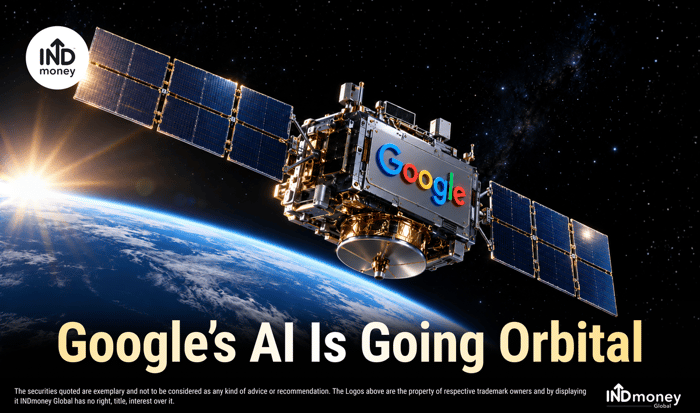
On September 24, Google announced that its first Suncatcher orbital test was scheduled for the following week. A prototype developed with Planet will travel on SpaceX’s Transporter-18 mission to test Google’s Tensor Processing Units (TPUs) in space. This is a planned experiment, not an operating commercial data centre.
The project itself is older than this week’s headline. Google introduced Suncatcher on November 4, 2025 as research into interconnected solar-powered computing satellites. Its original roadmap included a two-satellite mission with Planet by early 2027. The newly announced initial test is a separate step toward that broader ambition.
That chronology makes this a timely investment topic. However, “Google launches space data centres” would overstate what has happened. The accurate story is that an ambitious infrastructure idea is moving toward a hardware test.
For investors tracking Alphabet stock, the question is how much uncertainty that test can remove. A successful launch would demonstrate progress. It would not establish commercial demand, competitive pricing or an acceptable return on the money required to build a fleet.
Why does Google want to run AI chips in space?
TPUs are Google-designed processors built for the calculations behind AI. Training teaches model patterns from data. Inference is the work it performs when responding to a request. Google’s chips support both activities and form part of its wider computing platform.
The location matters because AI infrastructure needs more than processors. It needs reliable electricity and a way to remove the heat those processors produce. Space offers a possible alternative to adding ever more capacity to terrestrial power networks.
The International Energy Agency’s April 2026 update reported that data-centre electricity demand increased 17% in 2025. It also identified tighter supplies of transformers and gas turbines alongside delays in grid connections and approvals. Its outlook projected a doubling of data-centre electricity consumption by 2030, with consumption from AI-focused facilities tripling.
Our interpretation is that Suncatcher addresses two possible sources of value: cheaper computing and additional computing capacity. The second could matter even before the first. If an infrastructure constraint prevents a company from serving a profitable customer, removing that constraint can create value without making every unit of output cheaper.
Think of a factory with orders waiting but no available power connection. A lower electricity tariff is useful. Getting a functioning connection can be more valuable. Suncatcher is an attempt to explore a radically different version of that second option.
Can space-based data centres really be cheaper?
Google says suitable low-Earth-orbit satellites could access near-continuous sunlight and generate up to eight times more solar power than on Earth. That is a potential energy-harvesting advantage, not evidence that AI computation would cost one-eighth as much.
The investment case must compare the entire cost of completing useful work. A server that receives abundant power but spends too much time waiting for data can still be expensive. A processor that operates successfully but becomes uneconomic to replace can destroy the apparent savings.
Our framework is simple:
Cost per useful AI task = total lifetime infrastructure cost ÷ successfully completed AI work.
The numerator should include equipment, launch, cooling, communications, operations, financing and replacement. The denominator should reflect actual utilisation and reliability rather than the maximum performance printed on a chip’s specification sheet.
How much is the electricity saving worth?
Consider a hypothetical facility drawing one gigawatt continuously. The calculation below isolates electricity. It does not estimate Google’s electricity contract or Suncatcher’s operating costs.
| Illustrative input or result | Lower electricity price | Middle electricity price | Higher electricity price |
| Continuous facility demand | 1 GW | 1 GW | 1 GW |
| Annual operating hours | 8,760 | 8,760 | 8,760 |
| Annual electricity consumption | 8.76 billion kWh | 8.76 billion kWh | 8.76 billion kWh |
| Assumed electricity price | $0.05/kWh | $0.10/kWh | $0.15/kWh |
| Annual electricity bill | $438 million | $876 million | $1.314 billion |
Source: Author calculations using explicit hypothetical assumptions. One gigawatt equals one million kilowatts. Annual consumption equals demand multiplied by operating hours.
These are substantial amounts. Yet they are gross electricity bills that might theoretically be avoided, not net profits available to shareholders. Orbital solar panels and the systems attached to them still have to be purchased, launched and maintained.
At the middle assumption, any extra annualised cost of operating in orbit would consume some of the apparent savings. If that extra cost exceeded the avoided bill, the energy advantage alone would not justify the project. Additional customer revenue or other avoided terrestrial costs would then have to carry the investment case.
Google’s original research explored a scenario in which launch prices fall below $200 per kilogram by the mid-2030s. Under that assumption, launching and operating orbital infrastructure could approach terrestrial energy costs on a per-kilowatt-year basis. This is a conditional research estimate, not a current launch quotation or a finding that total computing costs have reached parity.
The economic hurdle also moves. Terrestrial chips, cooling systems and power procurement can improve while the orbital system is being developed. Suncatcher must compete with the future alternative, not just today’s most constrained data centre.
What must Google prove before space computing becomes commercial?
Google identifies radiation, cooling and satellite connections as major engineering challenges. Its laboratory work on Trillium chips is encouraging, but the company is collecting orbital evidence before scaling the concept. A further two-satellite test in 2027 is intended to examine laser connections.
The research also flags high-bandwidth communications with Earth and long-term system reliability as unresolved challenges. In space, heat must ultimately be radiated away rather than carried off by surrounding air. Abundant sunlight therefore does not mean effortless cooling.
For equity analysis, the useful way to assess these problems is to translate each into a commercial test.
| Commercial test | Evidence investors should seek | Why it changes the economics |
| Reliable operation | Completed workloads and manageable error rates over time | Failed or repeated work raises the cost per usable result |
| Sustained cooling | Stable performance under realistic workloads | A chip that must slow down delivers less work for the same investment |
| Effective networking | Chips working together without excessive waiting | Communication delays can leave expensive computing capacity idle |
| Affordable replacement | A credible refresh and retirement plan | Hardware can lose economic value before it physically fails |
| Commercial utilisation | Paying demand at sustainable prices | Technical capacity has little value when customers do not use it |
Source: Author’s investment framework based on the engineering issues identified by Google. These are proposed assessment criteria, not reported mission results.
A particularly important distinction is between survival and competitiveness. A chip may survive radiation tests and still be part of a system that costs too much to operate. Investors should resist treating a successful engineering milestone as proof that all later milestones will follow.
How could Project Suncatcher strengthen Google’s AI business?
The strongest potential outcome is not necessarily a new business selling “space computing” as a separate product. It could be a better cost base or additional capacity behind services customers already use.
Google already combines its own AI chips with software and cloud infrastructure. That combination gives it a plausible route to experimenting with hardware and workloads together. It does not establish that its eventual orbital design will beat every competing architecture.
There are three possible routes to shareholder value. First, cheaper computing could improve margins on existing services. Second, additional capacity could allow Google to serve demand it otherwise could not accommodate. Third, experience in integrating an orbital system could become an advantage if that market develops.
These benefits should not simply be added together. Lower costs may be passed to customers through lower prices. Customers may shift existing workloads into orbit rather than create new revenue. Competitors may develop similar capabilities before Google can earn an attractive return.
This is also why the news should not be presented as proof that Nvidia is losing its position. Suncatcher tests an infrastructure concept. It does not provide a commercial comparison of competing chips, software ecosystems or customer switching costs. The relevant long-term question is which complete system delivers reliable AI at an attractive cost.
What do Alphabet’s latest financial results tell investors?
Alphabet’s existing business provides the financial context for the experiment.
| Metric | Q2 2026 |
| Revenue | $119.796 billion |
| Operating profit | $40.770 billion |
| Google Cloud revenue | $24.768 billion |
| Google Cloud operating profit | $8.814 billion |
| Diluted earnings per share | $9.11 |
| Other income, net | $97.983 billion |
| Operating cash flow | $39.069 billion |
| Capital expenditure | $44.924 billion |
Source: Alphabet’s Q2 2026 earnings release and financial statements, July 22, 2026. Capital expenditure means purchases of property and equipment.
The earnings release attributes most of other income to unrealised equity gains. The distinction matters: revaluing investments can increase accounting profit without producing equivalent operating cash. Separately, cash flow less capital expenditure was negative $5.855 billion for the quarter.
Management’s earnings call placed full-year capital-expenditure guidance at $195 billion to $205 billion. It also reported a $514 billion Cloud backlog and said slightly more than half was expected to become revenue within the following 24 months. Backlog represents future contracted business rather than cash already earned.
That combination supports a more demanding investment question than “Can Google afford an experiment?” The question is whether each additional dollar committed to infrastructure generates enough future cash to compensate shareholders for its cost and risk.
There is another relevant change in the business mix. Management said Q2 included the first deliveries of TPU systems to customer data centres. It also warned that using more third-party capacity to meet demand could put near-term pressure on Cloud margins. Investors therefore need to examine how revenue is earned rather than assume all Cloud growth has identical economics.
Nothing in the Suncatcher announcement establishes what portion of Alphabet’s infrastructure spending belongs to the project. Assigning the group’s capital-expenditure budget to space would be misleading.
How should investors value Alphabet stock beyond the space headline?
Alphabet’s Class A shares, GOOGL, closed at $342.36 on September 24, up 1.34%. That was the latest completed regular US session at this article’s research cut-off. The price move alone does not establish that Suncatcher caused the gain.
A headline price-to-earnings ratio can look unusually low when investment gains inflate its earnings denominator. For a clearer operating lens, we use a deliberately simplified earnings proxy. This is not Alphabet’s adjusted EPS, an analyst consensus forecast or a complete fair-value estimate.
| Operating-earnings illustration | Calculation or assumption | Result |
| Quarterly operating profit | Reported Q2 figure | $40.770 billion |
| Assumed tax rate | Illustrative | 20% |
| After-tax operating profit | $40.770 billion × 80% | $32.616 billion |
| Diluted share count | Q2 weighted average | 12.309 billion |
| Annualised operating EPS proxy | $32.616 billion ÷ 12.309 billion × 4 | $10.60 |
| Price divided by this proxy | $342.36 ÷ $10.60, using unrounded values | 32.3 times |
Sources: Alphabet’s Q2 2026 financial statements for operating profit and diluted shares; verified September 24 closing price; author assumptions and calculations.
This method retains operating expenses and depreciation but excludes net non-operating income. It also leaves out a separate valuation of investments and net financial assets, preferred-share effects and future changes in the share count. Multiplying one quarter by four ignores seasonality and future growth. The result is an operating valuation lens, not a conventional trailing or forward P/E.
Its purpose is to prevent a category error: a company is not necessarily cheap because a large investment gain makes reported earnings look extraordinary. The stronger case for Alphabet must come from durable operating earnings and eventual cash generation.
What earnings would support the current share price?
Instead of attaching a speculative price target to Suncatcher, reverse the valuation question. How much sustainable annual EPS would justify the verified share price at different assumed multiples?
| Assumed earnings multiple | Sustainable annual EPS required to support $342.36 |
| 25 times | $13.69 |
| 30 times | $11.41 |
| 35 times | $9.78 |
Source: Author calculations. Required EPS equals $342.36 divided by the assumed multiple. Multiples are illustrations rather than recommendations or forecasts.
This table makes the disagreement between optimistic and cautious investors easier to understand. Someone accepting a higher multiple needs less near-term earnings support but depends more heavily on the durability of future growth. Someone requiring a lower multiple needs stronger sustainable earnings to justify the same price.
Our stance is that an unproven orbital project should not be used to fill a gap between the valuation investors want and the operating earnings they can reasonably support. Alphabet’s established operations must carry the central investment case.
How big could the opportunity become for Alphabet shareholders?
There is no reliable basis in the reviewed disclosures for assigning Suncatcher a specific commercial revenue forecast. However, investors can still test how a distant success might translate into value today.
The following exercise assumes that a mature project generates incremental annual cash after tax and ongoing capital needs in year ten. It assigns that cash a value of 20 times, discounts that value at 10% annually and applies a hypothetical 25% probability of success. None of those inputs is Google guidance or an estimated probability based on mission data.
| Hypothetical mature annual incremental cash | Value in year ten at 20 times | Discounted and probability-weighted value today |
| $1 billion | $20 billion | $1.93 billion |
| $5 billion | $100 billion | $9.64 billion |
| $10 billion | $200 billion | $19.28 billion |
Source: Present value equals annual cash × 20 × 25% ÷ 1.10¹⁰. The exercise excludes pre-commercial development spending and assumes no separate interim cash flows.
This is a sensitivity exercise rather than a project valuation. Development spending would need to be deducted. A delayed commercial outcome or a lower success probability would reduce the value. Earlier cash generation or a greater sustainable advantage could increase it.
The lesson is that a dramatic future business can translate into a much smaller present-day benefit once time and uncertainty are recognised. A successful launch should change the assumptions supported by evidence. It should not automatically remove the discount for every remaining commercial risk.
There is also a double-counting trap. If a model already assumes Google earns higher Cloud margins because computing becomes cheaper, investors cannot add the full value of the same savings again as a separate Suncatcher business. The project creates additional value only to the extent that its benefits exceed what is already embedded in the wider forecast.
What does Google’s space AI project mean for US and Indian investors?
For US investors, this is an infrastructure experiment inside a much broader company. The relevant comparison is between the prospective return on orbital computing and the return on alternative uses of capital. An exciting technology can still be a poor investment if it requires too much money before generating reliable cash.
Globally, the opportunity is tied to whether more computing can be delivered economically. The IEA’s bottleneck analysis helps explain why companies are exploring alternatives. It does not show that terrestrial data centres are becoming obsolete. An orbital system would have to establish where it fits alongside existing infrastructure and which workloads justify its additional complexity.
For Indian investors, exposure through Alphabet means exposure to the entire business rather than a standalone space venture. Someone comparing Nasdaq 100 ETFs with broader S&P 500 ETFs should also examine portfolio overlap. Owning an index fund and adding individual technology stocks can increase exposure to companies already present in the fund.
Currency adds another layer. Ignoring fees and taxes, a rupee-based return combines the dollar investment return with the change in the rupee value of the dollar. Rupee appreciation can reduce a positive dollar return while depreciation can amplify it. A promising company story is therefore only one part of the investor’s eventual outcome.
There is no evidence in the reviewed announcements that a particular Indian listed company has won a Suncatcher contract. Connecting the headline to domestic aerospace, power or electronics shares without a disclosed commercial relationship would be speculation. For Indian businesses using AI, the more relevant potential benefit is eventual access to better or cheaper computing, wherever that computing is performed.
What should investors watch next in Project Suncatcher?
The next useful disclosure is not simply a photograph of a satellite in orbit. It is evidence that narrows the range of possible commercial outcomes.
| Milestone | What would strengthen the investment case |
| Initial orbital test | Workloads completed reliably under real operating conditions |
| Satellite networking | Evidence that multiple units can cooperate effectively |
| Cost disclosure | Enough detail to compare lifetime costs with terrestrial alternatives |
| Customer use | Demand that supports sustainable pricing and utilisation |
| Capital discipline | Further spending tied to demonstrated progress |
Source: Author’s investment-monitoring framework. These are assessment criteria rather than announced financial targets.
Our view is favourable toward the research and cautious toward paying for its success in advance. An experiment can be worth funding precisely because it answers an expensive question before the company commits to a much larger system. The quality of that decision depends on what management learns and how it responds when the evidence is disappointing as well as encouraging.
Suncatcher becomes financially compelling when Google can show that it produces useful computing at a competitive lifetime cost or unlocks profitable demand that would otherwise remain unserved. Until then, the strongest reason to study Alphabet remains the cash its existing businesses can generate after funding their growth. Space could improve that equation. The launch alone does not prove that it will.