

- What Is the Federal Reserve and How Do Fed Rate Decisions Work?
- June Fed Meeting 2026: Why This FOMC Cycle Is Different
- The Trump Factor: Threat to Fed’s Independence?
- US Inflation, Economic Data Before the June Fed Meet
- Key Policy Signals to Watch in the FOMC Meeting
- Fed Interest Rate Decision: 3 Scenarios to Watch
- What the Fed Meeting Means for Investors
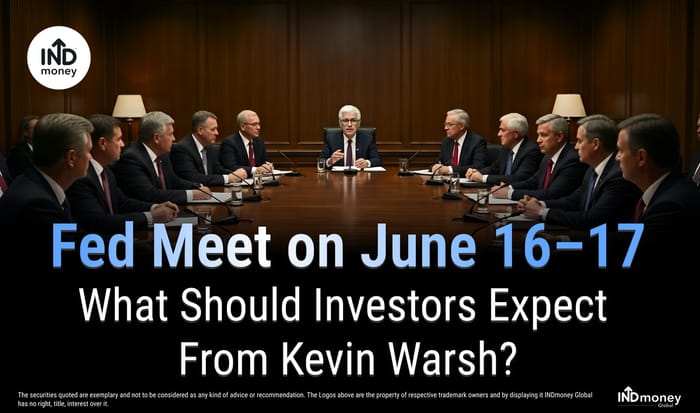
The most watched press conference in American finance this year happens on June 17, 2026, when Kevin Warsh walks up to a podium inside the Federal Reserve's headquarters for the first time as its 17th Chair. The rate decision itself is almost foregone.
Nearly 97.4% of traders in the CME FedWatch market expect rates to stay unchanged, and a Reuters poll of 102 economists found 72 of them expecting no rate change through the rest of 2026. So the headline is not the story. The story is everything that happens around it.
Let's break down why this is not your standard Fed meeting, what the economic data is actually telling us, how Warsh reads inflation through a genuinely different lens than his predecessor, and what the June 17 outcome means for markets in the US and in India.
What Is the Federal Reserve and How Do Fed Rate Decisions Work?
The Federal Reserve, or the Fed, is the central bank of the United States. Its main job is to keep inflation under control, support employment, and maintain stability in the financial system. It does this mainly by setting interest rates. When inflation is high, the Fed can raise rates to slow spending and borrowing. When the economy is weak, it can cut rates to support growth. Since US interest rates influence bond yields, the dollar and global capital flows, Fed decisions affect not just America but markets across the world, including India.
June Fed Meeting 2026: Why This FOMC Cycle Is Different
Kevin Warsh stepped into the role on May 22, replacing Jerome Powell, who navigated the Fed through a pandemic, a historic inflation surge, and a rate-hiking cycle that took the Fed Funds Rate from near zero to a peak of 5.5%.
However, Powell did not leave entirely. He stayed on the Board of Governors, retaining a vote on rate decisions through 2028. Some on Wall Street have taken to calling him the "shadow chair." That dynamic is more consequential than it sounds.
| Area | Jerome Powell | Kevin Warsh |
| How they read inflation | Focuses mainly on the Fed’s preferred inflation measure | Prefers inflation measures that remove extreme price moves |
| View on technology | Cautious; wants to see clear evidence first | Believes AI can help bring prices down over time |
| Communication style | Gives detailed signals to guide markets | Prefers fewer signals and more flexibility |
| Fed balance sheet | Wants to reduce it slowly | Wants to reduce it faster |
| Interest rate approach | Decides based on incoming economic data | May support rate cuts if AI boosts productivity and lowers inflation pressure |
The most important point about Warsh’s approach is this: he may not look at inflation the same way most people do. The usual inflation number, called headline CPI, includes everything, including items whose prices can jump sharply for temporary reasons.
Warsh prefers looking at a cleaner inflation measure that removes the biggest price increases and biggest price drops from the data. That matters because this cleaner measure is showing inflation at around 2.8%, while headline CPI is much higher at 4.2%.
So, in Warsh’s view, inflation may already be closer to the Fed’s 2% target than the main inflation number suggests. This could affect how he talks about interest rates on June 17.
The Trump Factor: Threat to Fed’s Independence?
Here is the part most analysis of this FOMC meeting glosses over, and it is arguably the most politically consequential angle heading into June 17.
Trump picked Kevin Warsh because he wanted lower interest rates. He had repeatedly criticised Jerome Powell for not cutting fast enough. In February 2026, Trump even said he would not have chosen Warsh if Warsh wanted rate hikes.
But the data has moved against that expectation. Inflation rose to a three-year high. The US economy added 172,000 jobs, far above expectations. After that, Goldman Sachs dropped its forecast for a December 2026 rate cut and pushed its expected cuts to 2027.
Trump still went public before Warsh’s first meeting, saying there was “no reason” to raise rates and that the Fed should lower them. That puts Warsh in a difficult position. If he sounds tough on inflation, Trump may see it as a betrayal. If he sounds too supportive of Trump’s demand for cuts, bond markets may worry that the Fed is losing independence.
That could weaken the dollar, push inflation expectations higher and hurt the Fed’s credibility. The historical warning here is not subtle. When political pressure successfully influenced the Fed in the late 1970s, the cost was 13.5% inflation and eventually Paul Volcker had to hike the federal funds rate to 20% to restore credibility. Warsh knows this. He has already told the Senate that he would not pre-commit to any rate decision.
So, June 17 is not just about rates or the dot plot. It is about whether Warsh can keep the Fed credible while facing pressure from the White House.
US Inflation, Economic Data Before the June Fed Meet
The May 2026 CPI report, released by the Bureau of Labor Statistics on June 10, confirmed what many households already felt in their energy bills.
| Indicator | Current Reading |
| US Headline CPI (YoY) | 4.2%, highest since April 2023 |
| Core CPI (YoY) | 2.9% |
| Energy CPI (YoY) | +23.5% |
| Unemployment Rate | 4.3% |
| Fed Funds Rate (target) | 3.50%–3.75% |
| 10-Year Treasury Yield | ~4.45%–4.55% |
| S&P 500 Forward P/E | ~24x |
Source: Bureau of Labor Statistics, Federal Reserve, FactSet
The headline number looks alarming. But the engine of that 4.2% reading is almost entirely energy, which accounted for over 60% of the monthly CPI increase in May due to the Iran Conflict and Strait of Hormuz blockades. Strip out energy, and core CPI on a monthly basis came in at 0.2%, below even the consensus forecast of 0.3%.
Key Policy Signals to Watch in the FOMC Meeting
The rate itself will almost certainly hold at 3.50%–3.75%. Every analyst expects it. So the three real signals to watch are:
1. The dot plot shift. The Fed will also release its dot plot, which shows where officials expect interest rates to be in the future. In March 2026, it pointed to one small rate cut. But with inflation at 4.2%, the June update may show no cuts, or even a possible hike. That alone can push bond yields higher and pressure stock valuations quickly.
2. The easing bias removal. The current Fed statement still hints that rate cuts may come later. Under Warsh, that hint could disappear. Instead of sounding open to cuts, the Fed may shift to a more neutral message: rates could move either way depending on inflation and growth.
Fed Interest Rate Decision: 3 Scenarios to Watch
The rate decision may not be the real market trigger. The bigger signal could come from the Fed’s tone and the updated dot plot.
| Scenario | Probability | What happens | Market impact |
| 1. Hold with neutral tone | 60–65% | Fed keeps rates unchanged, removes the soft rate-cut hint, and Warsh sounds balanced. | Mild pressure on real estate, utilities and growth stocks. Dollar and short-term bond yields may rise slightly. |
| 2. Hold with tougher dot plot | 25-30% | Fed keeps rates unchanged, but officials now show no cuts in 2026, or even a possible hike. | Bond yields could jump, and expensive growth stocks may fall because lower rates look less likely. |
| 3. Surprise rate hike | 2-5% | Fed unexpectedly raises rates by 0.25%. This is unlikely, but not impossible. | Sharp risk-off move globally. US stocks, emerging markets and rate-sensitive sectors could come under pressure. |
What the Fed Meeting Means for Investors
For Indian investors, the June 17 Fed meeting matters in two ways: it can move US stocks directly, and it can also affect the rupee, FIIs and Indian market sentiment.
A tougher Fed tone usually means higher US bond yields and a stronger dollar. That can put pressure on growth stocks, especially tech companies whose valuations depend on lower future interest rates. It can also weaken emerging market sentiment, including India, as foreign investors may prefer safer dollar assets.
The India impact is secondary but important. A hawkish Fed can pressure the rupee, increase FII outflows and weigh on rate-sensitive sectors like NBFCs, real estate and housing finance. IT stocks may get some benefit from a weaker rupee because they earn in dollars, but that advantage can be offset if global tech sentiment weakens.
For people investing in US Stocks from India, the real signal will come from three things:
| What to watch | Why it matters |
| Dot plot | Shows whether Fed officials still expect rate cuts in 2026 |
| Fed statement | Tells whether the Fed is moving away from a rate-cut bias |
| Warsh’s press conference | Shows whether he sounds open to cuts, neutral, or worried about inflation |
- If the Fed sounds neutral, investors do not need to panic. Quality US stocks with strong earnings, cash flows and AI exposure can still hold up.
- If the Fed signals no cuts in 2026, expect pressure on expensive growth stocks, long-duration tech and rate-sensitive sectors. Investors may want to avoid chasing high-valuation names purely on hype.
- If the Fed hints at a possible hike, the risk is sharper. In that case, investors should prioritise companies with real profits, strong balance sheets and pricing power over speculative growth stories.
Do not react only to the rate headline. Watch what the Fed says about future cuts. For US stock investors, June 17 is less about today’s rate decision and more about whether the easy-money trade gets pushed further into 2027.