

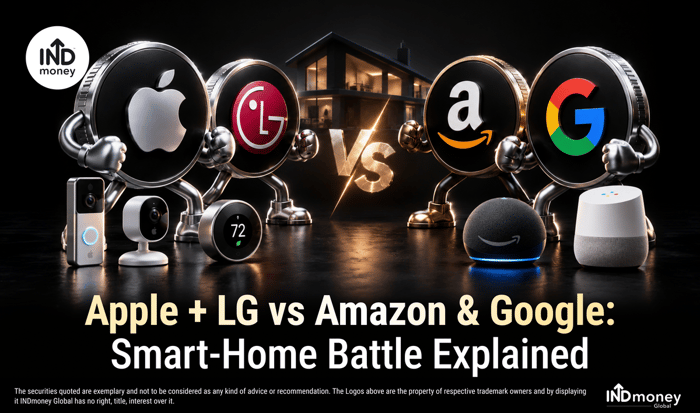
- What is confirmed about the Apple and LG smart-home partnership?
- Why would Apple work with LG instead of building every device?
- Can Apple compete with Alexa+ and Gemini for Home?
- How much could smart-home devices matter to Apple’s earnings?
- What does Apple’s valuation say about the opportunity?
- What could stop Apple from winning the smart-home battle?
- What does the Apple and LG news mean for India and global markets?
Apple’s reported smart-home collaboration with LG could make its Home app a more serious rival to Alexa and Google Home. The opportunity is bigger than a better doorbell: a home that runs smoothly through Apple could give a household another reason to stay in its ecosystem. My assessment is that the strategy looks more convincing than the near-term earnings opportunity.
Let's break down what Apple and LG are reportedly building, where Amazon and Google stand and how much this could matter to Apple’s business.
What is confirmed about the Apple and LG smart-home partnership?
The news comes from an October 6 Bloomberg report cited by 9to5Mac and MacRumors. It describes Apple working with LG Electronics on connected-home accessories. These follow-up articles share the same underlying reporting and should not be treated as independent confirmations of the partnership.
The distinction matters because neither an official joint launch announcement nor confirmed pricing was found in the company sources reviewed for this article. Reporting describes regulatory filings for LG devices but says those filings do not name Apple.
| Detail | Evidence status as of 7 October |
| Apple helping develop LG smart-home accessories | Reported by Bloomberg through coverage reviewed |
| Products carrying LG branding | Reported |
| LG handling manufacturing and product support | Reported |
| Wired video doorbell, smart deadbolt lock, thermostat and temperature sensor | Listed in the regulatory documents described by the reporting |
| Indoor camera, outdoor camera and floodlight camera | Listed in the same reporting |
| New Apple home hub potentially appearing on 13 October | Reported expectation rather than a confirmed launch date |
| LG accessories reaching consumers | Reported as several months away; no confirmed shipping date |
| Prices, country availability and commercial terms | Not established in the sources reviewed |
This is a timely development with a concrete reported product lineup. It is still too early to present an Apple–LG retail range as something customers can order.
Why would Apple work with LG instead of building every device?
A connected home needs more than a screen and a voice assistant. Someone has to make the locks and cameras, handle installation problems and support products exposed to everyday wear.
Under the reported arrangement, LG would take on manufacturing and product support. Apple could help shape how the accessories work with its software. That would give Apple a faster route to a fuller home experience without managing every category itself.
LG also brings an existing smart-home platform investment. In July 2024, LG Electronics announced that it had acquired an 80% stake in Athom, the company behind Homey. It said the agreement included plans to acquire the remaining stake within three years. That announced plan should not be confused with confirmation that the remaining purchase has happened.
Source: LG Electronics, “LG Acquires Athom to Advance AI-Enabled Intelligent Space Business,” 3 July 2024.
For LG, a successful collaboration could create an additional route into households already using Apple products. For Apple, it could turn a collection of compatible accessories into a more coordinated experience. These are strategic possibilities rather than disclosed sales forecasts.
The financial relationship needs care. An LG-branded camera sale would not automatically be Apple revenue. Apple might benefit through its own hardware, paid services or customer retention. Any accessory commissions or revenue-sharing arrangements remain unknown.
That makes this story a useful example of the difference between controlling an experience and owning every sale within it.
Can Apple compete with Alexa+ and Gemini for Home?
Apple already has a Home app and home-hub functionality through products such as HomePod and Apple TV. The reported LG range would build on that foundation. Apple is expanding an existing ecosystem rather than entering smart homes for the first time.
The competitive landscape has also changed. Amazon and Google are bringing more conversational AI into their home platforms, which means Apple would be competing against rivals that are still improving.
| Platform | Confirmed foundation | Potential competitive strength | What still needs to work consistently |
| Apple Home | Home app, existing home hubs and September 2026 Apple Intelligence updates | Familiar controls across Apple devices and privacy-focused architecture | Setup, household access and dependable everyday automation |
| Amazon Alexa | Echo devices, Ring security products and Alexa+ | A connected range of devices and an assistant bundled with qualifying Prime memberships | Reliable task completion across devices and services |
| Google Home | Nest devices, Gemini for Home and Google Home Premium | Conversational control, camera intelligence and automations | Accurate commands, compatibility and smooth regional rollout |
The table describes confirmed platform foundations. Apple’s reported LG accessories would be an additional development rather than proof that it has already matched either rival.
Sources: Apple Home app product page; Apple Newsroom, 14 September 2026; About Amazon’s Alexa+ availability information and CES 2026 announcements; Google’s Gemini for Home announcement and September 2026 release notes.
Apple released Siri AI in September 2026 with an English beta rollout on supported devices. Its release also described Home app improvements including generated video descriptions and searches across camera clips. Those Home features require an eligible setup including a home hub, an Apple Intelligence-enabled iPhone and an eligible iCloud+ plan.
There is a twist in the rivalry: Apple says its latest foundation models were developed in collaboration with Google and its Gemini models. The companies can compete for the household interface while cooperating on the intelligence underneath it.
Amazon’s US offering gives Apple a meaningful commercial hurdle. Alexa+ is available for $19.99 a month or at no additional cost to qualifying Prime members. A household already paying for Prime may see little reason to add another subscription unless the alternative delivers a noticeably better experience.
Google’s September 30 release notes describe faster responses to common commands and improvements to background-noise filtering. They also list fixes for device setup and camera playback. Those updates illustrate why reliability remains central to competition even after an AI platform launches. A home assistant has to get ordinary tasks right. A polished conversation helps, but the more valuable achievement is a light switching off reliably when the family asks.
How much could smart-home devices matter to Apple’s earnings?
Apple’s financial scale puts the opportunity in perspective. Its latest published quarterly results available for this analysis are for fiscal Q3 2026, which ended on June 27.
| Apple financial measure | Fiscal Q3 2026 |
| Total revenue | $109.42 billion |
| iPhone revenue | $54.25 billion |
| Services revenue | $30.74 billion |
| Wearables, Home and Accessories revenue | $7.88 billion |
| Net income | $29.79 billion |
| Services share of revenue, calculated | 28.1% |
| Services gross margin, calculated | 75.6% |
Services already contribute substantial revenue with a high gross margin. However, the broad Wearables, Home and Accessories category is not a measure of smart-home sales alone. Apple does not disclose the home business separately in these statements.
The existing Services margin also cannot be assigned automatically to a future home subscription. Camera storage, AI processing and support could have a different cost structure.
To test the scale, consider an illustrative annual scenario. Every commercial assumption below is hypothetical. These are neither announced prices nor an adoption forecast.
| Illustrative assumption or result | Annual scenario |
| Apple hubs sold | 5 million |
| Average revenue per hub | $250 |
| Apple hub revenue | $1.25 billion |
| Assumed net profit margin on hub sales | 25% |
| Net income from hub sales | $312.5 million |
| Share of those households adding genuinely incremental paid services | 40% |
| Incremental service revenue per paying household per year | $60 |
| Incremental service revenue | $120 million |
| Assumed net profit margin on incremental services | 30% |
| Net income from incremental services | $36 million |
| Combined incremental annual net income | $348.5 million |
| Incremental EPS using approximately 14.715 billion diluted shares | About $0.024 |
| Increase relative to the roughly $8.72 trailing EPS reference | About 0.27% |
Even this sizeable hypothetical rollout produces a modest direct earnings contribution relative to Apple’s scale. The model excludes LG accessory sales from Apple revenue and counts only new paid-service spending, which prevents existing subscriptions from being counted twice.
The service line assumes the paying households contribute a full year of incremental spending. A gradual rollout would produce less revenue in the launch year. The model also excludes any undisclosed partner economics and any separately unmodelled launch costs.
The potentially larger benefit is retention: a household using Apple for cameras and daily routines might be less inclined to switch its phones later. That is a plausible strategic advantage, but there is no disclosed evidence yet that lets us convert this reported partnership into a reliable retention forecast.
What does Apple’s valuation say about the opportunity?
For readers following Apple stock, an attractive product strategy and a material change in company earnings are separate questions.
| Valuation reference | Value and basis |
| Apple closing share price | $333.63 on 6 October 2026 |
| Trailing diluted EPS reference | Approximately $8.72 |
| Trailing price-to-earnings ratio | Approximately 38.3 times |
| Calculation | $333.63 divided by $8.72 |
A price-to-earnings ratio shows how much investors pay for each dollar of annual earnings. This multiple reflects expectations for Apple’s whole business. It cannot be attributed to the LG report.
Reported earnings also need context. Apple said its June-quarter EPS included a favourable $0.11 impact from tariff refunds. That benefit should not be assumed to recur.
Source: Apple’s fiscal Q3 2026 results announcement, 30 July 2026.
My view is that the reported partnership strengthens Apple’s strategic options more clearly than it changes the immediate earnings picture. A larger accessories ecosystem could help protect the customer relationship, but the evidence needed to support meaningful additional profit would be shipments, sustained usage and genuinely incremental paid spending.
The same discipline applies to Amazon and Alphabet. Smart-home developments are one part of much broader businesses. A comparison of home assistants alone cannot establish which company’s shares offer the better value.
What could stop Apple from winning the smart-home battle?
The largest obstacle is execution. Families need controls that work for the people who actually live in the home, including members with different devices and different levels of technical confidence.
Installation matters too. A camera can involve positioning and wiring. A smart lock must fit the door. If the hardware comes from LG while the controls come from Apple, support needs to make it clear who resolves a problem.
Compatibility creates both an opening and a limit to Apple’s advantage. Matter is a standard intended to help compatible smart-home products work across platforms. Its multi-admin feature allows a device to connect to multiple ecosystems.
That could make adoption easier because a household may be able to keep compatible accessories when adding Apple Home. It could also make switching away easier. Apple would have to earn preference through a better experience rather than assume that a compatible gadget belongs exclusively to its platform.
Reporting says several LG devices support technologies including Matter and Thread. It does not establish that every model will offer every feature on every platform. Final specifications and supported functions remain important.
Privacy could help Apple differentiate, but it must be assessed at the feature level. Existing HomeKit Secure Video provides encrypted recording for compatible cameras. It would be premature to assume that every reported LG camera will support it or receive identical privacy protections.
The evidence that would change the assessment is practical: published prices, clear specifications, shipping products and independent testing of setup and everyday use. A successful demonstration is the beginning of that process.
What does the Apple and LG news mean for India and global markets?
A smart-home range needs local availability and support to become useful beyond its first launch market. A reported US regulatory filing does not establish an Indian release or a global shipping schedule.
India already has a fresh competitive development. Amazon says Alexa+ began rolling out there on September 16 through Early Access. It describes English, Hindi and Hinglish support and integrations with local services and smart-home brands.
| Alexa+ India term announced by Amazon | Detail |
| Early Access start | 16 September 2026 |
| Early Access pricing | Free during the programme |
| After Early Access for qualifying Prime plan members | Included at no additional cost |
| After Early Access for Prime Lite, Prime Shopping Edition and non-Prime customers | ₹2,000 a month as a standalone subscription |
| Access during rollout | Invitations or registration for Early Access |
This is an announced rollout rather than proof that every Indian customer has access. It gives Apple a local benchmark: language support and everyday integrations matter alongside device design.
Apple’s September release also listed regional restrictions for Siri AI including initial limitations in the EU and unavailability in China while regulatory requirements are addressed. Those restrictions concern the announced AI release and should not be treated as a final availability map for the reported home hub.
For India, the unanswered questions are local pricing, installation, door compatibility and service support. For global markets, they include language coverage and which AI features are available in each region.
For Indian investors following US companies, the useful distinction is between a global platform opportunity and a locally successful product. A partnership can make Apple’s ecosystem stronger even before it produces meaningful revenue. The financial case becomes more substantial only when adoption and incremental profit can be measured.
Apple has a credible route to challenge Amazon and Google through a more coordinated home experience. The reported LG collaboration could improve that route. Winning sustained household use would be the achievement that turns the headline into a business result.