

- What is Apple HomeView and when does it launch?
- Why is Siri AI central to Apple’s smart-home strategy?
- HomeView is part of a broader Apple smart-home expansion
- How much revenue could Apple HomeView generate?
- How could HomeView increase Apple’s services revenue?
- Can Apple compete with Amazon Alexa+ and Google Gemini?
- What could prevent HomeView from becoming a growth engine?
- What does HomeView mean for Apple stock valuation?
- What does the HomeView launch mean for India?
- What should investors watch after HomeView starts shipping?
- Can Siri AI unlock Apple’s next growth engine?
Apple’s new $299 HomeView gives Siri AI a place on the kitchen counter. For investors, its significance depends on what happens after the device arrives: whether families use it regularly, spend more on Apple services and become less willing to leave the ecosystem. The opportunity is credible, but a successful smart display would still have to overcome Apple’s enormous financial scale.
Let’s break down what Apple HomeView does, how the smart-home strategy could make money and what would justify treating it as a growth engine for Apple stock.
What is Apple HomeView and when does it launch?
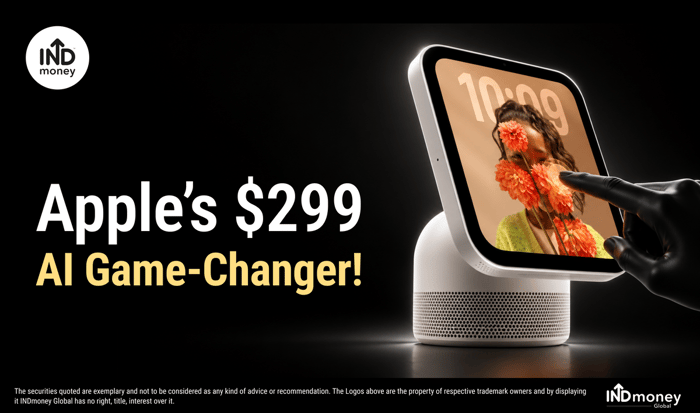
Apple announced HomeView on October 13, 2026. It combines a smart display with a speaker, offering a shared screen for entertainment, communication and control of compatible home accessories.
Its distinguishing feature is personalisation. HomeView can recognise different household members and bring up their own information instead of treating everyone as the same user.
| Apple HomeView detail | Confirmed information |
| US starting price | $299 for either the tabletop or wall-mounted model |
| India price | ₹39,900 |
| Availability | November 13, 2026; pre-orders have opened |
| Display and processor | 7-inch Liquid Retina display and A18 chip |
| Personalisation | Facial recognition for up to six enrolled household members |
| Core functions | Siri AI, FaceTime, entertainment and compatible smart-home controls |
| Siri AI status | Available in beta in HomeView software version 27.2 |
Sources: Apple HomeView launch announcement, Apple HomeView product information and Apple India online store, October 13-14, 2026.
The device’s commercial promise lies in combining these functions. A screen that only shows the weather competes for occasional attention. A device that helps coordinate family plans, retrieve relevant information and manage the home has a better chance of becoming part of everyday life.
However, personalisation has requirements. Setup needs a compatible iPhone or iPad with the latest required software, while personal-context requests need a paired Apple Intelligence-enabled device. HomeView therefore starts with its strongest proposition among existing Apple households.
Why is Siri AI central to Apple’s smart-home strategy?
The appeal of a home assistant is straightforward: it should save the user effort. If asking for help requires memorising commands, correcting mistakes or reaching for a phone anyway, the assistant has failed that test.
Apple says HomeView’s Siri AI can use information from a paired device to help with personal tasks. For example, it can find relevant content in Messages and Calendar rather than answering only general questions. Apple also describes privacy protections that keep household members’ information separate and use Private Cloud Compute for requests requiring cloud processing.
These are product capabilities and company privacy commitments. Their effectiveness in everyday households still needs to be established after shipping.
The investment logic is that useful personal assistance could create a reason to choose Apple that extends beyond the next phone’s camera or processor. If family routines become easier because devices work together, the value of staying with Apple increases.
That potential advantage depends on reliability. A polished demonstration can establish what is possible. Repeated use establishes whether the product deserves a permanent place in the home.
HomeView is part of a broader Apple smart-home expansion
Apple announced several connected products alongside HomeView. Together, they give the company more ways to serve different rooms and budgets.
| Product or initiative | US price | Announced timing | Business relevance |
| HomeView | From $299 | November 13, 2026 | Adds a shared display for household interactions |
| HomePod mini 2 | $149 | October 30, 2026 | Extends voice control and audio into more rooms |
| Apple TV 4K, fourth generation | $299 | November 13, 2026 | Connects entertainment and home controls to the television |
| Apple Home Collection | Varies by accessory | Rollout starts in December; selected accessories follow in early 2027 | Adds cameras, locks and temperature-management products developed with LG Electronics and Schneider Electric |
Sources: Apple’s October 13, 2026 announcements for HomeView, HomePod mini 2, Apple TV 4K and Apple Home Collection.
The staggered rollout matters. Siri AI will reach HomePod mini 2 through a future software update. Investors should distinguish the hardware shipping date from the availability of every advertised AI capability.
The accessory partnerships also address a practical adoption problem: customers need confidence that the products they purchase will work together. Apple says the Home Collection can be managed through the Home app without separate accessory accounts, alongside supported Apple Home and Matter products.
For financial modelling, partnership sales require care. A customer purchasing an LG accessory does not automatically generate the full purchase price as Apple revenue. Apple has not disclosed the commercial economics needed to make that assumption.
How much revenue could Apple HomeView generate?
A new category can be exciting while making only a small contribution to a large company’s results. Apple’s latest reported quarter illustrates the hurdle.
| Metric | Apple fiscal Q3 2026 |
| Total revenue | $109.42 billion |
| iPhone revenue | $54.25 billion |
| Services revenue | $30.74 billion |
| Wearables, Home and Accessories revenue | $7.88 billion |
| Net income | $29.79 billion |
| Diluted earnings per share | $2.02 |
Sources: Apple FY2026 Q3 consolidated financial statements and Form 10-Q.
The comparison should use matching periods. Apple generated approximately $466.82 billion in revenue over the twelve months through June 2026, calculated by adding fiscal Q4 2025 revenue to the first nine months of fiscal 2026.
Against that base, consider three hypothetical annual sales outcomes.
| Illustrative annual HomeView sales | Revenue at $299 per device | Share of Apple’s $466.82 billion trailing revenue |
| 1 million devices | $299 million | 0.06% |
| 5 million devices | $1.50 billion | 0.32% |
| 10 million devices | $2.99 billion | 0.64% |
This simplified model uses the US retail price as revenue per unit. Actual recognised revenue would differ with regional prices, distribution arrangements, discounts, returns and other factors. It also excludes sales of related products and services.
Even ten million devices would contribute less than 1% of Apple’s existing annual revenue base. HomeView could become a substantial product business before becoming a substantial driver of Apple’s overall growth.
The earnings hurdle is steeper. In an illustrative ten-million-unit scenario, assume a 20% incremental operating margin and a 20% tax rate. The resulting annual profit would be about $478 million, equivalent to approximately $0.03 per share using Apple’s latest quarterly diluted share count. Those margin and tax assumptions are ours; Apple has not disclosed HomeView profitability.
That is why a convincing investment case needs benefits beyond the screen itself.
How could HomeView increase Apple’s services revenue?
The clearest recurring-revenue opportunity is the connected household. HomeView could encourage additional spending on entertainment or cloud services, while compatible cameras give customers another reason to consider iCloud+.
Apple’s Home Collection announcement says camera event-history features require iCloud+, with supported camera counts depending on the plan. Certain AI camera functions also require an eligible subscription. That creates a potential link between buying connected hardware and maintaining a paid service.
There is a second route in the launch disclosures: Apple says expanded access to certain server-based Apple Intelligence features will be available for a fee in the future. The cited announcements do not provide enough detail to model a subscription price, conversion rate or launch schedule.
The financial attraction is understandable. Apple reported a Services gross margin of 75.6% in its latest quarter, compared with 40.1% for Products. These are broad company averages. Neither represents a disclosed HomeView or Siri AI margin.
A service can therefore be valuable even when its revenue is modest, provided the additional revenue exceeds the cost of delivering it. AI computing, video storage, customer support and development all have to be paid for.
Consider a simple illustration. If five million distinct HomeView households generated an extra $5 a month in service spending and 20% adopted that additional spending, annual revenue would be $60 million. The calculation is five million households multiplied by 20%, $5 and twelve months.
This is a full-year revenue run rate after adoption, not launch-year revenue or profit. It also counts only incremental spending: an existing Apple Music subscriber continuing the same subscription does not create a new subscription sale attributable to HomeView.
The distinction between devices and households is equally important. Three HomeViews in one home could mean three hardware purchases but only one family subscription. Multiplying subscriptions by device shipments would exaggerate the opportunity.
Can Apple compete with Amazon Alexa+ and Google Gemini?
Apple is entering a market where competitors are also trying to make home assistants more capable. Natural conversation alone is unlikely to remain a lasting differentiator.
Amazon offers the full Alexa+ experience in the US for $19.99 a month without Prime and includes it at no additional cost for Prime members. Google has launched Gemini for Home capabilities and a dedicated Google Home Speaker, with selected advanced features available through Google Home Premium.
| Ecosystem | Existing commercial approach | Strategic implication for Apple |
| Amazon Alexa+ | AI assistance bundled with Prime or offered separately | Customers may already receive an assistant through a subscription they maintain |
| Google Gemini for Home | Home devices and an optional premium service | Conversational controls and paid AI features are becoming competitive expectations |
| Apple HomeView and Siri AI | Home hardware linked to compatible Apple devices, services and personal context | Apple needs integration and daily usefulness to justify another household purchase |
Sources: Amazon’s Alexa+ availability and pricing information, Google’s Gemini for Home and Google Home Speaker announcements and Apple’s HomeView disclosures.
For Amazon, including Alexa+ in Prime makes the assistant part of a wider membership proposition. Apple’s challenge is to give customers a clear reason to add its home hardware when another assistant may already be available to them.
Its strongest prospective advantage is the relationship between the household device and information already held on the customer’s Apple products. Whether that advantage wins customers will depend on how smoothly it works and how much friction it removes.
What could prevent HomeView from becoming a growth engine?
The first obstacle is purchase priority. A smartphone is essential for many households; a dedicated smart display has to earn its place. At $299, customers need to see recurring convenience that their existing phone, tablet or speaker does not already provide adequately.
The second is the tension between shared access and personal information. Facial recognition and account separation address this problem by design. In practice, households will judge whether the device switches users smoothly and makes private interactions feel comfortable.
The third is the dependency on compatible devices. That integration can strengthen Apple’s position within an existing customer base while narrowing the audience for the full experience. It also means the addressable market cannot be estimated by simply counting every household with Wi-Fi.
Software maturity adds another constraint. Siri AI’s beta status makes real-world task completion, response speed and consistency particularly important. Apple’s usage terms also allow limits on AI features, meaning hardware ownership does not guarantee unlimited access to every cloud-based capability.
Geographic availability limits the initial opportunity too. Apple says HomeView is not available for sale in the European Union because Siri AI is currently unavailable there in iOS. A global sales model should account for that exclusion rather than assume immediate access to every major Apple market.
Finally, some spending may move within Apple rather than add to it. A household could choose HomeView instead of another Apple home device or postpone a different purchase. Investors need evidence of additional household spending before treating every HomeView dollar as net new demand.
What does HomeView mean for Apple stock valuation?
Apple stock closed at $341.27 on October 13, 2026. Using reported diluted earnings of $1.85 in fiscal Q4 2025 and $6.88 across the first nine months of fiscal 2026 gives approximate trailing earnings of $8.73 per share.
That puts Apple at approximately 39.1 times trailing earnings. Summing reported period EPS provides an approximation because weighted-average share counts vary between periods.
The valuation matters because a promising product and an attractive share-price outcome are separate questions. A high earnings multiple already requires confidence in the durability and growth of future profits.
| Illustrative earnings and valuation assumption | Implied share value | Difference from $341.27 |
| $8.73 EPS at 30 times earnings | $261.90 | −23.3% |
| $8.73 EPS at 35 times earnings | $305.55 | −10.5% |
| $8.73 EPS at approximately 39.1 times earnings | Approximately $341.34 | Approximately unchanged |
| EPS grows 12% and the multiple falls to 35 | $342.22 | +0.3% |
Sources: Apple Investor Relations stock-price information, FY2025 Q4 and FY2026 Q3 financial statements.
The last row shows the practical risk. Even a 12% increase in earnings could produce little share-price appreciation if investors became willing to pay a lower multiple for those earnings. Good business progress can be absorbed by a change in valuation.
Investors should also avoid treating the latest reported margin as a clean forecast of future profitability. Apple’s Q3 gross margin of 50.1% included approximately two percentage points from tariff refunds, while EPS included an $0.11 benefit. That adjustment matters when assessing how much underlying earnings growth a new category must deliver.
Our assessment is that HomeView strengthens Apple’s strategic case more than its near-term earnings case. At this valuation, the stock needs a broader combination of durable iPhone demand, profitable service growth and successful AI execution. HomeView alone cannot carry those expectations.
What does the HomeView launch mean for India?
Apple’s India store lists HomeView at ₹39,900 with availability from November 13. Siri AI on HomeView initially supports English in India, according to Apple’s launch announcement.
The local price matters more to household adoption than converting the US headline price into rupees. Accessories, subscriptions and any installation requirements can add to the total cost of creating a connected home.
Our expectation is that the clearest initial audience will be households already using several Apple devices and willing to pay for convenience. That is an assessment of product fit, not a forecast of Indian sales volumes or market share.
For Indian investors evaluating US stocks, the relevant question is global contribution to Apple’s profits. A visible India launch establishes market access; it does not establish material revenue. Rupee returns on Apple shares will also reflect currency movements alongside the dollar share-price return.
What should investors watch after HomeView starts shipping?
The useful sequence is adoption, continued use and additional spending. Strong initial orders would support the first step, while the others need evidence over time.
| Outcome | Evidence that would support it | Investment interpretation |
| Strong adoption with additional service spending | Sustained household use, extra paid services and purchases of complementary products | HomeView begins building a business beyond the initial hardware sale |
| Successful device with limited wider impact | Healthy shipments but little evidence of incremental subscriptions or retention | A useful new category with a modest contribution to group growth |
| Weak adoption or disappointing software | Friction in everyday tasks, persistent discounting or poor customer reception | The financial contribution may fall short of the strategic promise |
Investors should watch the broader Wearables, Home and Accessories category, Services trends and management’s discussion of engagement. However, those figures include many businesses. An improvement in either category would not prove that HomeView caused it.
The most convincing evidence would connect household adoption to incremental spending or better retention. Where Apple does not disclose that detail, the appropriate conclusion is that the impact remains uncertain.
Can Siri AI unlock Apple’s next growth engine?
HomeView gives Apple a credible way to make AI useful outside the phone. If it reduces everyday effort and encourages households to use more Apple services, the strategic value could exceed the profit on the device itself.
The scale calculations still argue for restraint. Even a large hardware business would initially represent a small share of Apple’s revenue. Future AI fees cannot be valued confidently before pricing and adoption are known.
Our view is positive on the direction and demanding on the evidence. HomeView deserves attention as a route to deeper household relationships. It earns the label of a growth engine only when sustained use translates into meaningful additional profit.