

- Who Is Andrej Karpathy? The Signal Behind the Name
- The AI Talent War: The Numbers Nobody Is Talking About
- Meta Layoffs vs. AI Hiring: The Trade-Off Hiding in Plain Sight
- The AI Jobs Paradox: 113,863 Cuts, 275,000 Open Roles
- What Indian Investors in US Stocks Should Take Away
Andrej Karpathy, a founding member of OpenAI, the man who personally led Tesla's Full Self-Driving program after Elon Musk recruited him in 2017, and the creator of "Neural Networks: Zero to Hero" with over a million YouTube subscribers, posted a single update: "I've joined Anthropic."
Not as a C-suite executive. Not to run a division. As a researcher, tasked with building a team that uses Claude to make Claude better at training itself. In AI, that loop has a name: recursive self-improvement. And for investors watching the AI race, Karpathy's choice of where to spend the next chapter of his career is one of the clearest competitive signals of 2026.
Let's break down what Karpathy's move reveals about the AI talent war, why the Meta layoffs paradox is the wrong headline, which specific roles are exploding in salary and demand, and what all of this means for where real value is being built.
Who Is Andrej Karpathy? The Signal Behind the Name
Karpathy holds a PhD in computer science from Stanford. He was on the original OpenAI founding team in 2015, left for Tesla in 2017 where he led the Autopilot and Full Self-Driving computer vision teams, returned to OpenAI in 2023, then left again in 2024 to start Eureka Labs, an AI education startup he has now paused. According to TechCrunch, he joins Anthropic's pre-training team under Nick Joseph with one mandate: use Claude to accelerate how Claude itself is trained. Pre-training is the most compute-intensive phase of building a frontier model. Getting it even 5% more efficient, compounded across training generations, is how labs compound capability without just spending more on chips.
The Anthropic pre-training team's output directly determines Claude's core knowledge and intelligence. This is not a marketing hire.
The AI Talent War: The Numbers Nobody Is Talking About
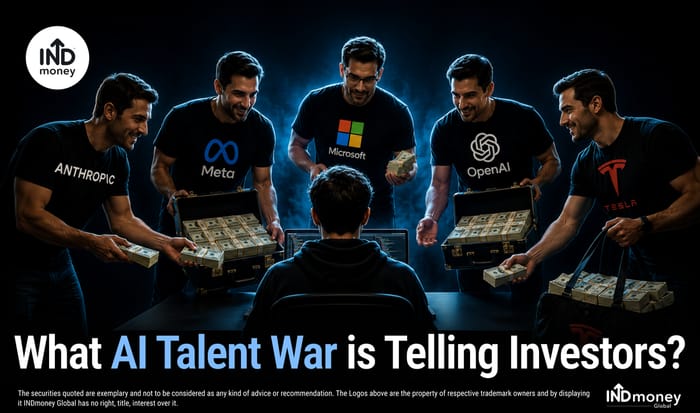
The real story is not just Karpathy. It is the pattern he is part of. According to The VC Corner, six CTOs from billion-dollar companies took individual contributor research roles at Anthropic between mid-2025 and early 2026, including the CTOs of Workday, Instagram, Box, You.com, Super.com, and Adept AI. These are people who had equity, salaries, and career trajectories most professionals would not give up.
Meanwhile, at the other end of the talent war, Meta CEO Mark Zuckerberg reportedly created a personal "List" of top OpenAI researchers to recruit. On the Uncapped podcast, OpenAI CEO Sam Altman confirmed that Meta had been offering "$100 million signing bonuses and more than that in compensation per year" to poach his engineers.
Fortune reported total packages for elite researchers reaching $300 million across four years. Meta also spent $14.3 billion to acquire a 49% stake in Scale AI, a deal structured primarily to bring founder Alexandr Wang in-house as Meta's first Chief AI Officer.
| Talent Move | Company | Reported Cost |
| Acquired 49% of Scale AI; hired Alexandr Wang as Chief AI Officer | Meta | $14.3 billion |
| Signing bonuses offered to OpenAI researchers | Meta | Up to $100M per person |
| 4-year packages for elite AI researchers | Meta | Up to $300 million |
| Hired Karpathy for pre-training research | Anthropic | Undisclosed |
| 6 sitting CTOs took individual contributor roles | Anthropic | N/A |
| OpenAI retention bonuses for new grad technical hires | OpenAI | $300,000 |
Source: The VC Corner, Fortune, Accler8 Talent, CNBC
At frontier labs specifically, Levels.fyi data shows OpenAI software engineers earning $251K (~₹2.43 crore) to $1.28M (~₹12.40 crore) annually, with a median of $555K (~₹5.38 crore). Anthropic senior engineers earn $300K (~₹2.91 crore) to $490K (~ ₹4.75 crore), with staff-level roles exceeding $600K (~₹5.81 crore). According to PwC's 2025 Global AI Jobs Barometer, analysing close to one billion job ads, the wage premium for AI-skilled roles is now 56%, up from 25% the year prior.
Meta Layoffs vs. AI Hiring: The Trade-Off Hiding in Plain Sight
Meta has kicked off its latest round of layoffs effective May 20, 2026 that will impact around 10% of its global workforce, or roughly 8,000 employees, with recruiting and HR absorbing cuts of 35 to 40%. Earlier in 2026, Meta also cut 1,500 Reality Labs roles. The reason, stated explicitly by Meta CFO Susan Li on the earnings call, is that "the highest order priority is investing our resources to position ourselves as a leader in AI".
The capex math makes this concrete. According to Financial Times data, Google, Amazon, Microsoft, and Meta plan a combined $725 billion in capital expenditure in 2026, up 77% from $410 billion in 2025.
| Company | Capex Commitment | Additional Details |
| Meta | $125B to $145B | Implies roughly $370 million per day on data center construction. |
| Amazon | $200B | — |
| Microsoft | $190B | $25 billion of this is attributed to rising memory chip costs alone (Source: Fortune, April 2026). |
Bank of America and Evercore now project combined Big Tech capex exceeding $1 trillion in 2027.
Human salaries are the only cost line flexible enough to partially offset a build-out at that scale. The Meta layoffs are not a retreat from AI. They are how Meta is funding it.
The AI Jobs Paradox: 113,863 Cuts, 275,000 Open Roles
According to Layoffs.fyi tracker data as of May 2026, tech layoffs have hit 113,863 workers across 179 events in 2026 alone, averaging 819 job losses per day. Q1 2026 alone saw 81,747 tech layoffs, the highest quarterly figure since early 2023, per Statista.
Yet the roles being created run in the opposite direction. LinkedIn's 2026 Jobs on the Rise report ranked AI Engineer as the fastest-growing job title in the US, with postings rising 143% year over year. Four of LinkedIn's top five fastest-growing positions are AI-related. The World Economic Forum's Future of Jobs Report 2025 projects 92 million jobs displaced by 2030 but 170 million new roles created, a net gain of 78 million.
Goldman Sachs estimates approximately 300 million full-time jobs globally face exposure to generative AI, and projects unemployment effects will be transitory and no larger than 0.5 percentage points above trend.
The specific roles expanding fastest, per LinkedIn 2026, Second Talent (Dec 2025), and the BLS:
| Role | YoY Growth | Median US Pay (2026) |
| AI Engineer | +143% | $195,000+ |
| LLM Fine-Tuning Specialist | Surging | $195,000 to $350,000 |
| ML Engineer (senior, frontier lab) | +20% through 2034 | $350,000+ total comp |
| Data Scientist / Big Data Specialist | Largest net global growth by 2030 | $170,000 median |
| Cybersecurity Analyst | +32% projected through 2032 | Varies |
| AI Solutions Architect | +35% to +110% | $140,000+ |
Source: LinkedIn, BLS, WEF, WeareTenet, Second Talent, KORE1
The average AI engineer base salary hit $206,000 in 2025, a $50,000 jump in a single year, with a further 7% increase tracked in Q1 2026, per MRJ Recruitment. Skillsoft and Pluralsight data shows 76% of employers still cannot fill open AI roles. There are an estimated 275,000 AI-specific roles open in just the US today while laid-off generalist workers cannot cross the skills divide to fill them
What Indian Investors in US Stocks Should Take Away
For people investing in US Stocks from India or planning to, the important number is the $700 billion-plus in AI capex. In previous tech cycles, investors chased apps. In this cycle, the biggest money is being made lower in the stack:
- Nvidia sells the GPUs
- Microsoft and Amazon rent the compute
- Memory and networking firms supply the infrastructure
- Frontier labs like OpenAI and Anthropic capture enterprise AI spending
That is why Meta can lay off 8,000 employees and still increase spending. AI infrastructure is now strategically more important than headcount efficiency.
The takeaway is simple: follow where Big Tech is concentrating capital. Karpathy joining Anthropic matters because it confirms where the smartest AI researchers believe the next wave of value creation is happening. And capital is following them aggressively. Maybe this is where your next investment opportunity lies.