

- What is Amazon’s reported $3 billion investment in India?
- How big is Amazon Now in India?
- Why quick commerce matters to Amazon’s retail business
- Can Amazon compete with Blinkit, Instamart and Zepto?
- Can quick commerce make money? A simple order-cost example
- What Swiggy’s results reveal about the profitability challenge?
- What could Amazon’s quick commerce business be worth?
- How much does India’s quick commerce expansion matter to Amazon stock?
- What should investors watch as Amazon Now expands?
A customer who opens an app for milk today may return for shampoo tomorrow and a phone charger next week. That habit is what makes India’s quick commerce opportunity valuable to Amazon. Its reported $3 billion expansion plan could help defend the starting point of a household’s shopping journey, but the investment only creates lasting value if repeat purchases eventually pay for the convenience.
Let's break down what the reported investment means, how Amazon Now compares with its rivals and the financial hurdles that separate rapid sales growth from a worthwhile business.
What is Amazon’s reported $3 billion investment in India?
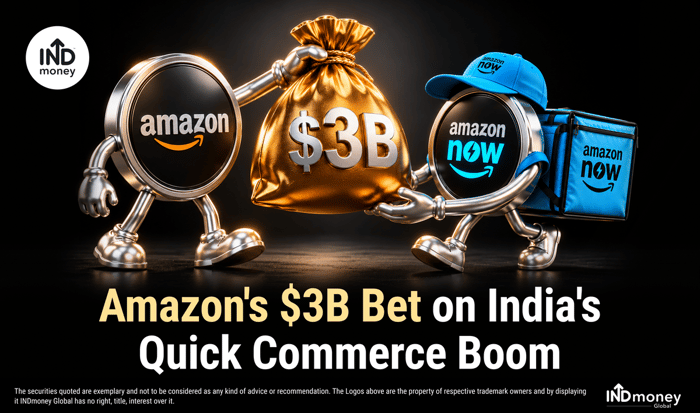
Reuters reported on September 24 that Amazon plans to invest $3 billion in Indian quick commerce by 2030, citing two people familiar with the plans. The reported schedule is $1 billion by the end of 2027 and another $2 billion by 2030. Amazon declined to comment on the investment figures.
That distinction matters: this is a reported plan, not a company-confirmed spending commitment or money already deployed. Reuters identified neighbourhood warehouses, inventory software, demand forecasting and product selection as spending priorities.
Amazon has separately announced a broader $48 billion India investment programme for 2026–2030, spanning multiple businesses. The quick commerce report does not establish that its proposed spending is additional to that programme. Adding the two figures would therefore risk double-counting.
For readers following Amazon stock, the immediate question is how effectively the company can turn spending into profitable customer relationships. A larger investment budget establishes the ability to compete. It does not establish the return shareholders will earn.
How big is Amazon Now in India?
Amazon’s own operating update provides a firmer starting point than investment speculation.
| Amazon Now metric | Company disclosure | How to interpret it |
| Annualised gross sales | More than $1 billion, based on the preceding three months | A sales run rate rather than completed annual revenue |
| Geographic presence | More than 60 Indian cities and towns | Coverage does not mean every address is served |
| Fulfilment network | More than 750 micro-fulfilment and urban fulfilment centres | A broader description than dedicated dark stores alone |
| Order growth | Orders doubled every quarter since launch | Company-reported growth from an expanding base |
| Near-term expansion goal | 100 cities by Diwali | A target rather than an achieved footprint |
The distinction between gross sales and revenue is essential. Gross sales measure the value of merchandise transacted. The amount recognised as a platform’s revenue depends on its business arrangements and accounting treatment. Neither number tells us how much remains after fulfilling orders.
An annualised figure also projects a shorter period’s pace across a year. It should not be described as a full year of realised sales and seasonal demand can affect how representative that pace proves to be.
These disclosures establish customer adoption and expansion. They do not yet establish Amazon Now’s standalone profitability: the cited update does not provide its operating profit, cash burn or return on invested capital.
Why quick commerce matters to Amazon’s retail business
Quick commerce competes for shopping occasions that traditional delivery can struggle to serve. If a household needs an ingredient before dinner, a wider catalogue arriving tomorrow may be less useful than a smaller selection available nearby.
The strategic risk for Amazon is that another platform becomes the customer’s first choice for frequent purchases. Once a shopper repeatedly uses that platform for essentials, it has more opportunities to introduce adjacent products. Losing the first search can eventually mean losing more than a grocery order.
Consider an illustrative household placing a ₹450 essentials order twice a week. Over 52 weeks, that represents ₹46,800 of merchandise purchases. More importantly, it creates 104 opportunities to serve the customer well, learn what they need and earn another visit. These are hypothetical figures, not Amazon customer data.
Amazon can potentially bring existing customers into Now without rebuilding every relationship from scratch. However, a familiar app is only an invitation to try the service. Consistent stock availability, product quality and reliable delivery determine whether the shopper returns after an introductory offer ends.
Our assessment is that quick commerce has a strong strategic rationale for Amazon. The financial case depends on whether the company can retain those visits without continually paying customers to make them.
Can Amazon compete with Blinkit, Instamart and Zepto?
Datum Intelligence estimates cited by Reuters put Amazon’s market share at 6.2%, compared with 77% collectively for Blinkit, Swiggy and Zepto and 11% for Flipkart. These are third-party estimates rather than audited company disclosures. Reuters also reported a target of about 1,300 Amazon stores by April 2027.
Amazon’s challenge is local execution. A national brand cannot compensate for an unavailable product in a particular neighbourhood. Each fulfillment location needs enough nearby demand to keep its staff, space and delivery capacity productively occupied.
That makes the contest more complicated than a comparison of store counts.
| Competitive factor | Potential advantage for Amazon | What still needs to work |
| Existing customer relationships | A familiar place to discover the service | Trial orders must become repeat purchases |
| Retail and logistics experience | Established capabilities in fulfilment and forecasting | Systems must handle local demand and perishables reliably |
| Financial resources | Capacity to invest through an expansion phase | Spending must produce improving economics |
| Shopping ecosystem | Opportunities to connect essentials with broader purchases | Additional spending must be genuinely incremental |
| Local network | More locations can shorten delivery distances | Nearby order volumes must justify the additional cost |
A useful way to judge the competition is to ask who can serve a neighbourhood profitably at a price customers accept. The largest network may win more orders, but an efficiently used network can generate a better return on each rupee invested.
For investors tracking Blinkit through Eternal or Instamart through Swiggy, Amazon’s expansion raises a specific risk: incumbents may need to spend more to retain customers even while their sales continue growing. Revenue growth and pressure on valuation can occur together if the expected route to profit becomes longer.
Can quick commerce make money? A simple order-cost example
The economics start with the amount a platform retains from each order after direct costs. That contribution must then cover the wider cost of running the business.
The following example shows why a modest change in promotions can matter more than an impressive headline growth rate.
| Illustrative amount per order | Initial promotion | Repeat order with a smaller promotion |
| Customer basket value | ₹500 | ₹500 |
| Platform income available before fulfilment costs | ₹100 | ₹100 |
| Picking and packing | −₹15 | −₹15 |
| Delivery | −₹35 | −₹35 |
| Payments, refunds and wastage allowance | −₹10 | −₹10 |
| Platform-funded promotion | −₹50 | −₹15 |
| Contribution before fixed costs | −₹10 | ₹25 |
The same basket moves from losing ₹10 to contributing ₹25 because the platform funds a smaller promotion. Whether that improvement is achievable depends on customer behaviour. If the shopper leaves when the offer shrinks, the attractive repeat-order economics remain theoretical.
Now assume a location has ₹7.5 lakh in monthly fixed operating costs that are excluded from the table. At ₹25 contribution per order, it needs 30,000 monthly orders to cover those costs or 1,000 a day in a 30-day month. At ₹15 contribution, the requirement rises to 50,000 monthly orders or roughly 1,667 a day.
Neither threshold represents company-wide breakeven. Technology, central teams, depreciation, financing and expansion costs can remain outside a store-level calculation. At negative contribution, increasing order volume would deepen losses unless something else improves.
There is also a limit to how much volume one location can handle. More orders may require additional labour or delivery capacity, so costs do not stay fixed indefinitely. The model is useful for understanding the pressure points rather than forecasting a specific operator’s profit.
The practical test for Amazon is whether mature locations generate more contribution while relying less on promotions. Opening new locations is much easier to observe than proving that financial progress.
What Swiggy’s results reveal about the profitability challenge?
Swiggy’s latest quarterly disclosure illustrates why investors should distinguish between contribution breakeven and broader profitability.
| Instamart metric | Q1 FY27, quarter ended June 30, 2026 |
| Gross order value | ₹7,907 crore |
| Year-on-year gross order value growth | 39.8% |
| Quarterly contribution margin | −0.2% of gross order value |
| Adjusted EBITDA loss | ₹778 crore |
| Dark stores at quarter-end | 1,171 |
Source: Swiggy, Q1 FY27 results press release, July 30, 2026. Figures relate to its quick commerce business.
Swiggy said quick commerce reached contribution breakeven in May. Across the full quarter, contribution remained slightly negative and adjusted EBITDA was still substantially below zero. The disclosure shows that passing one profitability milestone does not remove the remaining cost burden.
This is not evidence that Amazon will have identical economics. It establishes a useful standard of scrutiny: investors should ask which expenses a reported milestone includes and which remain outside it.
The more demanding evidence is sustained improvement across the business. That means stronger economics in established locations alongside a manageable cost of entering new areas. A platform can make its mature stores more efficient while still consuming considerable cash on expansion.
What could Amazon’s quick commerce business be worth?
A large addressable market is only the beginning of a valuation. Investors ultimately need assumptions about market share, retained profit and the capital required to reach that profit.
Datum Intelligence’s forecast, cited by Reuters, puts India’s quick commerce market at $41 billion by 2030, up from an estimated $19 billion. That is an industry forecast, not a guaranteed outcome.
Using that market size, the following scenarios show how sensitive potential value is to execution. They treat the market estimate as an annual merchandise-sales pool and assume comparable definitions. They are illustrative, not forecasts for Amazon.
| Illustrative 2030 scenario | Limited progress | Stronger execution | High success |
| Assumed market share | 10% | 15% | 20% |
| Annual gross sales | $4.10 billion | $6.15 billion | $8.20 billion |
| Assumed EBITDA as a percentage of gross sales | 2% | 3% | 4% |
| Annual EBITDA | $82 million | $184.5 million | $328 million |
| Illustrative enterprise value at 20 times EBITDA | $1.64 billion | $3.69 billion | $6.56 billion |
The calculation is straightforward: market size multiplied by share gives gross sales. Applying the assumed EBITDA yield gives earnings, which are then multiplied by an illustrative valuation multiple. The margin is explicitly measured against gross sales rather than accounting revenue.
The middle scenario produces a 2030 enterprise value of $3.69 billion. Discounted back four years at an assumed 12% annual rate, that is about $2.35 billion. This is the present value of the terminal business alone: it excludes interim cash flows, financing and any additional funding requirements. The 20-times multiple is a modelling choice rather than an observed comparable-company valuation.
A $3.69 billion future value therefore cannot simply be compared with a $3 billion multiyear spending headline and called a successful investment. A proper return calculation needs the timing of spending, subsequent cash generation and the assets or working capital that remain in the business.
Amazon could also benefit if Now improves retention or leads customers to make profitable purchases elsewhere in its ecosystem. Those benefits should be measured as incremental profit. Assigning value to every associated purchase would overstate the benefit if customers would have placed those orders anyway.
Our view is that meaningful market share alone is insufficient. The investment becomes more compelling when local operating efficiency, repeat demand and additional customer spending reinforce one another. A permanent subsidy programme would weaken that case even if gross sales grew quickly.
How much does India’s quick commerce expansion matter to Amazon stock?
Amazon’s consolidated results put the opportunity in perspective.
| Amazon financial metric | Reported figure |
| Q2 2026 net sales | $200.6 billion |
| Q2 2026 operating income | $27.5 billion |
| Q2 2026 AWS operating income | $16.6 billion |
| Trailing 12-month net income to June 30, 2026 | $135.3 billion |
| Trailing 12-month free cash flow to June 30, 2026 | −$7.6 billion |
Source: Amazon, second-quarter 2026 earnings release, July 30, 2026. Figures rounded.
AWS generated roughly 60% of quarterly operating income. India’s quick commerce expansion therefore deserves attention as a long-term retail opportunity, while cloud profitability and group investment returns remain much larger drivers of the overall financial picture.
There is also a valuation trap. At the roughly $2.8 trillion market capitalisation displayed on INDmoney when checked on September 24, dividing equity value by trailing net income gives approximately 20.7 times earnings. This is an approximate calculation using rounded inputs, not an independently timestamped closing multiple.
However, Amazon disclosed $53.4 billion of non-operating pretax other income in Q2, primarily associated with Anthropic investments. Reported earnings consequently include a substantial contribution outside normal operating profit. A seemingly moderate headline P/E should not be treated as proof of cheap recurring earnings.
The right valuation question is what sustainable earnings and cash generation the current price requires. Quick commerce can contribute to that outcome, but this investment report alone cannot establish that Amazon shares are attractively valued.
For Indian investors, the distinction is equally useful. Amazon offers exposure to a diversified global business with an Indian retail expansion opportunity. Eternal and Swiggy offer different combinations of domestic consumer businesses. These are materially different earnings exposures, even when all appear in the same quick commerce headline.
What should investors watch as Amazon Now expands?
The strongest evidence of progress will connect customer growth to better economics.
| Indicator | Evidence that would strengthen the case | Evidence that would weaken it |
| Repeat purchasing | Customers keep ordering after introductory offers end | Order activity falls sharply as offers shrink |
| Mature-location productivity | More contribution from established service areas | Expansion masks weak demand at existing locations |
| Product availability | Fewer missing items, substitutions and cancellations | Stock mismatches undermine repeat use |
| Profitability disclosures | Clear improvement with consistent cost definitions | Growth claims without visibility into the cost burden |
| Expansion discipline | New areas reach viable demand without excessive subsidy | More locations require sustained support |
| Customer spending | Additional profitable purchases across Amazon | Sales shift between Amazon services without enough extra profit |
Our assessment is that Amazon has a credible reason to compete aggressively in quick commerce: frequent shopping can help protect the wider retail relationship. Its financial resources give it room to build that capability, but capital alone does not create loyal customers or efficient neighbourhood operations.
The decisive question is whether convenience becomes self-funding. If repeat demand covers delivery costs and the wider expense of running the network, Amazon can create a useful new earnings stream. If growth requires continuing subsidies, the service may remain strategically important while delivering a disappointing financial return.