

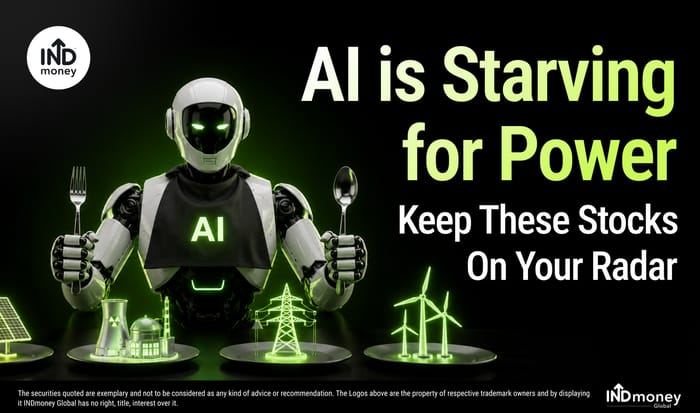
- Why AI Data Centres Are Driving a New Energy Investment Boom
- Why AI Data Centres Consume So Much Electricity
- Why Energy Stocks Are Becoming the Next AI Trade
- What Power Sources Do AI Data Centres Need?
- AI Energy Stocks to Watch as Data Centre Power Demand Rises
- Why the AI Energy Trade Could Be More Than a Short-Term Theme
- Key Risks for AI Energy Stocks and Power Demand
- What Investors Should Track in the AI Energy Stock Boom
Everyone chased the chip trade. NVIDIA became a household name. But there is a quieter, more structural bet quietly playing out, one about who keeps the lights on for it. Every large-language model (LLM), every AI agent, every inference query running right now needs something before it needs a GPU: it needs reliable, always-on, massive-scale electricity.
And the world is not built for what AI actually consumes. That gap, between what AI demands and what the grid can deliver, is where the next serious investment opportunity might live.
Let's break down why AI has become the biggest electricity story of our lifetime, how that demand is rewiring the global energy landscape, and which companies are positioned to profit from the power infrastructure buildout that nobody is talking about enough.
Why AI Data Centres Are Driving a New Energy Investment Boom
The IEA says data-centre electricity use rose 17% in 2025, over five times faster than global electricity demand. AI-focused data centres grew even faster, with power use up 50%. By 2030, global data-centre electricity demand could double to 945 TWh, nearly equal to Japan’s current power use.
In the US, data centres could drive nearly half of electricity demand growth through 2030. Meanwhile, capex by Amazon, Google, Meta, Microsoft and Equinix crossed $400 billion in 2025 and may rise another 75% in 2026, surpassing global oil and gas production investment.
The impact is already visible: gas-fired power plant orders hit a 25-year high in 2025, global grid investment is expected near $550 billion in 2026, and battery storage investment could cross $100 billion.
| Market Segment | 2025 Size / Base | 2030 Projected | CAGR / Growth |
| Global data-centre electricity demand | ~486 TWh | ~945 TWh | ~14% CAGR |
| AI-optimised data-centre electricity demand | Index: 100 | 4x+ by 2030 | ~30%+ CAGR |
| Accelerated server power consumption | Index: 100 | ~3.7x by 2030 | ~30% CAGR |
| US data-centre electricity demand | ~185 TWh base in 2024 | ~425 TWh by 2030 | ~130% total growth |
| Electricity generation for data centres | ~460 TWh in 2024 | 1,000+ TWh by 2030 | ~14% CAGR |
| Renewable power for data centres | 27% share today | Meets nearly 50% of demand growth | ~22% CAGR |
| Natural gas for US data centres | 40%+ share today | +130 TWh by 2030 | Largest US supply source |
Source: IEA World Energy Investment 2026, IEA Base Case, IEA Energy and AI report
The numbers come from the IEA, historically a conservative institution that once underestimated solar adoption by a decade. When the IEA is citing 25-year highs and doubling projections, the scale of what is happening to energy demand is not in question.
Why AI Data Centres Consume So Much Electricity
Think of a traditional data centre like a government office building: it hums along steadily, does its work, and its electricity bill is predictable. An AI data centre is more like a steel smelter that also needs air-conditioning cold enough to store food, 24 hours a day, 365 days a year, with no tolerance for even a 10-millisecond power outage.
Here is what actually drives the power consumption:
- GPUs and accelerators: AI racks consume far more electricity than standard servers. The IEA estimates one advanced rack could use peak power equal to 65 households by 2027.
- Training and inference: Training is energy-heavy, but inference is the bigger recurring load as every chatbot, AI search or coding query runs at scale.
- Cooling: High-density AI chips generate intense heat, pushing data centres toward liquid cooling.
- Networking: AI clusters need high-speed switches and interconnects running 24/7.
- Backup power: UPS systems, generators and redundant power lines are essential because outages are not acceptable.
- Always-on uptime requirement: Unlike commercial buildings that often run at 40–50% utilisation, hyperscale AI data centres target 90–95%. There is no off-season, so power demand stays near peak 24/7.
The result: many AI data centres need 50 MW to 500 MW of power, while some hyperscale campuses could exceed 1 GW, similar to a small city’s electricity demand.
Why Energy Stocks Are Becoming the Next AI Trade
For most of 2023 and 2024, the AI investment conversation revolved around a simple stack: chips (NVIDIA) → cloud infrastructure (Amazon, Microsoft, Google) → software and models (OpenAI, Anthropic, etc.). Energy was a background variable, an operating cost to manage, not an investable structural driver.
That thesis was partially right but incomplete. Here is why the frame has changed:
The AI Investment Stack — Then vs. Now
| Layer | Old Frame (2023–24) | New Frame (2025–26+) |
|---|---|---|
| Chips & Compute | Core bottleneck | Still critical, but supply catching up |
| Cloud / Hyperscalers | Key enablers | Now power-constrained buyers |
| Software / Models | Value creation layer | Dependent on uptime, not just code |
| Power Generation | Background operating cost | Hard structural bottleneck |
| Grid Infrastructure | Utility concern | Active investment frontier |
| Nuclear / Gas | Legacy assets | Irreplaceable baseload for AI demand |
| Onsite Power | Niche / emergency use | Strategic go-to for grid-delayed sites |
With this shift, the bottleneck has moved. It used to be: can we build enough GPUs? Now, in many markets, the question is: can we get enough power, fast enough, to the site where the GPUs are sitting?
What Power Sources Do AI Data Centres Need?
AI data centres need power that is reliable, scalable, cleaner and available quickly. No single source solves all four needs, so the buildout is moving toward a mixed energy stack.
- Natural gas: The near-term bridge because it is dispatchable and faster to deploy. But onsite AI gas projects may need 30–70% extra capacity to manage sudden load swings, while turbine shortages remain a major bottleneck.
- Nuclear: The long-term 24/7 clean power option. It offers reliable baseload electricity with no direct emissions. The IEA says data-centre-linked SMR offtake agreements have grown from 25 GW to 45 GW, while Constellation’s Three Mile Island restart for Microsoft shows how hyperscalers are locking in nuclear supply.
- Renewables + storage: Solar and wind are the volume layer because they are scalable and support net-zero targets. But they need batteries and grid support to manage intermittency. Tech firms signed nearly 40% of corporate renewable PPAs in 2025.
- Grid infrastructure: The hidden bottleneck. Global grid investment is expected to be near $550 billion in 2026, but transformers, substations and high-voltage lines still face multi-year backlogs. Without grid capacity, even funded AI data-centre projects can get delayed.
The AI Power Mix — What Each Source Provides
| Power Source | Role for AI | Key Advantage | Key Constraint |
| Natural Gas | Near-term dispatchable power | Fast, reliable, already deployed | Carbon exposure; turbine supply squeeze |
| Nuclear (existing) | 24/7 carbon-free baseload | Always-on, zero-emission | Limited restartable capacity |
| Nuclear (SMR) | Long-term baseload scale-up | Modular, scalable | 5–15 year build timelines |
| Solar + Wind | Bulk clean power supply | Cheapest new capacity | Intermittent; needs storage pairing |
| Battery Storage | Grid balancing and backup | Fast response; declining costs | Duration limited (4–8 hrs today) |
| Fuel Cells (onsite) | Behind-the-meter, grid-bypass | Fast deployment; high reliability | Natural gas dependent; costly at scale |
| Grid Transmission | Connecting all sources to demand | Enables all other solutions | 7–10 year queue times in key US markets |
AI Energy Stocks to Watch as Data Centre Power Demand Rises
These companies are not generic energy plays. They sit closest to the AI power bottleneck, with exposure to nuclear, gas turbines, onsite power, uranium, clean power and data-centre infrastructure.
1. Constellation Energy: It is the largest private nuclear operator in the US, with a 55 GW fleet and 21 nuclear units. After its $16.4 billion Calpine acquisition in January 2026, it became the country’s largest electricity producer. Its moat is hard to replicate: licensed, operating nuclear plants that can deliver 24/7 carbon-free power. The Three Mile Island restart, now called Crane, is contracted to Microsoft for around 835 MW, making it the clearest AI-nuclear deal so far.
2. GE Vernova: It supplies gas turbines, grid equipment, transformers and electrification systems, making it a key picks-and-shovels play on AI power demand. Its moat is scale. Gas turbine supply is tight, transformers have 2–3 year delivery timelines, and GE’s HA-class turbines are among the industry’s most efficient. Its electrification segment booked $2.4 billion in data-centre-related orders in Q1 2026 alone.
3. Bloom Energy: The company provides solid oxide fuel cells for onsite power, making it relevant where data centres cannot wait years for grid interconnection. Its moat is speed. Bloom says its fuel cells can be deployed in 55–90 days, and its $5 billion Brookfield partnership gives it deployment capital. Customers include Oracle, Equinix, CoreWeave and AEP.
4. Cameco: It is one of the strongest ways to track the nuclear fuel side of the AI power theme. It controls roughly 15–18% of global primary uranium supply and owns tier-one assets in Canada. Its moat is geology, jurisdiction and nuclear fuel-cycle exposure through Westinghouse. New uranium supply can take a decade to develop, while AI-linked nuclear demand is strengthening long-term visibility.
5. Vistra: It is the largest unregulated power producer in the US, with exposure to nuclear, gas, coal and battery storage. Its moat is market exposure. Unlike regulated utilities, Vistra can benefit directly when wholesale power prices rise in markets such as ERCOT and PJM. It has also signed nuclear power agreements with AWS and Meta.
6. NextEra Energy: It is the world’s largest wind and solar generator and a major supplier of clean power to hyperscalers. Its moat is scale. It can offer solar, wind, battery storage and nuclear exposure under one platform. Its AI-linked contracts include Google and Meta, including a Duane Arnold nuclear restart partnership with Google.
7. Vertiv: It provides UPS systems, switchgear, chillers, liquid cooling and power management systems for data centres. Its moat is deep integration with AI hardware requirements. As AI racks move toward extreme power density, liquid cooling and precision power delivery are becoming mission-critical.
AI Energy Stocks Compared: Moats, Financials and Risks
| Company | Key Moat | Latest Financials / Key Data | Main Risk |
| Constellation Energy (CEG) | Irreplaceable nuclear fleet | FY25 adjusted operating EPS: $9.39; completed $16.4B Calpine acquisition | PJM regulation, customer concentration, Calpine integration |
| GE Vernova (GEV) | Turbine supply chokepoint | Q1 FY26 revenue: $9.34B, up 16% YoY; total backlog: $163B; gas turbine backlog: 100 GW | Wind losses, lumpy revenues, tariff exposure |
| Bloom Energy (BE) | Speed-to-power, 55-day deployment | Q1 FY26 revenue: $751M; FY26 guidance: $3.4B–$3.8B; backlog around $20B | Gas dependence, valuation, hyperscaler demand risk |
| Cameco (CCJ) | Tier-1 uranium assets, Westinghouse stake | Controls roughly 15–18% of global primary uranium supply; long-term contract portfolio around 220M lbs; SMR offtake pipeline now 45 GW | Uranium price volatility, production delays, SMR timeline risk |
| Vistra Corp (VST) | Merchant power, nuclear + gas fleet | FY25 net income: $944M; operating cash flow: $4.1B; upgraded to investment grade by Fitch in Mar 2026 | Earnings volatility, coal exposure, power price sensitivity |
| NextEra Energy (NEE) | Scale, diversification, clean power platform | FY26 adjusted EPS guidance: $3.92–$4.02; Meta deals include 11 PPAs + 2 storage contracts, totalling 2.5 GW | Valuation, interest rate risk, project delays |
| Vertiv Holdings (VRT) | NVIDIA partnership, backlog depth | Q1 FY26 revenue: $2.65B; adjusted EPS up 83% YoY; backlog above $15B; FY26 sales guidance: $13.5B–$14.0B | Premium valuation, EMEA weakness, tariff exposure |
Why the AI Energy Trade Could Be More Than a Short-Term Theme
Most infrastructure booms are clear only in hindsight. The AI-power cycle is different because demand is already being contracted. Hyperscalers have committed over $400 billion in 2025 capex and are signing 10–20 year power purchase agreements, giving power producers rare forward visibility.
The constraint is physical, not digital. AI cannot shorten transformer lead times, build gas turbines, clear grid queues or expand uranium supply overnight. With grid investment near $550 billion in 2026 and gas turbine orders at a 25-year high, these bottlenecks could sustain pricing power for suppliers.
Efficiency gains may not reduce total demand either. The IEA says power use per AI task is falling rapidly, but cheaper AI can trigger more usage. Like mobile data after smartphones, lower unit costs may expand total consumption.
Key Risks for AI Energy Stocks and Power Demand
The AI-energy thesis is strong, but not risk-free. These are the key factors that could weaken it:
- AI capex slows: The IEA notes data-centre growth depends on market confidence in AI returns. If enterprise AI ROI disappoints or hyperscalers cut capex, power demand forecasts could reset quickly.
- Chip efficiency improves faster than usage: The IEA’s “High Efficiency” scenario shows data-centre power demand could grow slower if next-gen chips sharply reduce electricity use per AI task.
- Grid connections improve: Bloom Energy and onsite gas benefit because grid interconnections can take years. Faster permitting or grid reforms could reduce the premium for behind-the-meter power.
- Nuclear sentiment weakens: Nuclear demand depends on policy support and public trust. Any major incident or policy reversal could hurt companies like Cameco and Constellation.
- Financing gets tighter: The IEA says data-centre investment is now too large for company balance sheets alone. Higher real rates or tighter credit could slow the buildout.
- Regional overcapacity emerges: AI power demand is local. Some markets may stay undersupplied while others overbuild, creating uneven outcomes for utilities and generators.
These risks do not break the long-term AI-energy story, but they are useful leading indicators. The key metrics to watch are hyperscaler capex guidance, PPA activity, grid interconnection timelines, chip efficiency gains and nuclear policy support.
What Investors Should Track in the AI Energy Stock Boom
AI’s energy demand is no longer theoretical. Hyperscalers are signing long-term power contracts, the IEA is flagging a demand surge, and gas turbine orders are already at 25-year highs.
For people looking to invest in US stocks, the key opportunity is not just in AI chips, but in the infrastructure that powers them: nuclear, gas turbines, onsite power, renewables, storage, cooling and grid equipment.
For investors, the focus should be selective. Track companies with scarce assets, long backlogs, contracted revenues and clear exposure to data-centre power demand. The winners are likely to be the firms that can solve AI’s biggest physical bottleneck: reliable electricity.