

- What Is a 1:10 Stock Split?
- Key Data Points Investors Should Know
- Short Term Impact
- What Should Investors Do ?
- Conclusion
- Disclaimer
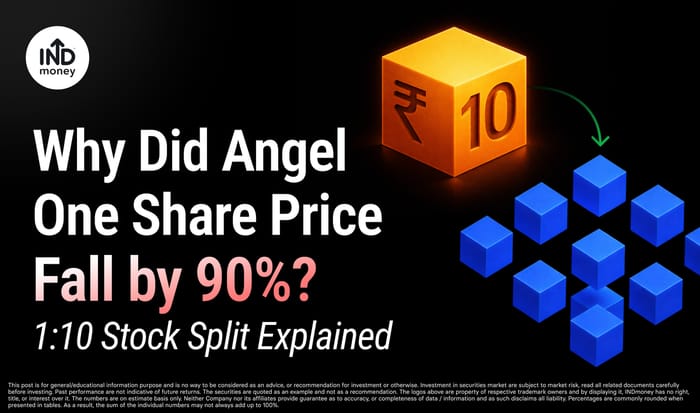
On February 26, 2026, Angel One’s share price appeared to fall by nearly 90% in a single day. For many retail investors, this looked like a massive crash. However, this was not a real fall in the company’s value. It happened because of a 1:10 stock split.
A stock split increases the number of shares while reducing the price per share in the same proportion. In Angel One’s case, the face value changed from ₹10 to ₹1. As a result, the share price adjusted to nearly one tenth of its earlier level. Importantly, the total value of an investor’s holdings remained broadly the same.
What Is a 1:10 Stock Split?
A stock split is a corporate action where a company divides its existing shares into multiple shares.
In a 1:10 stock split:
- Every 1 share becomes 10 shares
- The share price becomes roughly one tenth
- The total investment value remains unchanged
For example, if you owned 10 shares priced at ₹2,480 each, your total investment was ₹24,800. After the split:
- You would own 100 shares
- The price per share would adjust to around ₹248
- Your total value would still be close to ₹24,800
So, a stock split does not create or destroy wealth by itself.
Key Data Points Investors Should Know
To clearly understand what happened, here are the core numbers and what they mean in practical terms:
- Stock Split Ratio (1:10): For every 1 share held earlier, investors now hold 10 shares. This means the total outstanding shares of the company have increased tenfold.
- Face Value Revised: ₹10 to ₹1: Face value is the nominal value assigned to a share by the company. After the split, each share now carries a face value of ₹1 instead of ₹10. This is a structural change and does not affect business performance.
- Share Count Increased 10 Times: The company’s total number of listed shares has multiplied by 10. Example: If total shares outstanding were 9.08 crore earlier, they would now become 90.85 crore after the split.
- Share Price Adjusted Proportionately: Since the share count increased 10 times, the market price per share adjusted to roughly one tenth of its earlier level. If the pre-split price was ₹2,480, the adjusted price would be close to ₹248.
- Market Capitalisation Remains Broadly Unchanged: Market capitalisation means total company value in the stock market (Share Price × Total Shares). Because the share price fell proportionately while the number of shares increased proportionately, the total market value remains nearly the same.
- Investor Wealth Unchanged Due to the Split: If an investor held shares worth ₹1 lakh before the split, the value remains close to ₹1 lakh after the split, subject to minor market fluctuations.
- No Change in Fundamentals: There was no announcement of any sudden loss, sharp fall in revenue or profit, increase in debt, regulatory penalty, or governance concern linked to this adjustment. The company did not report any adverse business development at the time of the split. The balance sheet, earnings outlook, and operating performance remained unchanged.
- Purely a Technical Adjustment: The 90% drop seen on trading screens reflects a mathematical price reset due to the split. It does not indicate destruction of shareholder value.
Short Term Impact
In the short term, such events can create confusion. When investors see a 90% fall on their screen, panic selling may happen if they do not understand the reason. This can cause temporary volatility.
At the same time, the lower share price may attract new retail investors who previously found the stock expensive on a per-share basis. Trading volumes may increase after the split because more investors can buy the stock in smaller amounts.
What Should Investors Do ?
The biggest immediate risk in this situation is misinterpretation. A 90% fall on the screen can create panic, especially among new investors who may assume that something is seriously wrong with the company. In this case, that assumption would be incorrect because the price adjustment was due to a stock split, not a business setback.
However, investors should not ignore the broader business risks that genuinely matter for a brokerage company like Angel One.
One key factor to watch is overall trading activity in the Indian markets. Brokerage revenue is closely linked to trading volumes. If market participation slows down, earnings can be affected.
Competition is another important risk. India’s discount broking industry is highly competitive, with multiple platforms offering low brokerage and technology-driven services. Market share shifts can directly impact growth.
Regulatory changes can also influence the business. Rules related to derivatives trading, margin requirements, or transaction costs can affect both volumes and profitability.
Finally, a significant portion of revenue in the industry is linked to derivatives trading. If activity in this segment declines due to regulatory tightening or lower retail participation, earnings may face pressure.
These are real, ongoing business risks that investors should track. The stock split itself is not one of them.Before making any decision, investors should focus on fundamentals, not headlines.
Conclusion
Angel One did not lose 90% of its value. The sharp fall on trading screens was due to a 1:10 stock split. It was a technical adjustment, not a collapse in fundamentals.
For retail investors in India, the key lesson is simple: always understand corporate actions before reacting to price movements. Focus on business performance, earnings growth, and market position. A stock split changes the number of shares, not the company’s real value.
Disclaimer
Investments in the securities market are subject to market risks, read all the related documents carefully before investing. The securities are quoted as an example and not as a recommendation. This is nowhere to be considered as an advice, recommendation or solicitation of offer to buy or sell or subscribe for securities. INDStocks SIP / Mini Save is a SIP feature that enables Customer(s) to save a fixed amount on a daily basis to invest in Indian Stock. INDstocks Private Limited (formerly known as INDmoney Private Limited) 616, Level 6, Suncity Success Tower, Sector 65, Gurugram, 122005, SEBI Stock Broking Registration No: INZ000305337, Trading and Clearing Member of NSE (90267, M70042) and BSE, BSE StarMF (6779), SEBI Depository Participant Reg. No. IN-DP-690-2022, Depository Participant ID: CDSL 12095500, Research Analyst Registration No. INH000018948 BSE RA Enlistment No. 6428. Refer https://indstocks.com/pricing?type=indian-stocks; https://www.indstocks.com/page/indian-stocks-sip-terms-and-condition for further details.