

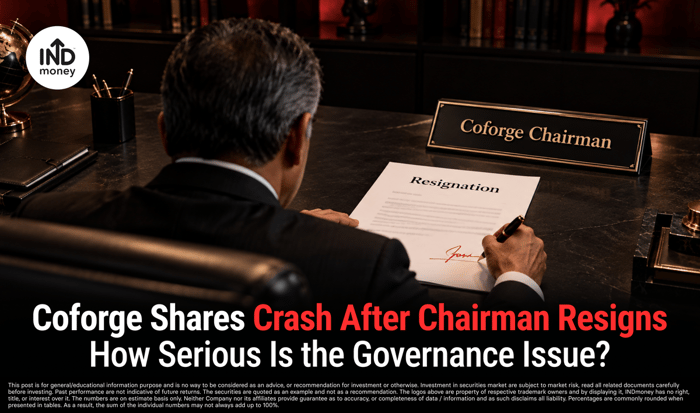
- Why Did Coforge Chairman O.P. Bhatt Resign?
- What Did O.P. Bhatt Say About His Resignation?
- So What Exactly Is the Governance Problem?
- Why Did Coforge Share Price Crash Nearly 9%?
- Interestingly, Coforge's Own Governance System Found the Problem
- Does the Chairman's Exit Change Coforge's Business Fundamentals?
- What Should Coforge Investors Track Now?
- Author's Take
Coforge shares fell sharply on September 9, 2026, after Chairman and Independent Director O.P. Bhatt resigned with immediate effect following concerns raised by an internal audit of the company's board evaluation process.
The stock fell as much as 8.7% to ₹1,780, its biggest intraday percentage decline in more than a year. The broader Nifty IT index was also weak, falling around 3%, but Coforge's much steeper decline showed that investors were reacting specifically to the governance uncertainty created by Bhatt's sudden departure.
At first glance, the combination of an internal audit, undisclosed material information and the Chairman's resignation sounds serious.
It is a governance concern. But the story is more nuanced than simply saying that an audit found wrongdoing and the Chairman resigned.
Bhatt maintained that he had acted in "good faith", the Board had not reached any final conclusion against him and his resignation appears to have followed a disagreement over how his actions during the Board evaluation process were being viewed.
So how serious is the problem for Coforge investors?
Why Did Coforge Chairman O.P. Bhatt Resign?
The issue started with Coforge's Board Evaluation Exercise. As part of its internal audit plan, the company's internal auditor reviewed the processes followed during the Board Evaluation Exercise and the resulting Board Evaluation Report.
A Board evaluation essentially examines whether the Board, its committees, individual directors and the Chairperson are performing their responsibilities effectively.
The internal audit raised concerns about how this report had been handled and presented to the Board.
According to Coforge, certain material information contained in or relating to the Board Evaluation Report, including information concerning the performance evaluation of the Chairman, had not been fully disclosed to the Board when the report was presented.
The Board then raised these concerns with Bhatt and asked him to explain his actions.
Bhatt submitted his response. Importantly, the Board was still considering his explanation and had not reached a final decision when Bhatt resigned on September 8. Coforge also disclosed that Bhatt maintained that he had acted in good faith.
That distinction matters. Bhatt did not resign after Coforge announced that he had been found guilty of misconduct.
He resigned while there was still a disagreement between him and the Board over his actions.
What Did O.P. Bhatt Say About His Resignation?
Bhatt's own resignation communication gives investors a clearer understanding of why he decided to leave.
He said he had considered the matters raised by the Board, his response to those matters and the circumstances that followed.
Bhatt maintained that he had discharged his responsibilities independently and objectively and believed that his actions during the Board evaluation process had been undertaken in good faith.
However, he concluded that continuing on the Board while a disagreement remained over those actions would not help the Board function effectively.
He therefore decided to resign immediately.
Bhatt also confirmed that the issues surrounding the Board evaluation were the material reasons for his departure and that there were no other material reasons for his resignation.
This changes how investors should interpret the event. The resignation does not resolve the disagreement. It actually leaves the central governance question unanswered.
So What Exactly Is the Governance Problem?
The concern is not simply that a Chairman resigned. It is what happened before the resignation.
The Chairman of a listed company plays an important role in ensuring that the Board functions independently and receives the information needed to oversee management.
A Board evaluation is part of that governance framework.
If material information relating to the Chairman's own performance was not fully disclosed to the Board, the effectiveness and independence of that evaluation process naturally comes into question.
That is why this cannot be dismissed as a routine administrative issue. But there is an equally important distinction investors need to make.
| Question | What We Know So Far |
| Did the internal audit identify a governance concern? | Yes |
| Was material information not fully disclosed to the Board? | Yes, according to Coforge |
| Did Bhatt admit wrongdoing? | No |
| What was Bhatt's position? | He maintained that he acted in good faith |
| Had the Board reached a final conclusion against him? | No |
| Is there evidence so far of a company-wide governance failure? | No |
The available evidence therefore points towards a genuine governance red flag, but not enough evidence currently exists to call it a systemic governance failure at Coforge.
Why Did Coforge Share Price Crash Nearly 9%?
The sharp reaction makes more sense when viewed through the lens of uncertainty.
Markets can reasonably estimate the impact of a 2% decline in revenue growth or a 100 basis point fall in margins.
Governance uncertainty is harder to price. Investors currently do not know what the undisclosed material information actually was.
Was it primarily a disagreement over the way certain evaluation comments were presented? Or was something significantly more serious about the Chairman's performance withheld?
The company's disclosures do not yet allow investors to answer that question. This creates an information gap.
The market also had to process an immediate leadership change. Bhatt's tenure as Chairman had been expected to continue until 2027, making the resignation an unexpected development rather than a planned succession.
These factors help explain why Coforge initially underperformed an already weak IT sector.
Interestingly, Coforge's Own Governance System Found the Problem
There is another side to the story that is easy to miss. Coforge did not learn about the problem from a media investigation or several years later through an external scandal.
Its own internal audit process identified the concerns. The Board then asked the Chairman for an explanation.
The Chairman submitted his response. The Board began evaluating it. Bhatt subsequently resigned and the development was disclosed to shareholders.
This does not make the original issue irrelevant. But it does tell investors something about Coforge's internal controls.
One governance mechanism appears to have failed because relevant information was apparently not fully presented to the Board.
Another governance mechanism, the internal audit, appears to have identified that failure.
That makes the situation more nuanced than simply saying Coforge's corporate governance has completely broken down.
Does the Chairman's Exit Change Coforge's Business Fundamentals?
So far, there is little evidence that it does. The governance development comes after a period of strong operational performance for Coforge.
The company reported Q1 FY27 revenue of around ₹5,528 crore, representing roughly 49% year-on-year growth.
Its signed executable order book for the next 12 months reached approximately $2.23 billion, up 44% year-on-year.
The order book matters because it provides visibility into revenue that has already been contracted and is expected to be executed over the coming year.
These strong operating numbers had helped Coforge materially outperform several IT peers before the current governance concern emerged.
But investors should not use strong earnings as a reason to ignore governance. A company can execute well operationally while still having weaknesses in Board oversight.
The correct question is whether this particular governance issue begins to affect clients, senior leadership, execution or investor confidence. There is no indication of that so far.
What Should Coforge Investors Track Now?
- Further disclosure on the Board Evaluation Report: More clarity about what information was not fully disclosed would help investors determine the actual severity of the lapse.
- Any wider governance review: If the issue remains restricted to this particular evaluation process, the risk looks more contained. Evidence of similar problems elsewhere would significantly change that assessment.
- Permanent Chairman appointment: Coforge has named Independent Director Vivek Sharma as interim Chairperson until January 31, 2027. The eventual permanent appointment will be important for restoring governance stability.
- Regulatory response: Investors should watch whether SEBI or the stock exchanges seek further explanations or disclosures.
- Business execution: Client wins, revenue growth, margins and execution of the $2.23 billion order book will show whether the Board-level episode is beginning to affect the operating business.
Author's Take
Coforge's Chairman resignation should not be treated as a routine leadership change. The company's internal audit found that material information relating to the Board Evaluation Report and the Chairman's performance had not been fully disclosed to the Board. That is a genuine governance concern.
But there is an important nuance. O.P. Bhatt did not admit wrongdoing and the Board had not reached a final conclusion against him. He maintained that he had acted in good faith and said continuing as Chairman amid the disagreement would not help the Board function effectively.
That makes this less straightforward than a case involving proven misconduct.
The bigger concern is what investors still do not know. Coforge has not yet explained what material information was withheld and why.
Until that becomes clearer, this should be seen as a governance red flag that deserves scrutiny, not a proven company-wide governance scandal. What Coforge discloses next will determine how serious this episode ultimately becomes.