

- Eternal vs Swiggy: Revenue exposure to restaurants
- Swiggy remains heavily dependent on restaurants
- Other restaurant businesses that could be affected
- What this means for investors
- Disclaimer
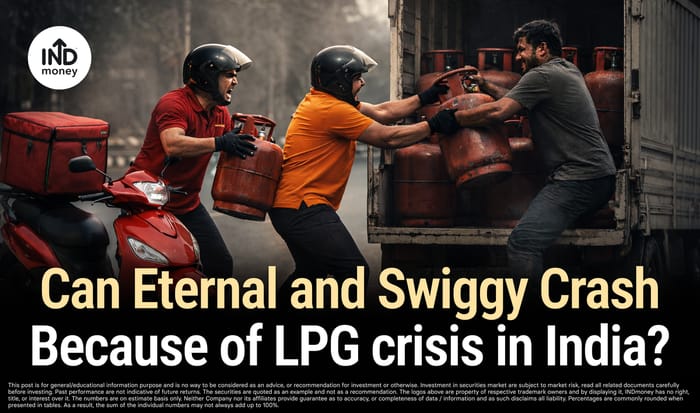
The LPG shortage reported across several Indian cities is mainly affecting commercial cylinders, which restaurants, hotels and cloud kitchens rely on to run their kitchens. If restaurants cannot get LPG cylinders on time, some outlets may reduce operations, cut menu items, or temporarily shut down. This can create ripple effects across the food delivery ecosystem.
For platforms like Eternal and Swiggy, restaurant partners form the core supply side of their business. Fewer active kitchens can lead to fewer available listings, slower order fulfilment and potentially lower order volumes.
But for investors, the more important question is not just whether restaurants are affected. The key question is how dependent each company’s revenue is on the restaurant ecosystem. Understanding this helps determine whether the LPG crisis can materially impact their businesses.
Eternal vs Swiggy: Revenue exposure to restaurants
At first glance, Eternal’s latest financials suggest that the company is now largely driven by quick commerce. In Q3 FY26, Eternal reported adjusted revenue of ₹16,692 crore, of which quick commerce contributed ₹12,256 crore, or about 73% of total revenue. In comparison, food delivery contributed ₹3,053 crore (around 18%).
| Segment | Revenue (₹ crore) | Revenue Mix |
| Quick commerce | 12,256 | 73.4% |
| Food delivery | 3,053 | 18.2% |
| Hyperpure | 1,070 | 6.4% |
| Going-out services | 300 | 1.7% |
| Others | 13 | .07% |
| Total | 16,692 | 100% |
However, this sharp shift in revenue mix is partly influenced by a change in how the company recognises revenue for its quick commerce business.
Earlier, the quick commerce business followed a marketplace model, where the platform recorded only the commission earned from sellers as revenue. The company later moved to an inventory-led model, where it records the entire value of goods sold through the platform.
This accounting change makes quick commerce revenue appear significantly larger, which can distort comparisons with earlier periods. To understand the underlying business mix without the impact of this accounting shift, it is helpful to look at a period before the change, such as Q3 FY25.
In Q3 FY25, Eternal reported adjusted revenue of ₹5,746 crore.
| Segment | Revenue (₹ crore) | Revenue Mix |
| Food delivery | 2,413 | 42% |
| Quick commerce | 1,399 | 24.19% |
| Hyperpure (B2B supplies) | 1,671 | 29.08% |
| Going out | 259 | 4.5% |
| Others | 4 | .06% |
| Total | 5,746 | 100% |
Combined, food delivery and Hyperpure and going out accounted for roughly 76% of Eternal’s revenue in that quarter. This shows that historically, Eternal’s business has been deeply linked to the restaurant ecosystem, through both its delivery platform and its B2B supply business.
Even today, these segments remain an important part of the company’s ecosystem. Food delivery relies on restaurant partners, while Hyperpure supplies ingredients and raw materials to restaurants. Quick commerce has grown rapidly, but the company’s network effects and merchant relationships are still closely tied to restaurant activity.
Swiggy remains heavily dependent on restaurants
Swiggy’s revenue structure shows an even stronger connection to the restaurant ecosystem. Based on the latest available segment numbers, Swiggy reported adjusted revenue of about ₹6,431 crore.
| Segment | Revenue (₹ crore) | Revenue mix |
| Supply chain services | 2,981 | 46.3% |
| Food delivery | 2,277 | 35.40% |
| Instamart | 1,052 | 16.35% |
| Out-of-home dining | 111 | 1.72% |
| Platform innovation | 9 | 0.13% |
Segments closely tied to restaurant activity include food delivery, supply chain services to restaurants and the out-of-home dining business. Together these generate about ₹5,369 crore, or roughly 83% of Swiggy’s revenue. This shows that Swiggy’s business remains much more directly dependent on restaurant operations compared with Eternal.
Other restaurant businesses that could be affected
The impact of an LPG shortage is not limited to food delivery platforms. Several listed restaurant chains and quick service restaurant (QSR) operators could also face operational pressure if the supply disruption continues.
Major players include:
- Jubilant FoodWorks (Domino’s, Popeyes, Dunkin’)
- Sapphire Foods (KFC and Pizza Hut franchisee)
- Restaurant Brands Asia (Burger King India)
- Westlife Foodworld (McDonald’s franchisee in West and South India)
These companies operate thousands of restaurants across the country and rely heavily on commercial LPG cylinders to run their kitchens. If LPG availability tightens or prices spike sharply, restaurants may have to reduce operating hours, limit menu items, or temporarily shut kitchens, which could disrupt sales in the short term.
For large chains, the key risks include higher operating costs, supply disruptions and possible store-level downtime, which can affect same-store sales growth and margins if the shortage persists.
This means the LPG crisis is not just a risk for Eternal and Swiggy. It could also impact the broader restaurant and QSR ecosystem, which forms the supply backbone of India’s food delivery market.
What this means for investors
- Swiggy has higher direct exposure to restaurants. Around 83% of its revenue comes from restaurant-linked segments such as food delivery, supply chain services and dining-out.
- Eternal’s latest numbers show quick commerce dominating revenue, but this mix is influenced by the shift from a marketplace to an inventory model in quick commerce.
- Historical data shows Eternal is still closely tied to restaurants. In Q3 FY25, food delivery and Hyperpure together contributed about 71% of revenue.
- Restaurant disruptions can still ripple through Eternal’s ecosystem, since food delivery and Hyperpure depend directly on restaurant activity.
- Investor takeaway: If LPG shortages disrupt restaurants, the impact may appear more immediate for Swiggy, but restaurant stress can still affect parts of Eternal’s broader ecosystem.
Disclaimer
Investments in the securities market are subject to market risks. Read all the related documents carefully before investing. The securities are quoted as an example and not as a recommendation. This is nowhere to be considered as advice, recommendation, or solicitation of an offer to buy or sell or subscribe for securities. INDStocks SIP / Mini Save is a SIP feature that enables Customer(s) to save a fixed amount on a daily basis to invest in Indian stocks. INDstocks Private Limited (formerly known as INDmoney Private Limited) 616, Level 6, Suncity Success Tower, Sector 65, Gurugram, 122005, SEBI Stock Broking Registration No: INZ000305337, Trading and Clearing Member of NSE (90267, M70042) and BSE, BSE StarMF (6779), SEBI Depository Participant Reg. No. IN-DP-690-2022, Depository Participant ID: CDSL 12095500, Research Analyst Registration No. INH000018948 BSE RA Enlistment No. 6428. Refer to https://indstocks.com/pricing?type=indian-stocks; https://www.indstocks.com/page/indian-stocks-sip-terms-and-condition for further details.