

- What Has Happened To Gold Prices?
- Why Are Indian Households Selling Old Gold?
- Is This A Gold Crash Or A Normal Correction?
- What The Demand Data Shows
- What This Means For Jewellery Companies
- What This Means For Gold Loan Companies
- What This Means For Gold ETF Investors
- Why Gold Recycling Matters For India
- What Should Investors Watch Next?
- Author’s Take
Gold has always had an emotional place in Indian households. It is bought during weddings, festivals, family milestones and important occasions. For many families, it is not just an investment. It is also a symbol of security.
But the latest trend shows something interesting. Indians are not looking at gold only emotionally anymore. They are also looking at it financially.
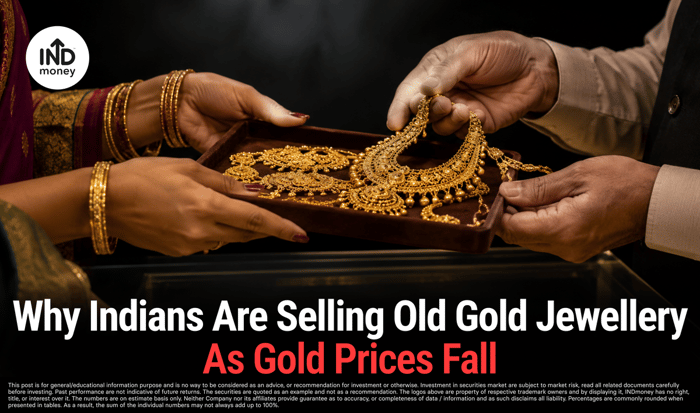
According to the India Bullion & Jewellers Association (IBJA), Indian households sold nearly 50 tonnes of old gold during the April-June quarter, a 43% jump from a year ago, as many rushed to book profits.
This selling comes at a time when gold prices are still very high, but the fear of a deeper correction has started rising. Many households are choosing to sell old jewellery for cash instead of exchanging it for new ornaments.
That raises an important question: why are Indians selling old gold now, and what does this mean for gold buyers, jewellery companies, gold loan companies and investors?
What Has Happened To Gold Prices?
Gold prices had seen a sharp rally earlier. Global uncertainty, inflation worries, central bank buying and safe-haven demand pushed prices to record levels.
In India, gold prices also moved sharply higher because of international gold prices and rupee movement. But after this strong rally, prices started correcting.
According to MCX gold prices had recently touched around ₹1.4 lakh per 10 grams. Market Reports also mentioned that many consumers feared prices could fall toward ₹1.2 lakh per 10 grams. This fear has pushed many households to sell old gold and lock in gains.
This does not mean gold has lost its importance. It simply means that after a very sharp rise, many people do not want to risk waiting too long.
Why Are Indian Households Selling Old Gold?
The biggest reason is profit booking. Many Indian families bought gold years ago at much lower prices. Even after the recent fall, gold prices are still far higher than where they were a few years back. So, for many households, selling old jewellery now still gives them a strong gain.
The second reason is fear. When prices rise too fast and then start falling, people worry that the fall may continue. This is especially true for families who were already thinking of selling old jewellery or unused gold.
The third reason is liquidity. Old jewellery often sits unused in lockers for years. When gold prices are high, selling it can give families instant cash. This cash can be used for household needs, business needs, debt repayment, weddings, education or other expenses.
The important shift is this: earlier, many people exchanged old gold for new jewellery. Now, more people are selling old gold for cash. That shows gold is being treated more like a financial asset.
Is This A Gold Crash Or A Normal Correction?
The word “crash” sounds dramatic. But investors should look at the context. Gold had already rallied a lot. When any asset rises sharply, some correction is normal. Stocks correct after a rally. Real estate can slow down after a boom. Gold is no different.
Gold generally benefits when there is fear in the market. If investors are worried about war, inflation, currency weakness or financial instability, they move money into gold. But when fear reduces or when interest rates and bond yields look attractive, gold can come under pressure.
So, the recent fall should be seen as a correction after a strong rally, not necessarily as the end of the gold story.
For Indian households, however, the timing matters. If someone has old gold bought at much lower prices, even a corrected price may still look attractive for selling.
What The Demand Data Shows
The World Gold Council’s India data for Q1 2026 showed a clear change in how Indians are buying gold.
Total gold demand in India rose 10% year-on-year to 151 tonnes in Q1 2026. But the mix changed. Investment demand rose sharply, while jewellery demand remained under pressure because of high prices.
This means people are still interested in gold, but many are preferring investment formats like bars, coins and ETFs instead of heavy jewellery.
| Segment | What happened | What it means |
| Old gold selling | Nearly 50 tonnes sold in April-June quarter | Households are booking profits |
| Jewellery demand | Volumes remained under pressure | High prices are hurting affordability |
| Investment demand | Strong growth in Q1 2026 | Gold is being treated more like a portfolio asset |
| Gold ETFs | Outflows seen in May 2026 | Financial investors also booked profits |
| Gold recycling | Organised recycling is rising | Idle household gold is coming back into circulation |
The key message is simple. Indians still value gold, but they are becoming more price-sensitive.
When prices rise too much, jewellery demand slows. When prices start falling, people who already own gold try to lock in gains. This makes gold behaviour look more investment-driven than before.
What This Means For Jewellery Companies
For jewellery companies, the impact is mixed.
If customers exchange old gold and buy new jewellery, it can support sales for organised jewellers. The jeweller gets business even if the customer is not bringing fresh cash. This is why old gold exchanges can help large jewellery retailers during periods of high prices.
But if households sell old gold only for cash and do not buy new jewellery, then it is less positive for jewellery retailers. In that case, the transaction benefits gold buying companies, refiners and recyclers more than jewellery sellers.
High gold prices also affect affordability. A family that planned to buy 100 grams may reduce the purchase to 60 or 70 grams. Some buyers may shift to lighter jewellery, lower-carat jewellery or studded jewellery where the gold content is lower.
For listed jewellery companies, investors should watch a few things: same-store sales growth, volume growth, margin trends, old gold exchange share and festive season demand.
Companies may still report strong revenue because gold prices are high. But revenue growth alone may not tell the full story. Investors should also check whether the growth is coming from higher prices or higher volumes.
What This Means For Gold Loan Companies
Gold loan companies are affected differently.
For companies like Muthoot Finance, Manappuram Finance and other gold financiers, gold is the collateral behind the loan. When gold prices rise, the value of collateral improves. When gold prices fall sharply, collateral value comes under pressure.
This matters more in loans where the borrower pays at the end of the loan period, also known as bullet repayment loans. If gold prices fall sharply, lenders may ask borrowers to provide more collateral or repay part of the loan.
That does not mean every gold loan becomes risky immediately. Gold loan companies usually maintain loan-to-value buffers. But a sharp and sudden fall in gold prices can create short-term pressure.
For investors, the things to track are loan-to-value ratio, auction trends, asset quality, management commentary and whether borrowers are facing margin calls.
What This Means For Gold ETF Investors
The profit-booking trend is not limited to physical gold. Gold ETFs also saw outflows in May 2026. This means some financial investors also booked profits after the sharp rally in gold prices.
This is important because it shows that both household investors and financial market investors are reacting in a similar way. When gold moved up too much, investors added money. When prices started cooling, some investors decided to take money off the table.
For long-term investors, this is a reminder that gold can be useful as a hedge, but it should not be treated as a one-way asset. Gold can also be volatile. It can rise sharply during uncertain times and correct when market conditions change.
Why Gold Recycling Matters For India
India imports a large part of its gold requirement. This puts pressure on the country’s import bill.
When old gold comes back into the system, it helps improve domestic supply. Jewellers and refiners can reuse recycled gold instead of depending only on fresh imports.
The ET report mentioned that India imported gold worth about $72.4 billion in FY26. It also said recycled gold contributed an estimated 125-150 tonnes in 2025, and this could rise to 200-250 tonnes in 2026 if the current trend continues.
This makes old gold recycling an important macro story. It does not remove India’s dependence on gold imports completely. But it can reduce some pressure at the margin. It also brings idle household gold back into economic use.
India is estimated to hold a huge amount of household gold. A large part of this remains locked in lockers and homes. If even a small share comes into organised recycling, it can become a meaningful supply source.
What Should Investors Watch Next?
Investors should not look at the gold price fall in isolation. They should track the larger picture.
- The first thing to watch is the global interest rate outlook. If US interest rates stay high for longer, gold may face pressure because investors can earn better returns from bonds and other interest-bearing assets.
- The second factor is the US dollar. Gold is priced globally in dollars. A stronger dollar usually puts pressure on gold prices.
- The third factor is geopolitical risk. If tensions rise again, safe-haven demand for gold can return.
- The fourth factor is Indian festive and wedding demand. If prices stabilise or fall further, jewellery demand may recover during key buying seasons.
- The fifth factor is ETF flows. If gold ETFs continue seeing outflows, it may show that investors are still booking profits. If inflows return, it may show that investors are again using gold as a hedge.
Author’s Take
The rise in old gold selling is important because it shows a behavioural shift. Indian households still love gold, but they are no longer treating it only as an emotional asset. They are also looking at price, return and timing.
When prices rise sharply, people are willing to sell. When prices look too high, buyers delay purchases. When prices start correcting, investors become cautious. That is the real story here.
Gold remains an important part of Indian household wealth. But the recent selling trend shows that even gold is now being judged like an investment. For investors, the lesson is simple: gold can protect a portfolio during uncertain times, but after a sharp rally, price discipline becomes important.