

- Why Cotton Is So Important for Textile Companies
- How Dependent Is India on Imported Cotton?
- Why Textile Stocks Rallied
- The Impact Will Depend on Margin Retention
- Why Export-Linked Companies May Benefit More
- Why the Benefit May Not Be Immediate for Everyone
- What Investors Should Track Now
- Author’s Take
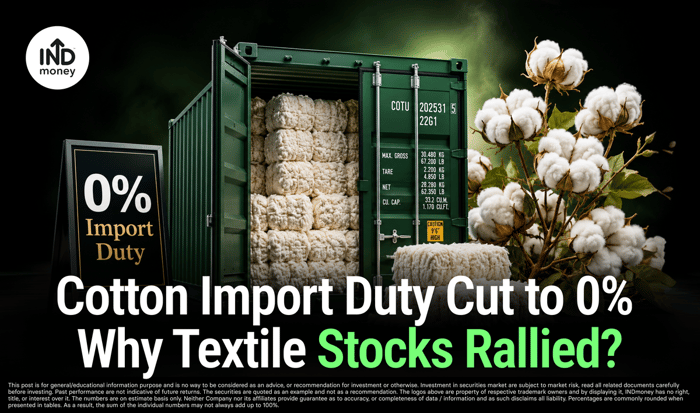
India’s textile sector got a strong boost after the government removed customs duty on cotton imports for five months. The exemption is effective from June 1, 2026 to October 30, 2026, and is aimed at improving cotton availability for domestic textile companies.
The move triggered a sharp rally in several textile stocks. Indo Count Industries rose around 11%, Raymond Lifestyle gained around 7%, while Welspun Living, and Vardhman Textiles moved over 5%.
But the bigger story is not just the stock price movement. The real question is why the market reacted so strongly. The answer lies in one simple factor: margin relief.
Why Cotton Is So Important for Textile Companies
Cotton is one of the most important raw materials for textile companies. It is used across products such as yarn, fabric, denim, garments, bedsheets, towels, and other home textile products.
When cotton prices are high, textile companies face pressure on their production cost. If they absorb the higher cost, their margins fall. If they increase prices, demand can get impacted, especially in export markets where pricing is highly competitive.
This is why the duty cut matters. By removing import duty, the government has made imported cotton cheaper for Indian textile companies. This can help improve cotton availability and reduce raw material cost pressure.
How Dependent Is India on Imported Cotton?
India is one of the world’s major cotton producers, so it is not fully dependent on imported cotton. But imports still matter in the cotton balance.
As per Cotton Association of India estimates for the 2025-26 season, India’s cotton consumption is estimated at 315 lakh bales, while imports are estimated at 47 lakh bales. This means imports are around 15% of domestic cotton consumption.
If we also include raw cotton exports of 15 lakh bales, then total cotton requirement becomes domestic consumption plus raw cotton exports. On that basis, imports are around 14% of total cotton demand.
This is important because it shows that the duty cut is not a complete structural shift for India’s cotton market. India still meets most of its cotton need through domestic production.
But a 14-15% import share is still meaningful. In commodities, even marginal supply can influence prices. Imported cotton can act as a pressure-release valve when domestic cotton is expensive, supply is tight, or mills need better-quality cotton.
That is why the policy can still matter for textile companies. It may not change the entire cotton market, but it can reduce cost pressure at the margin.
Why Textile Stocks Rallied
The stock market reacted positively because investors are expecting lower cotton costs to support margins.Here are some of the key stock moves after the announcement:
| Stock | Stock reaction | What Investor Should Track |
| Indo Count Industries | Around 11% up | Strong home textile exposure. Watch if lower cotton costs improve margins and export profitability. |
| Raymond Lifestyle | Around 7% up | Benefit may be indirect. Track whether lower fabric costs support branded apparel margins. |
| Welspun Living | Over 5% up | Cotton is key for towels and bedsheets. Watch export demand and margin retention. |
| Vardhman Textiles | Over 5% up | Directly exposed to cotton prices. Watch cotton costs and yarn prices together. |
This rally shows that investors are not just looking at the policy headline. They are looking at the possible earnings impact. If cotton costs come down and companies are able to maintain selling prices, the gap between cost and revenue can improve. That means better operating margins.
The Impact Will Depend on Margin Retention
The duty cut is positive for the textile sector, but the benefit will not be equal for every company.
The key factor is margin retention.
If a company gets cheaper cotton but has to pass on the entire benefit to customers through lower prices, the profit impact may be limited. But if the company can retain part of the cost saving, margins can improve.
This is why companies with strong brands, export relationships, efficient operations, or better pricing power may benefit more than others.
In simple terms, the policy reduces cost pressure. But the final earnings impact will depend on how much of that cost benefit companies are able to keep.
Why Export-Linked Companies May Benefit More
Export-linked textile companies may see a bigger advantage from this move because global textile pricing is highly competitive.
Indian textile exporters compete with countries like Bangladesh, Vietnam, and China. If Indian companies get cotton at lower prices, they can improve their cost position in global markets. This matters because exporters often work with tight margins, large order volumes, and price-sensitive international buyers.
The benefit may be more visible for export-linked names such as Indo Count Industries, Welspun Living, and Gokaldas Exports.
Indo Count and Welspun Living have strong exposure to home textiles, where cotton is a key raw material. Gokaldas Exports is linked to the garment export value chain. For such companies, cheaper cotton can help protect margins if export pricing remains stable.
So, the export angle is not just about higher sales. It is also about margin protection. If companies can buy cotton at lower prices and maintain global selling prices, the duty cut can support profitability.
Why the Benefit May Not Be Immediate for Everyone
Even though the duty cut is positive, investors should not assume that every textile company will see an immediate profit jump. There are a few reasons for this.
First, companies may already have cotton inventory purchased at earlier prices. In that case, the benefit of cheaper imported cotton may come with a lag.
Second, global cotton prices can still move depending on demand and supply conditions.
Third, selling prices of yarn, fabric, and garments may also adjust if cotton prices fall. If selling prices fall along with cotton costs, the margin benefit may reduce.
This means the real impact will be visible only over the next few quarters, when companies report their raw material cost, gross margin, and export performance.
What Investors Should Track Now
- Cotton price movement: The key question is whether the duty cut actually cools cotton prices. If domestic cotton prices remain high, the margin benefit may be limited.
- Import volumes: Investors should track whether textile companies increase cotton imports after the duty removal. Higher imports would show that companies are actually using the policy benefit.
- Gross margin trend: The real proof will come in company margins. If raw material cost falls but selling prices remain stable, gross margins should improve.
- Export demand: For export-linked companies, global demand will be important. Lower cotton cost helps only if export orders remain steady.
- Pricing power: Investors should watch whether companies retain the cost savings or pass them on to customers. The biggest beneficiaries will be companies that can protect pricing while lowering input costs.
Author’s Take
The cotton import duty cut is not a game-changing reform for the textile sector. India still produces most of the cotton it needs, while imports account for only around 14-15% of total cotton demand. But the policy still matters.
In commodity markets, even marginal supply can influence prices. By making imported cotton cheaper, the government has given textile companies a short-term cost cushion when raw material costs are important for margins.
My view is that this is more of a margin relief trigger than a demand trigger. It does not automatically mean textile companies will sell more.
The real winners will be companies that can retain the cost savings instead of passing them fully to customers. Export-linked companies may have an advantage because lower cotton cost can help them stay competitive globally.
So, the rally makes sense from a sentiment point of view. But the real test will come in the next few quarters, when we see whether lower cotton costs actually improve margins.