

- What Exactly Is Happening With Air India?
- The Two Biggest Reasons Behind The Flight Cuts
- India’s Aviation Market Is Becoming Highly Concentrated
- Could IndiGo Quietly Benefit From This?
- What Investors Should Watch Next
- Final Verdict
Air India cutting international flights is not just another airline update. It is exposing how vulnerable India’s aviation industry still is when global disruptions hit. Rising fuel costs, longer flight routes, geopolitical tensions, and operational pressure are now forcing airlines to rethink where they fly and how much they can afford to operate.
But this story is bigger than Air India alone.
It raises a bigger question: if India is one of the world’s fastest-growing aviation markets, why are foreign airlines still better positioned to benefit during crises? And if Air India pulls back, who gains from the disruption?
In this blog, we will break down what is happening, why it is happening, what it means for India’s airline industry, and which listed Indian companies investors should closely watch.
What Exactly Is Happening With Air India?
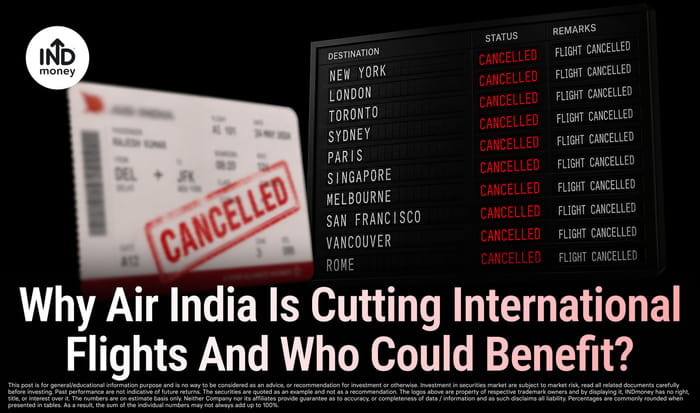
Air India has temporarily reduced or suspended several international routes between June and August 2026. According to reports, the airline may cut around 145 weekly international flights, while some estimates suggest nearly 400 international flights per month could be affected across Europe, North America, Australia, and Asia.
Some impacted routes include:
- Delhi–Chicago
- Mumbai–New York
- Delhi–Shanghai
- Chennai–Singapore
- Several Europe-bound routes like Paris, Milan, and Rome
This is not a complete shutdown. Air India still plans to operate over 1,200 international flights every month. But the scale of these cuts is significant enough to affect India’s international aviation market.
The Two Biggest Reasons Behind The Flight Cuts
1. Middle East Conflict Has Pushed Fuel Costs Higher
The biggest trigger is the recent geopolitical tension in West Asia.
When conflict rises in oil-producing regions, crude oil prices usually move higher. For airlines, this becomes dangerous because fuel is one of their largest operating expenses. Since February end, the brent crude price has increased nearly 40% to date.
Globally, fuel can contribute nearly 25% to 30% of an airline’s operating costs, as per International Air Transport Association (IATA) and analysis from McKinsey. Reuters recently reported that several airlines across the world have started raising ticket prices because jet fuel costs have surged sharply. Air India itself said record-high jet fuel prices have made several routes commercially difficult to operate.
Think of it like a food delivery app where petrol prices suddenly double overnight. Either delivery charges go up, or fewer deliveries happen because some routes stop making financial sense.
That is exactly what airlines are facing today.
2. Pakistan Airspace Restrictions Are Quietly Hurting Indian Airlines
This is one of the most important but under-discussed reasons.
Indian airlines flying west toward Europe or North America usually prefer shorter routes through nearby airspace. But restrictions linked to Pakistan’s airspace are forcing Indian carriers to take longer routes. Reuters reported that some US-bound Air India flights are now taking almost five hours longer because of rerouting.
A longer route means:
- more fuel burn
- higher crew costs
- lower aircraft utilization
- weaker profitability
Imagine driving from Delhi to Jaipur but suddenly being forced to go through Mumbai first. Even if the destination stays the same, the economics completely change. And this is where the story becomes bigger.
Foreign airlines are not equally affected. Many international carriers can reroute more efficiently because of their geographic location and network structure.
India’s Aviation Market Is Becoming Highly Concentrated
This issue matters even more because India’s aviation industry is now dominated by just two players.
According to government data shared in Parliament:
- IndiGo holds around 63.6% domestic market share
- Air India Group holds around 26.5%
Together, they control more than 91% of India’s domestic aviation market.
That means if one major airline faces disruptions, the impact spreads quickly across the industry.
This can lead to:
- higher ticket prices
- lower seat availability
- stronger pricing power for competitors
- increased dependence on foreign airlines
And this is where the investment angle becomes important.
Could IndiGo Quietly Benefit From This?
While rising fuel costs hurt all airlines, disruptions often benefit stronger players with better operational scale. This is where IndiGo (InterGlobe Aviation) becomes important. IndiGo already controls nearly two-thirds of India’s domestic market and has been aggressively expanding internationally. IndiGo is India’s biggest airline with around 63.6% market share.
If Air India reduces international capacity:
- some passengers may shift to IndiGo
- pricing power could improve on select routes
- IndiGo may gain additional market share
But there is another layer here.
As per reports, foreign airlines like Lufthansa, Cathay Pacific, KLM, and Swiss are already benefiting as Air India cuts flights and loses market share internationally. Foreign airlines’ share of international flights from India reportedly rose to 58.4% between March and May 2026, compared to 51.2% a year earlier, according to OAG data. That is a massive shift.
It also exposes a deeper reality: India’s aviation demand may be booming, but foreign airlines could still end up capturing a large part of that growth during global disruptions.
What Investors Should Watch Next
The next few months could become extremely important for aviation stocks. Here are the biggest things investors should track:
- Crude Oil Prices: If oil prices remain elevated, airline profitability may stay under pressure.
- Airfare Trends: Air India’s reduced capacity could push ticket prices higher during the busy travel season.
- Pakistan Airspace Situation: Any easing of restrictions could immediately improve route economics for Indian carriers.
- IndiGo’s International Expansion: If competitors like Air India struggle internationally for a longer period, IndiGo could use this opportunity to grow faster on international routes and capture more global travelers.
- Foreign Airline Expansion In India: Global carriers are already increasing focus on India’s fast-growing travel market.
Final Verdict
Air India’s flight cuts are exposing a much bigger weakness in Indian aviation.
India has one of the world’s fastest-growing airline markets, but the industry still remains highly vulnerable to fuel shocks, geopolitical tensions, and airspace disruptions. And during such crises, foreign airlines may sometimes be better positioned to benefit from India’s booming international travel demand than Indian carriers themselves.
For investors, this is not just a story about canceled flights. It is a reminder that in aviation, demand growth alone is not enough. Operational efficiency, fuel management, network strength, and financial resilience become far more important when global conditions suddenly turn unstable.