
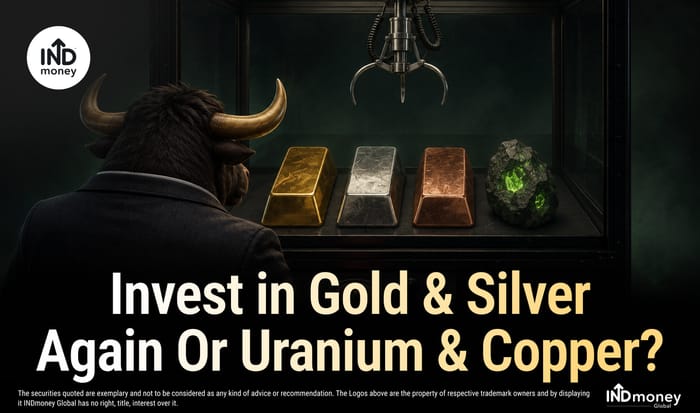
- The Iran-US War That Broke the Old Playbook
- So What Happens If Peace Talks Fail Completely?
- But Wait! Is AI Stealing Gold's Thunder?
- Should Indian Investors Still Hold Gold and Silver ETFs?
- But, Are Uranium and Copper ETFs the Better Choice?
- The Playbook for Indian Investors in US Markets
US President Donald Trump just slammed Iran's latest peace proposal as "TOTALLY UNACCEPTABLE!" on Truth Social. Oil futures jumped overnight. And people investing US Stocks from India are staring at their portfolios wondering: is this the moment gold and silver finally roar back to life? The short answer is: maybe. But the full story is more interesting than a simple yes or no. Let’s break this down.
The Iran-US War That Broke the Old Playbook
When the US-Iran war began on February 28, most investors expected gold to shoot skyward. It is, after all, the classic "hide your money here when the world is burning" asset. That is exactly what happened initially. Gold had already touched an all-time high of $5,602 per ounce in 2026. Silver had gone even wilder, riding a wave of safe-haven buying and exploding industrial demand.
Then came the twist.
The Iran war, rather than lifting gold further, actually triggered a near 25% crash from its January peak. Gold prices fell to around $4,100 at the lows, and is currently trading near $4,500. The reason? Iran's closure of the Strait of Hormuz sent oil past $100 a barrel, which drove US PCE inflation from 2.8% in February to 3.5% in March.
This spooked the Federal Reserve into holding rates high, which crushed gold prices. Gold is like money kept idle at home in a cupboard. When bank FD rates are low, people are okay keeping money at home because they are not missing out on much.
But when FD rates become very high, people start thinking: “Why keep money lying idle when the bank is giving good interest?” That is what happens with gold too. When interest rates rise, many investors move money from gold into assets that give regular returns.
As Ross Norman, CEO of Metals Daily, noted, gold entered the conflict "significantly overbought." A stronger dollar from oil surges and traders exiting leveraged positions added to the pressure.
So What Happens If Peace Talks Fail Completely?
Here is where Trump's rejection of Iran's latest proposal gets interesting.
When Axios reported the US was close to a peace deal on May 6, gold jumped toward $4,700 and silver spiked nearly 5% to roughly $77 an ounce. But analysts pointed out that gold did not rise because of safe-haven demand returning. It rose because peace would reopen the Strait of Hormuz, lower oil prices, cool inflation, and give the Fed room to cut rates.
Now that Trump has rejected Iran's terms, that relief trade gets pushed back. Elevated oil prices, sticky inflation, and fewer Fed rate cuts remain the base case. That keeps the ceiling on gold in the near term. However, it does not mean gold collapses. Analysts surveyed by Reuters increased the average 2026 price target for gold to $4,916 per ounce, up from $4,746 earlier. Goldman Sachs has a target of $5,400, while JPMorgan sits at $6,300 for year-end.
Philippe Gijsels, chief strategy officer at BNP Paribas Fortis, sees the current downturn as a "consolidation phase" in what he believes will be "the strongest and longest bull market in gold and silver in history." He expects secular bull market conditions to resume, with central banks and governments continuing to diversify away from US government paper into gold.
The big structural forces have not gone away: US debt keeps rising, the dollar keeps weakening, and central banks globally are still buying gold in size. Central banks added 254 tonnes of gold in just the first ten months of 2025, with quarterly demand running 28% above the five-year average.
But Wait! Is AI Stealing Gold's Thunder?
This is the question every Indian investor in US stocks is really asking. Why park money in gold when Nvidia, Sandisk, Micron, and the AI ecosystem are on a structural growth wave? The honest answer is: both can coexist, but they serve very different purposes in a portfolio.
The World Gold Council notes that US equity valuations are approaching dotcom-era levels, margin debt is surging, and it would take only a couple of missed earnings targets to puncture confidence. In every such period of systemic risk, gold has generated positive returns and reduced overall portfolio losses.
Sprott's John Ciampaglia has explicitly called out AI bubble fears as one of the drivers bringing money back into gold ETFs. "Whether that is related to potential bubbles in AI and equity markets, or geopolitical and trade tensions, gold ETFs have been significant winners with tens of billions of dollars flowing in," he said. So the picture is not gold versus AI. It is: use AI stocks for growth, use gold as the seatbelt. The two serve entirely different functions.
Should Indian Investors Still Hold Gold and Silver ETFs?
Yes, but with clear eyes about what you are buying and why. For Indians, investing via SIP in gold or silver ETFs is actually the ideal structure, according to experts because an SIP in a gold ETF functions like a drip irrigation system: you are not trying to time the exact moment of a rally. You are steadily accumulating at different price points, smoothing out volatility over time.
Given the structural bull case for gold, an SIP allocation to dollar-denominated gold ETFs remains sensible as a portfolio hedge.
Silver has an additional argument that gold does not. Supply of physical silver remains tight while strong demand from green technologies continues to grow. AI-related demand for silver is significant and growing, adding further pressure to an already stretched supply-demand balance.
By 2025, cumulative silver shortages had reached 800 million ounces, driven by industrial demand growth of 51% since 2016 in the electrical and electronics sector, fueled by solar panels, EVs, and AI data centers. Silver, aside from being a safe haven, is also an industrial commodity with a structural deficit. That is a powerful combination and makes a case for Silver ETFs.
But, Are Uranium and Copper ETFs the Better Choice?
This is where the AI-infrastructure story gets truly compelling for Indian investors in US-listed ETFs. By 2030, data centers worldwide are expected to consume 3-4% of global electricity, up from just 1-1.5% today, according to the International Energy Agency. Someone has to power those data centers. And that someone increasingly looks like nuclear energy, which means uranium.
Uranium entered 2026 with renewed momentum, spot prices moved back above $100 per pound in January, mining equities repriced materially, and utility demand re-emerged following prolonged under-contracting. A global investor survey of 600 investors found that 63% believe uranium remains materially mispriced, while 58% already hold a bullish outlook, with energy security, clean-energy transition, and supply-demand imbalance cited as core drivers.
Copper tells an equally exciting story. AI data centers could consume half a million tons of copper annually by 2030. JPMorgan expects copper to reach $12,500 per ton in Q2 2026, while UBS projects $13,000 by year-end. Every cable, every transformer, every cooling system in an AI data center runs on copper. It is the circulatory system of the AI economy, and supply is genuinely constrained.
The Playbook for Indian Investors in US Markets
Rather than choosing between these asset classes, the smarter framing is: how much of each, and in what form?
- Gold ETFs like GLD and IAU are mainly a hedge. The logic is simple: if US debt, inflation or geopolitical risk rises, gold usually gets attention because it is not linked to any company’s earnings.
- Silver ETFs like SLV are higher-risk than gold because silver moves more sharply. But the business case is stronger: it is used in solar, electronics and industrial manufacturing.
- Uranium ETFs like URA and URNM are a long-term energy bet. If AI data centres keep growing, demand for stable power could rise, and nuclear energy benefits from that theme.
- Copper ETFs like CPER are the cleanest infrastructure angle. More AI data centres means more power grids, wiring, cooling systems and electrification, all of which need copper.
The failed Iran negotiations do not change this portfolio logic. They reinforce it. As one analysis neatly put it, the key for 2026 is to avoid overexposure to either asset class, and instead embrace a diversified strategy that leverages the strengths of both precious metals and AI-linked commodities.