

- Why is Marvell Stock Rising After Jensen Huang’s Trillion-Dollar Comment
- What Does Marvell Technology Do? AI Chips, ASICs and Data Centre Networking Explained
- Why Jensen Huang Thinks Marvell Could Become a $1T Company
- Marvell’s AI Moat: Custom Silicon, Optical Interconnects
- Marvell Stock Valuation: How Much Upside Is Already Priced In?
- Marvell Stock Risks: Customer Concentration, Broadcom Competition and TSMC Dependency
- Should Investors Buy Marvell Stock After the Surge?
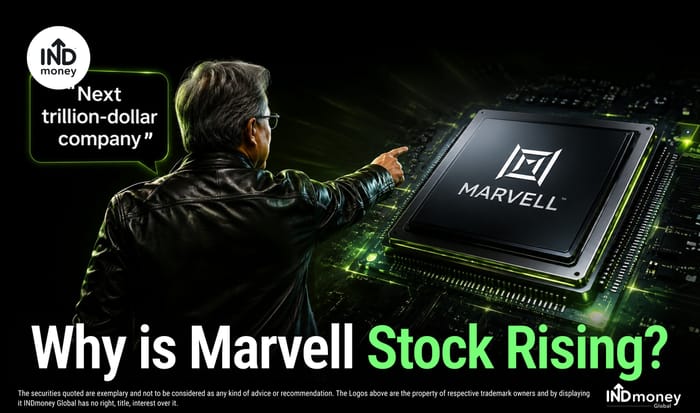
One sentence from one man added roughly $50 billion to a company's market cap in a single day on June 2, 2026. Jensen Huang, the CEO of Nvidia, stepped on stage at the Computex trade show in Taipei alongside Marvell CEO Matt Murphy and said the words every semiconductor company dreams of hearing: Marvell would be "the next trillion-dollar company."
Marvell stock surged over 32.5% that day, its biggest single-day gain in 26 years, according to Bloomberg, and then climbed a further 10% in after-hours trading. But here's the thing most coverage missed entirely: Jensen Huang doesn't say things like this without skin in the game.
Let's break down why Jensen Huang made this call, whether the data actually backs it up, what Marvell truly does, the genuine risks that could make this thesis fall apart and what Indian investors specifically should think about before acting on any of this.
Why is Marvell Stock Rising After Jensen Huang’s Trillion-Dollar Comment
The headline numbers are dramatic. Marvell ended Monday, June 1, with a market cap of roughly $192 billion. After Jensen Huang's remarks at Computex, shares shot to approximately $290, a new all-time high. To put that in context, Marvell’s market cap gain in a single trading session was larger than the market capitalization of most Nifty 50 companies.
But here is the detail that changes the entire story: Nvidia had already invested $2 billion directly into Marvell just two months earlier as part of a formal partnership called NVLink Fusion.
So when Jensen Huang called Marvell a future trillion-dollar company from a public stage, he was, as Bloomberg noted, a company executive talking up the value of his own firm's investment. That conflict of interest doesn't necessarily make Huang wrong. But every investor needs to factor it in before making a decision.
What Does Marvell Technology Do? AI Chips, ASICs and Data Centre Networking Explained
Most people know about Nvidia. But only a few outside the semiconductor world know Marvell Technology. And that knowledge gap is precisely where investment opportunity and investment risk lives simultaneously.
Marvell is a fabless semiconductor company, which means it designs chips but doesn't manufacture them. Think of it like a top architect who draws the blueprints but hires a construction company (in this case, TSMC) to actually build the structure. This model keeps capital costs lower but makes Marvell entirely dependent on manufacturing partners.
What Marvell actually builds falls into three categories that are increasingly at the heart of the AI revolution:
1. Custom AI Chips (ASICs) — This is the crown jewel of Marvell's business. ASICs are custom-built chips designed for one specific job, unlike Nvidia’s GPUs, which are more general-purpose AI processors. Marvell co-designs major AI chips such as Amazon’s Trainium and Microsoft’s Maia, creating large, multi-year partnerships that can generate meaningful revenue across the full life of each chip programme.
2. Optical Interconnects and Silicon Photonics — This is where Jensen Huang’s thesis gets real. AI data centres are increasingly constrained not just by computing power, but by how fast data can move between chips and servers. Copper cables are hitting physical limits around heat, distance and bandwidth. The industry is now shifting toward optical interconnects, which use light instead of electricity to move data faster and more efficiently. Marvell is well placed here through its optical DSP business, its Celestial AI acquisition, and its NVLink Fusion partnership with Nvidia.
3. Data Centre Networking — Marvell also supplies Ethernet switch chips and related networking silicon that keeps the internal communications of large data centres flowing. Think of this as the roads inside a massive city — without them, even the most powerful processors are stuck in a traffic jam.
Marvell Revenue Breakdown: Why Data Centres Now Drive the Business
| Segment | FY2026 Revenue Share | YoY Growth |
| Data Centre | ~74% of total | +38% YoY (Q3 FY26) |
| Carrier Infrastructure | ~10% | Declining |
| Enterprise Networking | ~8% | Recovering |
| Consumer | ~5% | Declining |
| Automotive / Industrial | ~3% | Modest growth |
Sources: Marvell Investor Relations, Q3 FY2026 Earnings Report, Trefis analysis
Marvell has gone from being a diversified semiconductor company, selling chips for hard drives, enterprise networking, and carrier equipment, to being, essentially, an AI data centre pure-play.
In FY2026, Marvell reported record revenue of approximately $8.2 billion, up 42% year-over-year, with earnings per share rising approximately 81%. Its custom silicon (custom ASIC) business alone had reached a $1.5 billion annual run rate by FY2026.
For FY2027, management has guided for approximately 40% YoY data centre revenue growth, with overall company revenue expected to grow around 30-35%.
Why Jensen Huang Thinks Marvell Could Become a $1T Company
Huang's $1 trillion prediction isn't random cheerleading. It's rooted in a very specific, very consequential thesis about what AI data centres will look like in 3-5 years. Let's unpack it.
Data Centres Need Faster Connectivity, and Marvell Is Betting on That Shift
Nvidia’s GPUs are powerful, but AI data centres now face another big problem: moving data fast enough. As AI systems get larger, data needs to travel quickly between chips, servers and data centres. That is why Jensen Huang has highlighted the move from copper cables to optical communication.
Marvell is important here because it works across the key parts of this shift: custom AI chips, optical networking, silicon photonics and CXL switching. Its NVLink Fusion partnership with Nvidia also helps bring Marvell’s technology closer to Nvidia’s AI ecosystem.
This makes the opportunity large. Even in a cautious scenario, analysts believe Marvell could earn around $5 per share next fiscal year. If demand from major AI customers grows faster, the upside could be much bigger.
Custom AI Chips: Why Marvell’s ASIC Business Matters
Industry estimates suggest the custom ASIC market is growing at approximately 45% in 2026, outpacing even the GPU market. This matters because hyperscalers like Amazon, Google, Microsoft, Meta are increasingly choosing custom chips over general-purpose GPUs for specific, high-volume AI tasks. It saves them billions in operating costs. And the two companies they primarily rely on for those chips are Broadcom and Marvell.
Marvell’s AI Moat: Custom Silicon, Optical Interconnects
Here is a framework for understanding Marvell's true position in the AI supply chain.
Think of Nvidia as the power plant of AI. Its GPUs create the raw computing power. But that power needs a distribution network to be useful. That is where Marvell comes in. It builds the chips and connectivity infrastructure that help move data across AI systems at high speed.
That is why Nvidia’s investment in Marvell matters: it strengthens the infrastructure Nvidia needs to expand its AI ecosystem. This also explains why Marvell’s custom chip revenue moves on a different timeline.
When a hyperscaler selects Marvell to co-design a custom chip, it is called a design win. These deals usually take 2-3 years to ramp into full revenue. For investors, this is important. It makes Marvell’s revenue pipeline more predictable, but also creates a delay: if current design wins slow down, the impact may not show up in revenue for another 2-3 years.
Marvell Stock Valuation: How Much Upside Is Already Priced In?
To appreciate how far Marvell has come, consider this: CEO Matt Murphy has been in the role since July 2016. Since then, shares have risen over 2,700%, compared to approximately 450% for the Nasdaq Composite over the same period. On a 1-year basis through June 2026, MRVL is among the strongest performing semiconductor stocks globally.
| Metric | Value |
| Forward P/E | 53x |
| Current Market Cap | ~$250+ billion |
| Jensen Huang's $1T Target Implied Upside | ~4x from current levels |
Sources: Google Finance, Guru Focus | Data as of June 3, 2026
Marvell Stock Risks: Customer Concentration, Broadcom Competition and TSMC Dependency
This is the section most financial media skips. We won't. Any serious investor — especially one managing capital from India with currency risk and tax complexity layered on top — needs to stress-test the bullish thesis.
Risk 1: Heavy Customer Concentration: Marvell’s custom silicon revenue depends heavily on a few hyperscalers, especially AWS. Data centre revenue makes up about 74% of total sales, with Amazon, Microsoft and Google driving most of the demand. Any delay, spending cut, or shift to in-house chip development by one major customer could materially affect Marvell’s growth.
Risk 2: Broadcom Remains the Bigger Threat: Broadcom is expected to control around 60% of the custom AI ASIC market by 2027, versus Marvell’s roughly 25%. Broadcom also has much higher gross margins, around 77.5% versus Marvell’s 59%, and has locked in a major Google supply agreement through 2031. Marvell is growing fast, but Broadcom remains larger and more entrenched.
Risk 3: TSMC and Geopolitical Dependency: Marvell’s most advanced chips rely on TSMC’s 5nm and 3nm nodes in Taiwan. Its March 2025 10-K mentions multi-year TSMC capacity agreements of 4-10 years. Any Taiwan-related geopolitical escalation, export controls, or capacity constraints could disrupt production.
Risk 4: Hyperscalers May Eventually Go In-House: A long-term risk is that Amazon, Microsoft and Google build enough internal chip design capability to reduce dependence on Marvell and Broadcom. Patent analysis has already flagged this disintermediation risk. It is not immediate, but it matters for investors.
Risk 5: Jensen Huang’s Forecast Is Not a Guarantee: Huang’s comments carry weight, but they are not infallible. His shifting views on quantum computing show that even influential tech leaders revise forecasts.
Should Investors Buy Marvell Stock After the Surge?
Investors, especially those investing in US Stocks from India, chasing the 32% single-day pop based solely on what one executive said about a company in which his own firm has a $2 billion investment, may not be smart. Do the work. Understand the business. And size the position accordingly.
Indian investor interest in Marvell has surged sharply. INDmoney data shows that investment activity in the stock jumped 91% in the last 30 days, while search interest jumped 126%. For these investors, here are a few frameworks to keep in mind:
- The Shovel Seller Framework: In the AI gold rush, Marvell sells the “shovels”. It does not need to pick the winning AI model. It supplies the chips and connectivity infrastructure that most AI systems need, making its position more durable.
- The Position Sizing Framework: Marvell has strong upside, but also high valuation and customer concentration risk. For Indian investors, it may suit a small, disciplined allocation of around 2-5% of a US portfolio, not an oversized bet.
- The Time Horizon Framework: Marvell’s custom chip revenue takes 2-3 years to ramp after a design win. That aligns well with a 2+ year investor horizon, especially for Indian investors considering US stock LTCG rules. The opportunity may be better suited to patient holding than short-term trading.
The best way to think about Marvell is this: it is one of the most interesting, data-backed, genuinely differentiated AI infrastructure plays available in public markets today. The business case is genuinely strong. The custom ASIC duopoly with Broadcom is real. The optical interconnect transition is real. But at ~113x GAAP earnings, you are buying a lot of future execution that hasn't happened yet.