


- Why is Dell Stock Rising?
- Analysts Racing Each Other to the Upside on Dell Stock
- What to Expect From Dell Earnings on May 28
- The Part Nobody Else Is Covering: Dell's $43 Billion Moat
- Dell’s Margin Compression: Misread Risk or Real Risk?
- What Should Investors Watch For Now?
Dell Technologies stock surged around 16% today to hit an all-time high of $294.89, pushing the company’s market cap to $188 billion. What is actually happening at Dell right now is a fundamental business transformation that most coverage keeps reducing to a single headline: "AI server demand is strong."
That framing undersells the story by a wide margin. Dell is not riding the AI wave. In large ways, it is the wave.
Let's break down why Dell stock is surging ahead of its Q1 FY2027 earnings on May 28, what analysts are saying, what the numbers actually mean, and why the most important part of this story is the one almost nobody is covering.
Why is Dell Stock Rising?
Dell Stock has jumped around 150% in the last 3 months. In fact, INDmoney data shows that Indian investors’ interest in Dell is rising sharply, with investment activity up 77.82% and search interest up 120% in the last 30 days.
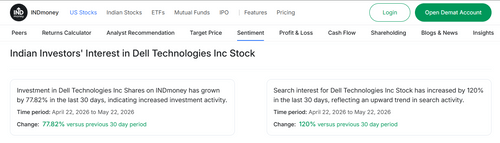
The immediate trigger for this week's move in Dell Stock is twofold.
First, Dell's annual user conference, Dell Technologies World 2026 in Las Vegas (May 19-21), delivered a product blitz that the market read as a strong signal of execution.
The company unveiled its 18th generation PowerEdge servers delivering up to 70% better performance and 13-to-1 infrastructure consolidation ratios, a completely refreshed storage platform called PowerStore Elite, and a deskside agentic AI solution built in collaboration with NVIDIA.
Second, Dell earnings on May 28 are days away, and analysts are loading up their targets before the print.
Analysts Racing Each Other to the Upside on Dell Stock
The analyst activity around DELL in the past four weeks has been unusually aggressive, and the divergence between bulls and bears is worth examining closely.
| Analyst Firm | Rating | Previous Target | New Target | Target Upside |
| Bank of America | Buy | $246 | $280 | +13.8% |
| Citigroup | Buy | $235 | $290 | +23.4% |
| JPMorgan | Overweight | $205 | $280 | +36.58% |
| Wells Fargo | Overweight | $180 | $270 | +50% |
| UBS | Neutral (Downgrade) | $167 | $243 | +45% |
Bank of America raised its target to $280 for the second time in just 21 days, citing "strong neocloud and sovereign AI demand with improving enterprise mix," as reported by The Street. The street high is now $300.
The one dissenting voice is UBS analyst David Vogt, who downgraded to Neutral while simultaneously raising his target to $243, arguing that accelerating server demand is already priced in at roughly 18-20 times calendar 2026 earnings versus roughly 10 times just three months ago.
While UBS has a point on valuation optics, it is using 2024-era hardware company multiples to price a business that has structurally shifted. More on that below.
What to Expect From Dell Earnings on May 28
Dell reports Q1 FY2027 results on May 28, 2026 before the market open. Here is the setup:
| Metric | Consensus Estimate | YoY Change |
| Revenue | ~$34.95B - $35.46B | +51% |
| Non-GAAP EPS | ~$3.00 | +93.6% |
| AI Server Revenue (est.) | ~$13B | +333% |
| ISG Revenue Growth (guided) | >100% YoY | -- |
Sources: Yahoo Finance, TipRanks, MEXC News, American Market News
Bank of America explicitly expects Dell to beat both revenue and EPS estimates and raise full-year guidance. The company's own guidance entering Q1 was $34.7B-$35.7B in revenue and EPS of $2.90, both of which look conservative given the momentum.
For context, Dell beat estimates in Q4 FY26 by delivering $3.89 EPS against a $3.53 consensus while revenue of $33.38 billion cleared the $31.60 billion estimate. The single most important data point to watch on May 28 is not the revenue print. It is the AI backlog update and ISG operating margin trajectory.
The Part Nobody Else Is Covering: Dell's $43 Billion Moat
1. AI Server Backlog: Dell entered FY2027 with a $43 billion AI server backlog after booking more than $64 billion in AI-optimized server orders across FY2026 and shipping $25 billion of those. Wall Street is treating this as a revenue visibility story. It is actually something more structurally significant.
Think of it this way. Imagine a construction contractor who has already signed contracts for 43 buildings worth of work before January even begins. A cyclical downturn in real estate sentiment might spook investors, but that contractor has a guaranteed pipeline that competitors cannot touch for several quarters. That is Dell's position in AI infrastructure right now.
2. Dell’s USP within AI ecosystem: But backlog is only one part of the story. Dell’s real advantage is that it does not just sell AI servers with NVIDIA and AMD chips. It can provide the full AI infrastructure stack, including servers, storage, networking, deployment, and ongoing support. Basically, NVIDIA sells you the engine. Dell hands you the entire vehicle, with the service contract, the fuel plan, and the mechanic on call.
This full-stack position matters because enterprise and sovereign AI customers need partners who can design, deploy, and manage entire data centres. They cannot just order GPUs from NVIDIA and figure out the rest. Dell's 4,000+ AI customers now span neoclouds, sovereign AI programmes, and large enterprises, per Futurum Research's Q4 FY26 earnings analysis.
3. AI Transition: The AI Factory transition is real. AI-optimized server revenue at Dell grew 342% year-over-year in Q4 FY26 to reach $9 billion in a single quarter, now representing 26% of total revenue. FY27 guidance points to $50 billion in AI revenue, which would be a near-doubling. These are not incremental numbers. They are structural.
Dell’s Margin Compression: Misread Risk or Real Risk?
The one legitimate bear argument on Dell is gross margin. GAAP gross margins have compressed from roughly 24% to 20% as the mix shifts toward AI servers, which carry lower gross margins due to the cost of NVIDIA and AMD chips. This has given some investors pause.
Here is the nuance that most people miss. Dell's dollar-level operating profit is expanding, not contracting. ISG operating margin in Q4 FY26 was 14.8% on $19.6 billion in revenue, up 73% year-over-year. The total operating income number is growing faster than the gross margin percentage is falling.
It is like a restaurant that used to earn ₹5,000 per table on 20 tables. Now it serves 200 tables at ₹3,500 per table. The per-table margin is lower, yes. But the restaurant is earning almost 3.5 times more total profit than it was before.
Additionally, Dell management has signaled explicitly that as storage and services attach rates grow alongside AI server deployments, the mix improves. PowerStore Elite, the newly launched storage platform, is a higher-margin product. The margin picture is dynamic, not static.
What Should Investors Watch For Now?
There are five things that matter in the days ahead.
- AI Backlog: Dell’s AI backlog stands at $43B. If it keeps growing, the AI revenue story remains strong. A decline would be a major warning sign.
- ISG Margins: Watch if Infrastructure Solutions Group margins stay above 14%. Margin expansion could ease valuation concerns.
- FY27 Guidance: Markets expect Dell to raise its $138B–$142B revenue guidance along with EPS forecasts.
- Storage & Services Sales: Higher attach rates alongside AI servers are critical for long-term margin growth.
- Insider Selling: Dell executives, including Michael Dell, sold over $1.08B in stock in three months. Worth tracking, though not necessarily bearish.
At its current price, Dell trades at roughly 22x times forward earnings, well below the software and semiconductor companies that get credit for the same AI tailwind. If Dell executes on May 28 and raises guidance, the valuation case for re-rating the stock toward 22-25 times becomes the dominant narrative heading into the second half of 2026. AI infrastructure spending is still strong. Dell was always set to benefit. The real question was whether investors would recognise it, and now they are starting to.