

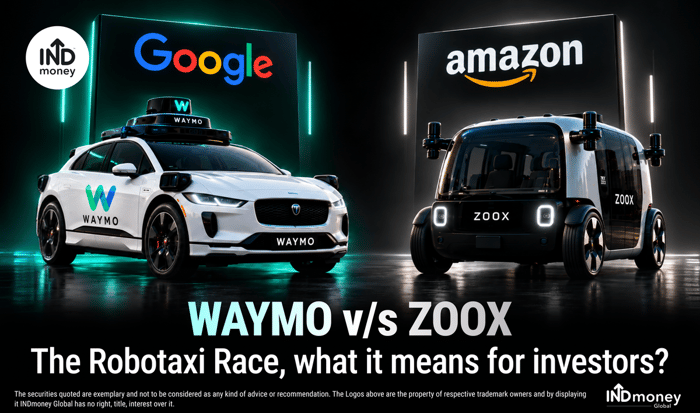
- Waymo and Zoox expansion news at a glance
- Why does Waymo's three-city launch matter?
- Waymo's scale advantage is becoming measurable
- Zoox has crossed from demonstration to paid service
- Waymo vs Zoox vs Tesla: Who is leading the U.S. robotaxi race?
- The five numbers that will decide the robotaxi winner
- What Waymo's $126 billion valuation implies?
- What Zoox means for Amazon stock?
- Could robotaxis hurt Uber and Lyft?
- Robotaxi safety is both a social issue and a financial metric
- Key risks investors should not ignore
- What investors should watch next?
- Analyst view: Waymo leads, but the business model has not finished the race
The U.S. robotaxi race has entered a more serious phase. Waymo is a company owned by Alphabet that develops and operates self-driving cars for passenger rides. It is no longer just proving that a driverless car can complete a carefully selected trip. It is trying to build a large autonomous ride network across 14 cities. Zoox is Amazon's self-driving car company. It has crossed a different but equally important threshold: its purpose-built robotaxi can now charge passengers in Las Vegas and serve airport trips while the company prepares to enter two more major markets.
The investment question is therefore shifting from, "Can the technology work?" to, "Can these companies operate enough vehicles at high enough utilisation to justify the money already being spent and the valuations investors are assigning?"
Let's break down what Waymo and Zoox announced, how far each company has progressed, what the economics may look like and which U.S. stocks give investors exposure to the autonomous driving race.
Waymo and Zoox expansion news at a glance
| Development | Waymo | Zoox |
| Latest expansion | Began admitting public riders in Denver, San Diego and Tampa on 1 September 2026 | Announced mapping and testing in Houston and San Diego on 1 September 2026 |
| Commercial position | Fully autonomous public trips across 14 U.S. cities, with access in the three new cities expanding gradually | Paid public service in Las Vegas; other cities remain at different testing or limited-rider stages |
| Recent demand milestone | More than 500,000 paid rides per week, reported in March 2026 | Ride volume is not publicly disclosed |
| Major near-term target | More than 1 million paid weekly rides by the end of 2026 | Scale paid service beyond Las Vegas, subject to operating readiness and local approvals |
| Vehicle strategy | Conventional and purpose-built vehicles fitted with the Waymo Driver | Fully purpose-built, four-passenger vehicle with no steering wheel or pedals |
| Public-market owner | Alphabet | Amazon |
The first point investors must understand is that these announcements are not the same. Waymo is adding public fully autonomous rides. Zoox is initially using modified Toyota Highlander test vehicles with human safety drivers to map Houston and San Diego before its purpose-built robotaxis can arrive. One is a commercial rollout. The other is preparation for a future launch.
Why does Waymo's three-city launch matter?
Waymo began welcoming its first public riders in Denver, San Diego and Tampa on 1 September. Tens of thousands of people in each city had registered their interest, according to the company. Access is being released gradually rather than opened to every rider at once.
That phased approach may look slow, but it is part of Waymo's risk-control model. The company maps a city, tests local situations, checks performance without passengers, introduces fully autonomous employee trips and only then admits public riders. It can then widen the operating area, extend operating hours and add destinations such as highways and airports.
Denver, San Diego and Tampa are useful tests for different reasons. Denver adds colder weather and the possibility of snow. Tampa adds heavy rain, heat and flooding risk. San Diego adds another large California market where permits and local transport opposition can influence the speed of expansion. If one autonomous system works reliably across all three, Waymo is demonstrating that it can reuse more of its technology rather than rebuild the product from scratch for every city.
The new Ojai vehicle is central to this strategy. It is the first public vehicle using the sixth-generation Waymo Driver. Its sensor suite includes 13 cameras, four lidar units, six radar units and external audio receivers. Waymo says this generation provides better resolution and range at a significantly lower cost than the earlier system. It can detect objects as far as 500 metres away under supported conditions and was designed for a wider range of weather.
This matters because a robotaxi business is not won only by driving skill. It also depends on lowering vehicle and autonomous hardware costs, reducing the time needed to validate a new city and keeping each car carrying paid passengers for more hours each day.
Waymo's scale advantage is becoming measurable
Waymo disclosed more than 500,000 paid rides per week in March 2026, up from roughly 400,000 at the start of February. It completed 15 million rides during 2025 and had passed 20 million lifetime fully autonomous trips by May 2026. Its year-end ambition is to exceed 1 million paid rides per week.
| Waymo operating measure | Latest disclosed figure | Why it matters |
| Paid rides per week | More than 500,000 | Proves repeat use beyond a small pilot |
| Annualised rides at the current weekly rate | More than 26 million | Provides a base for estimating revenue capacity |
| 2026 weekly ride target | More than 1 million | Would double the March run rate |
| Annualised rides at the target rate | More than 52 million | Could create a meaningful mobility business, although not yet a large Alphabet segment |
| Fully autonomous miles analysed for safety | More than 220 million through March 2026 | Gives Waymo a growing real-world data advantage |
| Cities providing fully autonomous trips | 14 after the September launches | Tests whether the operating model can travel across markets |
The scale is impressive for autonomous driving, but it still needs context. At 500,000 weekly trips, Waymo is completing about 26 million trips on an annualised basis. Uber facilitates billions of trips across its wider global network. Waymo leads the U.S. driverless market, but it remains small compared with mainstream ride-hailing.
This is why city count alone can be misleading. A small invitation-only fleet in a new city creates publicity. Dense coverage, short passenger wait times and high vehicle utilisation are what create better economics.
Zoox has crossed from demonstration to paid service
Zoox reached a different milestone in 2026. In July, the National Highway Traffic Safety Administration granted it a temporary exemption that allows commercial use of a vehicle without conventional human controls. The approval covers up to 2,500 vehicles in each of the next two years and includes additional reporting and oversight conditions.
Zoox started charging passengers in Las Vegas in August. Fares use a base charge plus time and distance, and Reuters reported that pricing would be comparable with the premium "comfort" tier of conventional ride-hailing. On 3 September, Zoox extended the Las Vegas network to Harry Reid International Airport. Airports are valuable because they can generate frequent, predictable trips and higher fares, although they also involve complex pickup rules, congestion and local transport regulation.
The Houston and San Diego news expands Zoox's presence to 12 U.S. locations, but it does not mean paid Zoox rides are immediately available in those cities. The company will first map roads and collect data using retrofitted vehicles with human safety operators. Houston is particularly demanding because of its sprawling road network, service roads, unusual merging patterns, heat, heavy rain and flooding.
Zoox's purpose-built design may eventually offer a cost advantage. It carries four passengers facing each other, can travel in either direction and does not dedicate space to a driver's seat. In simple terms, Waymo has spent years teaching cars to drive without a human driver, while Zoox designed its robotaxi from the start for passengers rather than for a driver.
The trade-off is that Zoox must scale both its self-driving system and a new vehicle-manufacturing operation. Waymo can work with established vehicle manufacturers and focus more of its capital on the self-driving system, fleet and service. Zoox controls the full product, but that also gives it more operational responsibilities.
Waymo vs Zoox vs Tesla: Who is leading the U.S. robotaxi race?
| Factor | Waymo | Zoox | Tesla |
| Commercial maturity | Clear U.S. leader by paid fully autonomous rides and city presence | Paid service has started in Las Vegas, but scale remains limited | Cybercab rides began in Austin in September, while Model Y robotaxi operations were already expanding |
| Sensor approach | Cameras, lidar and radar | Cameras, lidar and radar | Primarily camera-based autonomy |
| Vehicle model | Mix of modified production vehicles and Ojai purpose-built platform | Purpose-built four-seat robotaxi | Model Y plus purpose-built two-seat Cybercab |
| Regulatory route for no-control vehicle | Uses a controlled operating model across approved locations | Received a federal exemption capped at 2,500 vehicles annually for two years | Self-certified Cybercab compliance, now under NHTSA audit |
| Main investment strength | Real paid-trip volume, safety data and operating experience | Passenger-first design and Amazon's financial backing | Potentially lower hardware cost and a huge installed consumer-vehicle base |
| Main weakness | High capital needs and unclear standalone profitability | Very limited disclosed commercial scale | Regulatory uncertainty and less public evidence of fully driverless scale |
Tesla made the competitive story even more intense on 3 September when it began offering Austin rides in its two-seat Cybercab, which has no steering wheel or pedals. The next day, NHTSA opened an audit into how Tesla determined that the vehicle complied with federal safety standards. Tesla shares fell nearly 6% on 4 September to $354.08, erasing the prior day's gain.
That market reaction is revealing. Robotaxis are an important but still relatively small option inside Alphabet and Amazon. At Tesla, autonomous driving is already a major part of the valuation narrative. A regulatory setback can therefore produce a much larger share-price response.
The five numbers that will decide the robotaxi winner
Investors should evaluate robotaxi operators using a simple five-part scorecard.
| Number to track | What it tells investors |
| Paid rides per week | Whether passengers are actually using the service |
| Rides per vehicle per day | Whether expensive vehicles are being utilised efficiently |
| Revenue per ride | Whether pricing can support the fleet and technology costs |
| Cost per autonomous mile | Whether the removal of a driver creates a real economic advantage |
| Safety incidents per million miles | Whether the service can retain regulatory permission and public trust |
The key concept is utilisation. A robotaxi earns nothing while it is charging, being cleaned, waiting in a depot or travelling empty to collect a passenger. Removing the driver saves labour costs, but sensors, insurance, remote assistance, maintenance, charging, cleaning and fleet depots still cost money.
Consider a simple illustration. This is not company guidance because Waymo does not disclose average fare or profit per trip.
| Illustrative Waymo scenario | 500,000 weekly rides | 1 million weekly rides |
| Annual rides | 26 million | 52 million |
| Assumed average fare | $20 | $20 |
| Illustrative annual gross bookings | $520 million | $1.04 billion |
| Assumed contribution after direct trip costs | 30% | 30% |
| Illustrative annual contribution | $156 million | $312 million |
This model shows why doubling rides matters, but it also shows how early the economics still are. Even at 1 million weekly rides and a $20 average fare, illustrative annual gross bookings would be only about $1 billion. Actual revenue could differ because average fares, partner revenue sharing, discounts, trip length, empty miles and vehicle availability are not disclosed.
The long-term opportunity is larger. If autonomy reduces the cost per mile below human-driven ride-hailing, lower prices could lead to more trips. The same driving system could also support delivery, logistics or licensing. But investors should not treat these possibilities as if they are already reported revenue.
What Waymo's $126 billion valuation implies?
Waymo raised $16 billion in February 2026 at a $126 billion post-money valuation. The round was led by external investors, while Alphabet remained the majority owner. Waymo said it would use the capital to accelerate global expansion. The valuation rose sharply from the roughly $45 billion figure associated with its 2024 funding round.
At Alphabet's 4 September 2026 market capitalization of about $4.14 trillion, Waymo's entire latest private valuation equals roughly 3.0% of Alphabet's market value. Alphabet does not disclose its exact current ownership percentage, so investors should not assign the full $126 billion to Alphabet shareholders.
There is another important caution. At the illustrative $1.04 billion gross-bookings level associated with 1 million weekly rides, Waymo's $126 billion valuation would equal about 121 times that figure. This is not a conventional valuation based on current revenue. It assumes that Waymo can scale far beyond its 2026 target, improve its unit economics and possibly earn revenue from more than passenger fares.
Alphabet can afford that long runway. In Q2 2026, it generated $119.8 billion in total revenue and $40.8 billion in operating income. Other Bets, which includes Waymo but is not limited to it, produced only $382 million in revenue and recorded a $1.8 billion operating loss. Investors should therefore view Waymo as a valuable option backed by a profitable advertising and cloud business, not as the main reason to buy Alphabet today.
Headline valuation multiples also require care. Alphabet traded near $338.46 on 4 September with a reported market value of roughly $4.14 trillion. Its headline trailing price-to-earnings ratio was distorted by a large Q2 unrealised gain on equity investments. The operating performance of Search, YouTube and Cloud remains more useful for valuing the core company.
What Zoox means for Amazon stock?
Amazon bought Zoox for about $1.2 billion in 2020. Zoox does not publish standalone revenue, operating loss or a current private valuation. That lack of disclosure makes it impossible to build a reliable separate valuation from public accounts.
For Amazon shareholders, Zoox is best viewed as a long-term opportunity. If the platform works, Amazon could use the technology in passenger transport and potentially apply its self-driving expertise to logistics. If commercialisation is slower than expected, AWS, advertising, Prime and retail will still determine most of the investment outcome.
The parent company's financial capacity is not in doubt. Amazon reported Q2 2026 revenue of $200.6 billion and operating income of $27.5 billion. However, trailing 12-month free cash flow was an outflow of $7.6 billion, mainly because property and equipment investment rose sharply for artificial intelligence infrastructure. With Amazon already funding a historic AI buildout, Zoox must compete internally for capital and eventually show why expanding a vehicle fleet deserves more investment.
Amazon closed at $258.51 on 4 September with a market capitalisation of about $2.82 trillion. At that scale, even a several-billion-dollar increase in Zoox's value would have little immediate effect on Amazon's share price. The strategic impact could become meaningful over time, but current investors are still buying AWS and commerce first, and Zoox second.
Could robotaxis hurt Uber and Lyft?
The simple fear is that autonomous vehicles remove drivers and therefore remove ride-hailing platforms. The emerging industry structure is more nuanced. Uber distributes Waymo rides in Austin and Atlanta. Lyft is working with Waymo in Nashville, where Lyft's Flexdrive unit manages charging, maintenance and depot operations. These partnerships suggest that autonomous-driving companies may still need established apps for demand, payments, customer support and fleet utilisation.
The market could eventually have three layers:
- Companies such as Waymo, Zoox and Tesla provide the autonomous driver.
- Fleet operators finance, charge, clean and maintain the vehicles.
- Consumer platforms match vehicles with passengers and keep demand flowing.
Uber and Lyft can survive if they remain the marketplace connecting these layers. Their risk is weaker economics. If an autonomous-driving company owns the car and the customer relationship, the ride-hailing platform may receive a smaller share of each fare than it receives from its current network.
Robotaxi safety is both a social issue and a financial metric
Waymo's latest analysis covered more than 220 million fully autonomous miles through March 2026. The company reported 94% fewer serious or fatal injury crashes and 82% fewer injury-reported crashes than human-driver benchmarks in the same operating areas. The comparisons include crashes regardless of fault.
These are strong results, but they are company-produced comparisons and depend on methodology, matched geography and reporting quality. Investors should also follow independent studies, NHTSA investigations, recalls and performance in new weather conditions.
Zoox provides the reason for that caution. In July 2026, it recalled autonomous-driving software used in 105 vehicles after an unoccupied robotaxi encountered heavy smoke at an emergency scene. The vehicle entered the scene, braked hard and stopped. No injury was identified, and Zoox deployed updated software to the affected fleet on 15 July.
Software recalls are not automatically proof that an autonomous platform is failing. A centrally operated fleet can update every affected vehicle quickly. But frequent recalls, emergency-scene failures or regulator intervention can delay expansion, reduce fleet utilisation and raise insurance and compliance costs. Safety therefore flows directly into valuation.
Key risks investors should not ignore
Expansion may be wider but not deeper
A company can announce many cities while operating a small area with limited hours and a short destination list. Investors need ride volumes and utilisation, not only map pins.
Unit economics remain largely undisclosed
Neither Waymo nor Zoox publishes the full cost per ride, vehicle payback period or fleet-level profit. Without those numbers, investors cannot know whether more rides are creating value or simply increasing cash burn.
Regulation can change deployment speed overnight
Federal vehicle rules, state operating permits and local airport requirements create several layers of approval. Zoox's commercial exemption and Tesla's Cybercab audit show that vehicle design can become a regulatory constraint.
Weather and unusual road events remain difficult
Snow, flooding, heavy smoke, emergency scenes and temporary road layouts create rare situations that are hard to train and validate. Expansion into Denver, Tampa and Houston will test whether the systems generalise.
Public trust can reverse quickly
One serious incident can produce investigations, recalls or local opposition. A strong safety record must persist as fleet size and geographic complexity rise.
Valuations already assume considerable success
Waymo's $126 billion private valuation reflects leadership, data and future potential, not current disclosed earnings. Tesla's roughly $1.25 trillion market value and very high reported earnings multiple also leave little room for robotaxi disappointment.
What investors should watch next?
| Catalyst | Why it matters |
| Waymo's progress toward 1 million weekly paid rides | Tests whether the 2026 expansion is converting into real demand |
| Public access in Denver, San Diego and Tampa | Shows how quickly launch waitlists become scaled services |
| Ojai production and fleet deployment | Determines whether lower-cost hardware can improve unit economics |
| Zoox paid launches outside Las Vegas | Separates national ambition from one-market commercial proof |
| Zoox ride and fleet disclosures | Needed before investors can value the business with confidence |
| Airport and highway coverage | Adds valuable trip categories and tests more complex operations |
| NHTSA actions involving Zoox and Tesla | Could shape the federal route for purpose-built vehicles |
| Other Bets losses and Amazon capital spending | Indicates how much financial patience the parent companies are providing |
Analyst view: Waymo leads, but the business model has not finished the race
Waymo is the clear U.S. robotaxi leader as of 7 September 2026. It has the strongest combination of paid rides, fully autonomous miles, safety evidence and multi-city operating experience. Zoox deserves credit for becoming the first purpose-built robotaxi to receive the federal exemption needed for paid rides without human controls. Its Las Vegas airport expansion is commercially more meaningful than another test-city announcement.
The investment conclusion is more measured. Waymo's operating lead does not automatically make Alphabet a robotaxi stock. At about 3% of Alphabet's total market value on a full-valuation comparison, Waymo is meaningful potential value but still secondary to Search, YouTube and Cloud. Zoox is even less visible inside Amazon and should not yet have a major effect on a standard Amazon valuation.
The best signal in the next phase will not be another city announcement. It will be evidence that a robotaxi can complete more paid rides per day, with fewer empty miles and lower hardware and support costs, while maintaining a superior safety record. The company that proves those four things will not merely win the autonomous-driving demonstration. It will have built a transport business.