

- When The Omaha Oracle Calls It A Casino, You Pay Attention
- The $397 Billion Question Of Berkshire Hathaway
- The Valuation Problem No One Wants to Talk About
- What This Means For Indian Investors
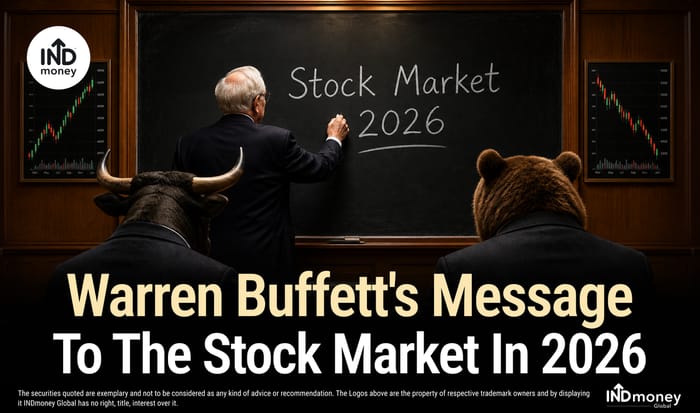
At the Berkshire Hathaway annual meeting on May 2, 2026, the most watched investor alive sat in the audience for the first time in 60 years and still managed to steal the show. Warren Buffett, now chairman emeritus, looked at the current US stock market and called it what many are reluctant to say out loud: a casino. "We've never had people in a more gambling mood than now," he said.
Let's break down what Buffett and Berkshire Hathaway have to say about where markets stand today, how the world's most admired conglomerate is positioned, and what it all means if you're an Indian investor watching US stocks.
When The Omaha Oracle Calls It A Casino, You Pay Attention
Buffett was not mincing words. When asked why Berkshire wasn't deploying capital despite the market volatility of 2026, he was direct. He specifically called out one-day options and prediction markets as behavior that has crossed the line from investing or even speculating into outright gambling.
This is not just colorful language from a 95-year-old. It is a signal rooted in decades of pattern recognition. The last time Buffett described markets in terms this cautious, the conditions that followed were not kind to investors who ignored him.
His benchmark for deploying capital is clear. He needs to see genuine fear, not a 10% pullback, but the kind of dislocated, panicked selling that happened in 2008 or during the Covid crash of March 2020. A volatile but fundamentally supported market does not meet that bar.
The $397 Billion Question Of Berkshire Hathaway
Here is the number that matters most. Berkshire ended Q1 2026 with a record $397.4 billion in cash and Treasury bills which is up from $373 billion just three months earlier. The company also posted operating earnings of $11.35 billion, up nearly 18% from a year ago, driven largely by a rebound in its insurance business.
The cash pile keeps growing because Berkshire keeps choosing not to spend it.
For context, Berkshire has not made a major acquisition since it bought Alleghany Corporation in 2022. That is four consecutive years of sitting on the sidelines. The company has also been a net seller of equities for multiple quarters running, trimming Apple and reducing its Bank of America stake.
Cash at this scale is not hesitation. It is a strategy. Buffett has built an institution that can move fast and move big when others cannot. The $397 billion is a loaded gun, not a parked car.
The Valuation Problem No One Wants to Talk About
Even after 2026's market volatility, the numbers do not flatter the bull.
The S&P 500 forward P/E ratio sits at approximately 21x which is well above its long-run historical average of 16x. That means you are paying a meaningful premium for future earnings that may or may not materialise in a tariff-heavy, rate-uncertain environment.
Then there is the Buffett Indicator; the ratio of total US stock market capitalisation to GDP. It currently reads around 227%. Buffett himself once said a reading above 200% is "playing with fire." At 227%, even a sharp correction might not be enough to bring valuations to levels where Berkshire's standard for buying is met.
What This Means For Indian Investors
If Buffett, with a $397 billion war chest, the best deal-flow access on the planet, and 60 years of pattern recognition, is choosing patience, that should prompt every investor to think carefully about what they are actually buying right now.
A few things worth anchoring on:
- A dip is not the same as a bargain: When valuations are stretched, a 10-15% fall still leaves you in expensive territory. The entry point matters enormously over a 5-10 year horizon.
- The dollar tailwind is real: The rupee's long-term depreciation against the dollar does add a return layer for Indian investors in US stocks.
- Watch what Berkshire does next: When Abel starts deploying that $397 billion, it will be one of the clearest signals the market has produced in years that valuations have finally come in. That is worth tracking.
What Can Still Work:
- SIP still works: Buffett's caution is about lump-sum deployment at today's prices, not about the logic of steady, regular investing. Dollar-cost averaging into quality US stocks or broad ETFs over time remains a sound approach for long-term Indian investors. Add the depreciating rupee dynamic to this averaging and it starts to make sense.
- Doing what Buffett is doing, doing nothing: If you’re someone who believes in lumpsump investment, going all in at stretched valuations will be counterproductive. Instead you can build your cash pile just like Berkshire, put it in US treasury ETFs, so that when valuations do seem right, you have your firepower ready.
Buffett is not predicting a crash. He is not telling anyone to exit. He is simply saying the current environment does not meet Berkshire's standard for committing capital at scale and that is as honest a market read as you will find anywhere.