

- Why The Middle East Conflict Matters For Chips
- Taiwan’s Energy Risk
- Industrial Gases And Materials Vulnerability: The Helium, Sulfur Angle
- AI Spending Boom Meets Supply Chain Reality
- Europe And Logistics Add Another Layer Of Risk
- Market Reaction And Investor Signals
- What Should Investors Watch?
- The Bigger Picture For Global Markets
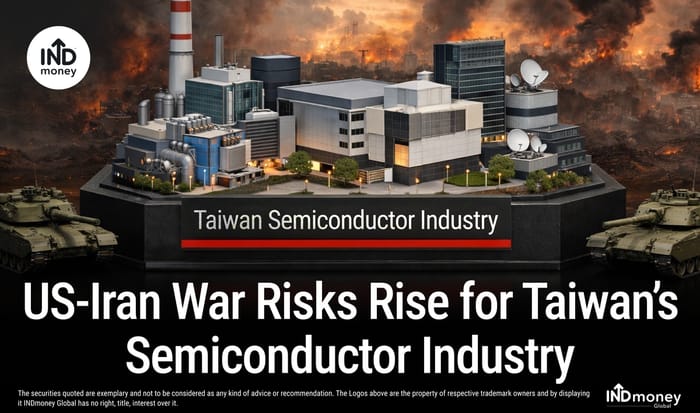
War risks are rising for the global semiconductor supply chain as the Middle East conflict stretches into a third week. The Strait of Hormuz; a 21-mile-wide chokepoint between Iran and Oman, has almost nothing to do with chipmaking on paper. Yet right now, the ongoing Middle East conflict and the effective closure of that strait since March 4, 2026, is threatening to disrupt the very heart of the global technology economy. Taiwan, which manufactures roughly 90% of the world's most advanced semiconductors through TSMC alone, runs on imported energy. And a significant chunk of that energy flows through the Strait. Any prolonged disruption to energy routes, industrial gases, or logistics could raise chip costs, slow AI infrastructure rollout, and ripple across global technology markets.
Let’s break down how the war could impact Taiwan’s chip dominance, global AI spending, and the broader tech economy.
Why The Middle East Conflict Matters For Chips
The semiconductor industry depends on a tightly coordinated global supply chain. Taiwan sits at the center of this system, producing nearly 90% of the world’s most advanced logic chips.
That dominance means geopolitical shocks that affect energy, materials, or shipping routes can quickly translate into higher technology costs worldwide. Analysts estimate the global semiconductor market could approach $1 trillion in annual sales this year, making even small disruptions economically significant.
Key concern: Taiwan’s chip ecosystem relies heavily on imported fuel and specialty gases that are partly sourced or routed through the Middle East.
Taiwan’s Energy Risk
Taiwan imports about 97% of its energy needs, with roughly one third of its liquefied natural gas linked to Middle Eastern suppliers. LNG is critical because semiconductor fabrication plants require uninterrupted power to maintain production yields.
Wood Mackenzie has flagged Taiwan as one of the most exposed LNG importers globally, and the numbers explain why.
Unlike South Korea or Japan, Taiwan’s LNG storage capacity is relatively limited.
- Taiwan LNG reserve: ~11 days
- South Korea LNG reserve: ~52 days
- Japan LNG reserve: ~21 days
This dependency makes supply disruptions or price spikes a direct threat to chip manufacturing economics.
Why it matters: Higher energy costs increase the price of producing advanced chips, which then feeds into AI infrastructure costs and consumer electronics pricing.
Industrial Gases And Materials Vulnerability: The Helium, Sulfur Angle
Beyond fuel, chip fabrication relies on rare gases and chemicals. One example is helium, which is used in semiconductor cooling and lithography processes. Qatar, which is currently offline after Iranian drone strikes hit its Ras Laffan industrial facilities, processes roughly a third of global helium supply. Europe sources roughly 40% of its helium from Qatar, and Taiwan faces similar exposure. Taiwan's government has said local companies can source helium from the US and Australia as alternatives, but analysts warn this isn't seamless.
Sulfur, another essential input, is a byproduct of oil and gas refining. Supply shocks in energy markets can therefore indirectly affect chipmaking inputs.
If shortages intensify, analysts warn that chipmakers may prioritize high margin AI chips over lower margin components. That could deepen shortages in sectors like automobiles and consumer electronics.
AI Spending Boom Meets Supply Chain Reality
US Technology companies are expected to invest roughly $650 billion in AI infrastructure this year. Much of that spending depends on advanced chips produced in Taiwan.
Demand already exceeds production capacity for AI accelerators. Any disruption could:
- Delay data center construction
- Increase cloud computing costs
- Slow AI product rollouts
This creates a feedback loop where geopolitical risk translates into technology inflation.
Bottom line: AI growth is increasingly constrained by physical supply chain limits, not just innovation cycles.
Europe And Logistics Add Another Layer Of Risk
Europe’s semiconductor ecosystem also depends on helium imports, with a significant portion sourced from the Middle East. While strategic reserves and diversified sourcing offer some buffer, logistics bottlenecks could emerge faster than material shortages.
For example, air cargo hubs in the Gulf region play a major role in semiconductor wafer transportation. Any sustained disruption could slow chip distribution even if production remains stable.
This highlights a broader reality: modern semiconductor supply chains are globally synchronized. Weakness in one region can disrupt the entire network.
Market Reaction And Investor Signals
Shares of leading chip manufacturers have already shown sensitivity to geopolitical developments. While companies have reassured investors about near term operations, market volatility reflects uncertainty about prolonged disruptions.
At the same time, the memory chip market is facing a historic supply crunch driven by AI demand. Rising energy and materials costs could intensify pricing pressure across the electronics industry.
Investor takeaway: Semiconductor supply risk is shifting from cyclical demand swings to structural geopolitical exposure.
What Should Investors Watch?
The situation is fluid and fast-moving. A few key indicators to track:
- LNG spot prices in Asia: Sustained prices above $20/mmbtu will force Taiwan into costly substitution strategies that hit chipmakers' margins.
- Duration of Hormuz closure: Wood Mackenzie's base case assumes disruptions last roughly two months, from mid-March to mid-May, with Qatari production gradually ramping back by end of May 2026, but contract prices linked to oil will keep rising through June.
- TSMC operational updates: Any announcement of production adjustments or power rationing at Taiwanese fabs would be a significant market signal.
The Bigger Picture For Global Markets
Semiconductors underpin everything from smartphones to electric vehicles and defence systems. Any disruption to Taiwan’s ecosystem would have far reaching consequences across industries.
This is why investors, governments, and corporations are closely monitoring geopolitical developments. The war’s duration, rather than its immediate impact, will likely determine how deep the supply chain shock becomes.
Disclaimer:
The content is meant for education and general information purposes only. Investments in the securities market are subject to market risks, read all the related documents carefully before investing. Past performance is not indicative of future returns. The securities quoted are exemplary and are not a recommendation. This in no way is to be construed as financial advice or a recommendation to invest in any specific stock or financial instrument. Readers are encouraged to verify the exact numbers and financial data from official sources such as company filings, earnings reports, and financial news platforms and to conduct their own research, and consult with a registered financial advisor before making any investment decisions. All disputes in relation to the content would not have access to an exchange investor redressal forum or arbitration mechanism. INDmoney Global (IFSC) Private Limited,Registered office address: Office No. 507, 5th Floor, Pragya II, Block 15-C1, Zone-1, Road No. 11, Processing Area, GIFT SEZ, GIFT City, Gandhinagar – 382355.