

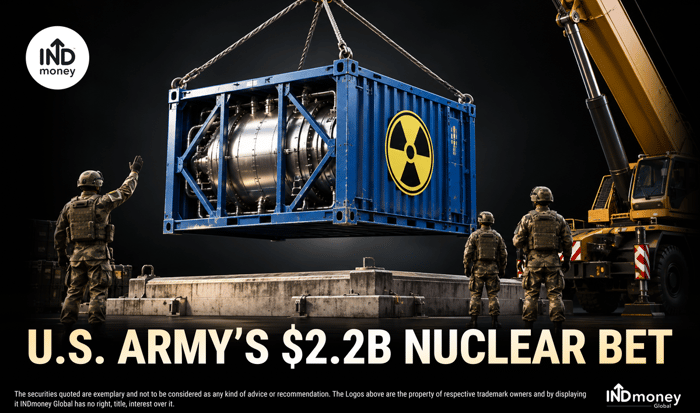
- What Is the U.S. Army’s $2.2B Janus Nuclear Program?
- Which Companies Won the U.S. Army’s Nuclear Microreactor Contracts?
- What Is a Nuclear Microreactor and How Does It Work?
- Why Does the U.S. Army Want Nuclear Microreactors on Military Bases?
- Why does the Janus Program matter more as an industrial policy than as a power project?
- Will the Army's microreactors change the U.S. electricity market?
- What does the U.S. Army nuclear push mean for natural gas and renewable energy?
- Why is the nuclear fuel supply chain the biggest bottleneck?
- Which nuclear stocks could benefit from the U.S. Army's $2.2 billion programme?
- How could Janus influence global nuclear energy markets?
- What could go wrong with the U.S. Army's nuclear plan?
- What should investors track next?
- Author's take
The U.S. Army is preparing to spend up to $2.2 billion on nuclear microreactors, but the biggest impact may not come from the electricity these reactors generate. It may come from something the advanced nuclear industry has struggled to secure for years: a credible first customer willing to pay for development, deployment and real-world operating experience.
The Janus Program will support more than 20 contractor-owned and operated microreactors across U.S. military installations. That is meaningful for reactor developers and the nuclear supply chain. However, it is still far too small to materially change U.S. electricity generation, natural gas demand or uranium consumption in the near term.
Let's break down what the Army has announced, how nuclear microreactors work, which companies stand to benefit and why this relatively small power programme could still influence the global nuclear market.
What Is the U.S. Army’s $2.2B Janus Nuclear Program?
On August 26, 2026, the U.S. Army selected five nuclear technology companies and paired each with an initial military installation. The Army and the Defense Innovation Unit, or DIU, can award the companies up to a combined $2.2 billion across fiscal years 2027 to 2031.
This is not a $2.2 billion cheque being paid immediately. It is a maximum programme value spread over five fiscal years. Payments are linked to technical milestones and vendors must contribute private capital. The reactors will also remain owned and operated by the contractors rather than the Army.
| Janus Program detail | What has been confirmed |
| Maximum government funding | Up to $2.2 billion |
| Funding period | FY2027 to FY2031 |
| Expected deployment | More than 20 microreactors across Department of War installations |
| Payment structure | Milestone-based payments after technical targets are achieved |
| Ownership model | Contractor-owned and operated |
| Private funding | Significant vendor capital expected alongside government funding |
| First major deadline | At least one Army-regulated reactor operating by September 30, 2028 |
The difference between a programme ceiling and recognised revenue is important. Each company must first complete agreed technical, regulatory, site and construction milestones. If milestones are delayed or funding is not appropriated, the full $2.2 billion may never be paid.
Which Companies Won the U.S. Army’s Nuclear Microreactor Contracts?
The Army selected a mix of established nuclear contractors and privately held start-ups. Their technologies also differ substantially in size, fuel, cooling systems and expected deployment schedules.
| Company | Initial installation | Reactor or technology | Planned output or disclosed feature | Publicly investable exposure |
| Antares Nuclear | Fort Bragg, North Carolina | TRISO-fuelled factory-built microreactor | Mark-0 reached first criticality in June 2026 | Private company |
| BWXT Advanced Technologies | Fort Campbell, Kentucky | BWXT Advanced Nuclear Reactor, or BANR | 20 MWe for Janus, four-year refuelling cycle | Direct exposure through BWX Technologies stock |
| General Atomics Electromagnetic Systems | Fort Hood, Texas | GA Tactical Energy System | About 5 MWe baseline, scalable to around 20 MWe | Private company |
| Radiant Industries | Fort Benning, Georgia | Kaleidos | 1 MWe, up to five years before refuelling | Private company |
| Westinghouse Government Services | Fort Drum, New York | eVinci microreactor | 5 MWe and eight or more full-power years before refuelling | Indirect exposure through Cameco and Brookfield Renewable Partners |
Radiant disclosed the most detailed award. Its binding agreement is worth up to $750 million for the development and deployment of 15 Kaleidos reactors by 2030. That represents about 34% of the entire Janus ceiling.
Dividing $750 million by 15 produces a headline value of up to $50 million per reactor. Investors should not treat that as a simple construction cost. The contract includes development, manufacturing, deployment and operating obligations. It also uses milestone-based payments. It therefore cannot be compared directly with the cost per megawatt of a mature gas, solar or nuclear power plant.
The exact Janus values for Antares, BWXT, General Atomics and Westinghouse had not been publicly disclosed as of September 7, 2026. It would be incorrect to assume that the remaining $1.45 billion will be divided equally among them.
What Is a Nuclear Microreactor and How Does It Work?
A nuclear microreactor is a compact reactor that is generally designed to be manufactured largely in a factory, transported to the customer and installed with much less site construction than a conventional nuclear plant.
Most concepts target specialised users that value reliable on-site power more than the lowest possible wholesale electricity price. Military bases, remote mines, isolated communities, data centres and disaster-response facilities are natural early customers.
| Feature | Nuclear microreactor | Large conventional nuclear reactor |
| Typical scale | Roughly 1 MW to 20 MW, depending on whether output is measured as electricity or heat | Often around 1,000 MW or more of electricity |
| Construction approach | Factory fabrication with modular site installation | Large project built mainly at the site |
| Main use | On-site power, isolated microgrids, defence and remote industry | Bulk electricity supplied to a regional grid |
| Refuelling interval | Several years for many proposed designs | Usually every 18 to 24 months for part of the core |
| Cooling | Several designs avoid large water-cooling systems | Most existing large reactors require substantial cooling systems |
| Commercial maturity | Early demonstration and deployment stage | Established global operating industry |
The simplest way to understand the difference is to compare a central railway station with a specialised shuttle. A large reactor is designed to move enormous volumes through the main grid. A microreactor is designed to deliver a smaller amount of dependable power exactly where a critical customer needs it.
Small does not automatically mean cheap. A microreactor may cost more per unit of electricity than a large power plant. Its value comes from avoiding grid outages, diesel deliveries, long transmission connections and the financial cost of interrupted operations.
Why Does the U.S. Army Want Nuclear Microreactors on Military Bases?
Modern military installations depend on data processing, communications, air defence systems, radar, autonomous equipment and secure computing. A prolonged grid failure can therefore become an operational problem rather than a normal power outage.
The Army is pursuing microreactors for four main reasons.
Reliable power during grid disruptions
A base can remain connected to the commercial grid during normal conditions but use on-site nuclear power to protect critical loads if the grid is disrupted by extreme weather, physical attack or a cyber incident.
Less dependence on delivered fuel
Diesel generators are useful for short emergencies, but prolonged operation requires a continuous fuel supply. A microreactor can potentially operate for several years before refuelling. That reduces the logistical burden at remote or strategically important locations.
Continuous electricity for high-density loads
Nuclear reactors can operate day and night. This makes them suitable for facilities that need continuous power rather than power that varies with weather conditions. Microreactors can also be combined with solar, wind and batteries inside a local microgrid.
A domestic test market for U.S. nuclear technology
The Army is not only buying electricity. It is helping vendors establish manufacturing lines, regulatory knowledge, supply chains and operating records. If the reactors work reliably on military bases, the same designs could become easier to sell to data centres, mines, utilities and overseas customers.
This fourth objective is the most important one for investors.
Why does the Janus Program matter more as an industrial policy than as a power project?
The advanced nuclear industry faces a difficult financing loop.
Customers hesitate to order a first-of-a-kind reactor because its cost and performance are uncertain. Investors hesitate to fund manufacturing capacity without firm customer orders. Suppliers hesitate to expand fuel and component production without visibility into reactor demand.
Janus attempts to break this loop by putting the federal government in the role of an early customer. This is why the programme can matter even if its electricity output remains small. It transfers part of the first-deployment risk from private customers to the government while still forcing vendors to invest their own capital and achieve milestones before receiving payments.
The model also encourages competition. The Army selected five different vendors rather than betting the entire programme on one design. Underperforming technologies may fail to progress, while stronger designs can receive follow-on deployments.
Will the Army's microreactors change the U.S. electricity market?
Not in the near term.
The United States generated about 4,430 TWh of electricity in 2025. Even an optimistic illustration shows how small Janus is relative to the national grid.
| Illustrative scenario | Nameplate capacity | Annual generation at a 90% capacity factor | Share of 2025 U.S. generation |
| 20 reactors averaging 5 MW each | 100 MW | About 0.79 TWh | About 0.018% |
| 20 reactors at 20 MW each | 400 MW | About 3.15 TWh | About 0.071% |
These are simple scale illustrations, not Army forecasts. The actual fleet will contain different reactor sizes and the final number of units is expected to exceed 20. Still, the conclusion is clear. Janus is not large enough to move national electricity prices or displace a meaningful amount of natural gas generation by 2030.
At the individual base level, the impact can be far more important. A 20 MW reactor operating at a 90% capacity factor can produce roughly 158 GWh in a year. That may be enough to support a substantial portion of a military installation's critical electricity demand without relying entirely on the external grid.
What does the U.S. Army nuclear push mean for natural gas and renewable energy?
The programme is not a direct threat to U.S. natural gas demand. Natural gas supplied about 40% of U.S. electricity in 2025 and remains the country's largest power source. Janus capacity is simply too small to change that balance.
Microreactors could, however, compete with diesel generation and smaller gas systems in remote or high-reliability applications. The relevant comparison is not always the average wholesale electricity price. It is the total cost of dependable power after including fuel transport, backup systems, transmission upgrades and the economic damage from an outage.
Renewable energy is not necessarily displaced either. A military microgrid can combine continuous nuclear output with low-cost solar or wind generation and batteries. Nuclear can provide a steady foundation while batteries and other sources respond to short-term fluctuations.
The likely near-term result is therefore a more diversified on-site energy system rather than a nuclear replacement of the wider grid.
Why is the nuclear fuel supply chain the biggest bottleneck?
Many advanced reactors need high-assay low-enriched uranium, or HALEU. Conventional U.S. commercial reactors generally use uranium enriched to below 5% uranium-235. HALEU is enriched above 5% and below 20%, allowing developers to design smaller cores that can operate for longer periods.
The problem is availability. The U.S. Department of Energy said in July 2026 that HALEU was not yet available from domestic suppliers at commercial scale. The government has therefore been allocating material from federal inventories while funding new domestic enrichment capacity.
In January 2026, the Energy Department finalised two HALEU enrichment task orders of up to $900 million each with American Centrifuge Operating, a Centrus subsidiary and privately held General Matter. These awards sit inside a broader $2.7 billion federal effort to rebuild domestic low-enriched uranium and HALEU infrastructure.
For investors, this creates a second layer to the Janus opportunity. Reactor developers cannot scale without fuel. Enrichment, fuel fabrication and specialised nuclear manufacturing may therefore gain demand visibility before the reactors generate meaningful electricity.
Centrus Energy is the clearest listed HALEU exposure. Its Q2 2026 revenue increased 14% year on year to $176.1 million and total backlog reached $4.5 billion, including contingent commitments. However, the company also said the proposed FY2027 federal budget did not include further funding for options under an older HALEU operating contract representing about $0.8 billion of Technical Solutions backlog.
That is a useful warning. Government support can create enormous opportunity, but programme priorities and appropriations can change.
Which nuclear stocks could benefit from the U.S. Army's $2.2 billion programme?
Investors should separate direct contract winners from indirect beneficiaries and companies that merely operate in the same theme.
| Listed company | Link to Janus | Financial position as of September 7, 2026 | Investor interpretation |
| BWX Technologies, BWXT | Direct winner through BANR at Fort Campbell | Share price $157.59, market value about $14.5 billion and trailing P/E about 40.7 times | Clearest listed direct beneficiary, but high expectations are already embedded in valuation |
| Cameco, CCJ | Owns 49% of Westinghouse | Share price $100.74 and market value about $43.8 billion | Gains indirect exposure to eVinci plus uranium and fuel services, but Janus alone is small relative to Cameco |
| Brookfield Renewable Partners, BEP | Brookfield-led investors own 51% of Westinghouse | Share price $31.41 | Indirect and diluted exposure through a diversified renewable and infrastructure platform |
| Centrus Energy, LEU | Potential fuel-chain beneficiary, not a disclosed Janus reactor awardee | Share price $173.89, market value about $3.8 billion and trailing P/E about 90 times | Strong HALEU leverage with substantial execution, capital and policy risk |
| Oklo, OKLO | Was eligible under the earlier ANPI process but was not selected for these five Janus sites | Share price $41.27 and market value about $7.3 billion | Janus supports the sector narrative, but it is not a direct award for Oklo |
The U.S. stock market was closed for Labor Day on September 7, 2026. The prices above therefore reflect the September 4 close, the latest completed trading session available on the research cut-off date.
Investors looking at the broader opportunity can also compare companies through INDmoney's nuclear energy stocks page. However, a thematic connection is not the same as contract revenue.
BWX Technologies is the clearest direct listed beneficiary
BWXT already has an established nuclear manufacturing and defence business. Its Janus selection is therefore an extension of existing capabilities rather than a complete change in business model.
The company plans to deploy a 20 MWe BANR at Fort Campbell. Its first phase includes site work, Army regulatory activity, TRISO fuel fabrication and supply-chain preparation. BWXT is targeting site construction in late 2028 and reactor operations in the early 2030s. This means BANR is unlikely to be the reactor that satisfies the September 2028 deadline.
BWXT's Q2 2026 results provide useful context.
| BWXT metric | Latest disclosed figure |
| Q2 2026 revenue | $901.6 million, up 18% year on year |
| 2026 revenue guidance | About $3.8 billion |
| 2026 adjusted EBITDA guidance | $662 million to $672 million |
| 2026 adjusted EPS guidance | $4.70 to $4.80 |
| 2026 free cash flow guidance | $345 million to $360 million |
| Backlog at June 30, 2026 | $8.4 billion |
At $157.59, the stock traded at roughly 33 times the midpoint of management's 2026 adjusted EPS guidance. Its guided free cash flow yield was about 2.4%, calculated using the midpoint of $352.5 million against a market value of around $14.5 billion.
That is not a cheap valuation. It suggests investors already expect years of growth from naval nuclear work, commercial reactor services and advanced nuclear programmes. Janus strengthens the long-term case but the undisclosed value and distant operating timeline make it difficult to justify a major change in near-term earnings estimates.
BWXT shares rose about 5.1% on August 27 after the Janus announcement. Part of that move may also have reflected a Wall Street rating upgrade issued at roughly the same time. By the September 4 close, the last U.S. trading session before Labor Day, the stock stood at $157.59, around 35% below its 52-week high.
Cameco offers broader nuclear exposure through Westinghouse
Cameco owns 49% of Westinghouse, while a Brookfield-led group owns the remaining 51%. That makes Cameco an indirect beneficiary of the eVinci deployment at Fort Drum.
The case for Cameco is broader than this one contract. It sells uranium, operates fuel-services businesses and participates in Westinghouse's reactor technology and service earnings. In Q2 2026, Cameco's share of Westinghouse adjusted EBITDA was $163 million, compared with $352 million a year earlier. The decline largely reflected an unusually large contribution in Q2 2025 from the Dukovany reactor project.
Westinghouse has also confidentially filed for a potential initial public offering and received conditional federal financing support linked to large AP1000 reactors. Janus adds another proof point for its smaller eVinci platform, but investors should not confuse a microreactor award with the much larger economics of full-scale AP1000 projects.
Centrus could benefit if HALEU demand moves from plans to purchase contracts
Centrus is not building a Janus reactor. Its exposure sits upstream in enrichment. If military, data-centre and industrial reactor projects move forward, developers will need long-term fuel contracts.
The upside is strong operating leverage to a scarce domestic capability. The risk is that the company must invest heavily before the scale, timing and price of future demand become certain. At around 90 times trailing earnings and roughly eight times the midpoint of 2026 revenue guidance, the market was already assigning substantial value to future enrichment growth as of September 7.
Oklo is a sector beneficiary, not a Janus contract winner
Oklo stock is often grouped with advanced nuclear companies. Oklo was among eight companies found eligible for the earlier Advanced Nuclear Power for Installations programme in April 2025. It was not included in the five vendors selected for the initial Janus sites in August 2026.
The broader government push may improve regulatory pathways, fuel availability and customer confidence across the sector. Still, investors should not label Oklo a direct beneficiary of this $2.2 billion award without a separate contract announcement.
How could Janus influence global nuclear energy markets?
The global effect will depend on whether the Army creates a repeatable commercial product rather than a collection of expensive prototypes.
U.S. vendors could gain export credibility
Countries considering microreactors for remote communities, mines, islands and critical infrastructure will want evidence that the technology works outside a laboratory. Several years of safe military operation could provide a valuable reference case.
The White House's May 2025 executive order also directed the U.S. government to promote advanced nuclear exports and pursue additional civil nuclear cooperation agreements. Janus supports that strategy by giving domestic technologies an operational platform.
Factory manufacturing could become more important than project construction
Large reactors are typically site-specific megaprojects. Microreactor developers want to build standardized units repeatedly in factories. If Radiant can manufacture and deploy 15 identical units, it will test whether nuclear power can develop a production learning curve closer to industrial equipment than traditional plant construction.
This is still unproven. Cost reductions require genuine standardisation, repeat orders and high factory utilisation. A government-funded first fleet does not guarantee competitive commercial economics.
Fuel security will become part of national energy policy
The race is not only about reactor designs. It also includes uranium mining, conversion, enrichment, TRISO fuel fabrication, specialised components and waste management. Nations that cannot secure these inputs may remain dependent on foreign suppliers even if they own the reactor technology.
The International Energy Agency expects global electricity demand to grow at an average annual rate of 3.6% between 2026 and 2030. It also expects nuclear generation to continue setting records through 2030. Janus is one small part of a much wider shift in which governments are treating nuclear capacity and fuel supply as strategic infrastructure.
What could go wrong with the U.S. Army's nuclear plan?
The 2028 deadline is aggressive
President Trump's executive order requires an Army-regulated reactor to begin operating at a domestic military installation by September 30, 2028. Advanced reactors still face design, fuel, manufacturing, site, safety and construction risks. BWXT's own target of early-2030s operations shows that not every selected project is aligned with the first deadline.
The full $2.2 billion may not become vendor revenue
Awards depend on milestone completion and future government funding. Programme ceilings are not guaranteed payments, while Other Transaction Authority agreements can be modified or terminated.
Commercial licensing remains a separate challenge
The Army can regulate reactors used for military purposes under the national-security framework. A reactor that later supplies ordinary commercial customers may still need to satisfy Nuclear Regulatory Commission requirements. Military deployment can generate useful data, but it does not automatically provide a commercial licence.
HALEU supply remains constrained
Domestic commercial HALEU production is still being built. Delays in enrichment plants, fuel fabrication or federal material allocations could slow reactor schedules even when the reactor design itself is ready.
Waste, security and local acceptance cannot be ignored
Vendors must establish credible plans for transport, physical security, refuelling, spent fuel and eventual site restoration. A serious safety or security failure in an early project could affect the entire sector.
Nuclear valuations already assume substantial growth
Several listed nuclear companies trade at high earnings multiples or have limited current revenue. When a valuation depends mainly on projects several years away, delays can have a much larger effect on the share price than on the underlying long-term market opportunity.
What should investors track next?
The announcement is only the starting point. The most useful indicators will be evidence of execution.
- The exact contract values and milestone schedules disclosed by each vendor.
- Which reactor is selected to meet the September 2028 operating deadline.
- Successful criticality and full-power testing at Department of Energy facilities.
- Firm HALEU supply and TRISO fuel-fabrication agreements.
- Site preparation, environmental reviews and local approvals.
- Private capital invested alongside Army funding.
- Follow-on orders from the Army, Air Force, data centres, utilities or industrial customers.
- Commercial cost disclosures, including expected electricity prices and operating expenses.
- Progress toward NRC licensing for non-military deployments.
- Whether early units operate reliably for long periods rather than only completing short demonstrations.
Author's take
The $2.2 billion Janus Program should not be viewed as a near-term shock to global energy supply. Even under generous assumptions, the initial reactors would produce less than one-tenth of 1% of annual U.S. electricity. Natural gas prices, utility earnings and national uranium consumption will not move materially because of these installations alone.
The real investment significance is that the Army is paying to turn advanced nuclear designs into operating products.
That makes Janus most valuable as a commercialisation bridge. It can fund factories, train operators, create a safety record and show potential customers that microreactors can function outside a test site. If those achievements lead to repeat orders from data centres, mines, remote grids and allied governments, the follow-on market could be much larger than the original Army programme.
Among listed companies, BWXT has the clearest direct exposure and the strongest existing earnings base. Cameco offers a broader nuclear value-chain position with indirect exposure through Westinghouse. Centrus has potentially powerful leverage to the fuel bottleneck, but it also carries greater execution and valuation risk. Oklo may benefit from the wider policy environment, but it is not a winner of the five initial Janus awards.
The most important question is therefore not how many megawatts the Army buys. It is whether the Army can help five competing technologies cross the gap from promising prototypes to reliable, repeatable and commercially financeable products. If it can, Janus may have a much larger impact on the global nuclear industry than its initial electricity output suggests.