

- Why Nvidia, Apple and AMD Depend on TSMC
- The Moat: By the Numbers
- Why TSMC Has No Real Competition Right Now
- Why TSMC Is Warning Investors About Memory Pricing
- TSMC vs Memory Stocks: Which AI Bet Looks Stronger?
- TSMC Positioning for the Next Wave of AI Hardware
- Key Takeaway for TSMC, Other AI Stock Investors
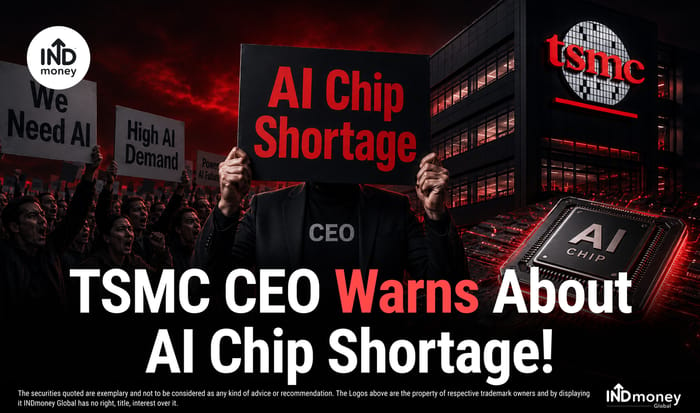
The world's most important semiconductor company is completely sold out. TSMC CEO C.C. Wei stood before shareholders in Hsinchu, Taiwan, on June 3, 2026, and made something clear. Even with a $165 billion factory build-out underway in the United States, the largest foreign direct investment in American history, TSMC still cannot make enough chips to satisfy the demand that AI is creating.
Wei reiterated a 30%+ revenue growth forecast for 2026 and said the supply gap would persist "for years." But the sharpest moment in his entire address wasn't about supply. It came when someone asked him about prices. And what he said next is something every investor holding memory stocks needs to sit with.
Let's break down why TSMC's moat is unlike anything else in technology, what Wei's pricing comment is actually signalling, and how this shapes the semiconductor investment picture heading into the second half of 2026.
Why Nvidia, Apple and AMD Depend on TSMC
Nvidia doesn't manufacture GPUs. Apple doesn't build its own chips. AMD, Qualcomm, Broadcom, none of them own a fabrication plant. They design chips and send those designs to contract manufacturers. At the bleeding edge of semiconductor technology, that means one company: TSMC.
Think of it like this, if chip companies are architects, TSMC is the only contractor in the world who can actually build their skyscrapers. You want to make an AI accelerator that trains GPT-class models? You go to TSMC. There is no plan B.
The Moat: By the Numbers
| Metric | Data |
| TSMC Global Foundry Market Share (2025) | ~70% |
| Samsung Foundry Market Share (2025) | ~7% (falling) |
| TSMC 2025 Revenue | $122.5 billion (+36% YoY) |
| Q1 2026 Net Income Growth | +58% YoY |
| HPC/AI as % of Revenue (Q1 2026) | 61% |
| 2026 Revenue Guidance | 30%+ |
| 2026 Capex | $52–56 billion |
Source: TSMC Earnings, TSMC AGM, TrendForce, TSMC Investor Relation
Samsung's foundry share has slipped from 9% to around 7% over the past year, even as TSMC's climbed. Intel Foundry is targeting competitive yields by 2027 at the earliest. The gap is not narrowing. TSMC's advanced nodes, 3nm and now 2nm in volume production, have no real competition today.
AI-related high-performance computing (HPC) went from 51% of TSMC's revenue in 2024 to 58% in 2025 to 61% in Q1 2026. That’s a structural shift with momentum.
Why TSMC Has No Real Competition Right Now
TSMC is hard to challenge because its moat is not just technology, but execution at scale.
A leading-edge fab costs tens of billions of dollars, takes years to build, and only matters if yields are high enough for customers to trust it. This is critical for AI chips, which are large, expensive and difficult to manufacture.
The AI shift is already visible. HPC/AI rose from 51% of TSMC’s revenue in 2024 to 58% in 2025 and 61% in Q1 2026. As Nvidia, AMD, Broadcom, Apple and hyperscalers rely more on TSMC, the relationship becomes deeper and harder to replace.
That is why Samsung or Intel cannot quickly catch up. The challenge is not just building advanced chips, but matching TSMC’s scale, yields, packaging ecosystem and customer trust while AI demand is exploding. Right now, there is no real alternative.
Why TSMC Is Warning Investors About Memory Pricing
When asked whether TSMC could raise chip prices to protect margins, Wei said: "I'd like to do that... we still need to make money." Reasonable enough. But the next sentence is the one that matters for investors. "We don't want to suddenly raise prices like memory companies do. That's not sustainable."
That was a deliberate statement. TSMC has already planned gradual annual price hikes of 3–15% across advanced nodes through 2029, controlled, technology-led increases tied to genuine demand, not supply manipulation. Memory companies did something entirely different.
In 2025, NAND producers including SanDisk, Samsung, Micron, and SK Hynix coordinated output cuts that sent NAND prices up by over 200% within months, with Kingston reporting a 246% surge since the start of 2025. The result was parabolic stock returns. But Wei called it exactly what it is: unsustainable. Memory pricing is notoriously cyclical. When hyperscalers diversify suppliers, or when production ramps back up, those margin spikes compress, fast.
TSMC vs Memory Stocks: Which AI Bet Looks Stronger?
| TSMC (TSM) | Memory (MU / SNDK / WDC) | |
| Growth Driver | Structural AI compute demand | AI demand + coordinated supply cuts |
| Pricing Strategy | Gradual, technology-led (3–15% annual) | Cycle-driven, volatile (200%+ spikes) |
| Competition Risk | Very low at advanced nodes | Multiple global players (Samsung, SK Hynix, Kioxia) |
| 1-Year Stock Return | ~140% | 1,000%–4,500%+ |
| Sustainability | High — structural demand | Cyclical — pricing can reverse sharply |
| Wei's View | Our own model | "Not sustainable" |
SanDisk is up over 4,400% in the past year after spinning off from Western Digital. Micron has gained nearly 1,000%. These are extraordinary numbers. But part of that return was built on price hikes that Wei explicitly flagged as the wrong approach. Investors entering these names today are effectively betting the cycle has no end. That is a bold bet.
TSMC Positioning for the Next Wave of AI Hardware
Beyond AI, Wei identified autonomous vehicles and robotics as major long-term demand drivers that TSMC is actively investing to support. These aren't distant possibilities, they represent the next wave of compute-intensive hardware that will require leading-edge nodes. TSMC's customer base doesn't just sustain. It expands.
Key Takeaway for TSMC, Other AI Stock Investors
In the last three years, TSMC stock has rallied nearly 350%, according to Google Finance. INDmoney data shows that Indian investor interest in TSMC is accelerating sharply. Investments in the stock from the platform rose 65.62% in the last 30 days, while search interest jumped 113%..
For investors, TSMC is the infrastructure layer behind the AI trade. Nvidia, AMD, Apple, Broadcom and hyperscalers may design the chips, but TSMC manufactures them at scale. That gives TSMC a rare advantage: it benefits from overall AI chip demand, not just one winner in GPUs, cloud or AI models.
However, a key risk investors cannot ignore is concentration risk, both geopolitical and customer-related. TSMC’s most advanced manufacturing capacity is still heavily concentrated in Taiwan, exposing it to China-Taiwan tensions and supply-chain disruption risks. At the same time, hyperscalers like Amazon, Google and Microsoft are increasingly designing their own AI chips to reduce dependence on Nvidia.
While these companies still rely on TSMC to manufacture those chips today, greater in-house chip development could eventually increase customer bargaining power and reduce dependence on any single AI chip vendor.
Long Story Short: TSMC investors should track valuation and geopolitics, Nvidia and AI chip investors should track TSMC’s capacity and pricing, and memory stock investors should remember Wei’s warning: AI demand may be structural, but memory pricing spikes can reverse quickly.