

- Why SK Hynix's Nasdaq IPO Matters for AI Memory Investors
- Will SK Hynix's Nasdaq Listing Reduce Micron's Scarcity Premium?
- SK Hynix vs Micron: Revenue, Valuation and Market Share Compared
- SK Hynix vs Micron: Analyst Views & Bull vs Bear Cases
- SK Hynix vs Micron: Which Stock Offers Better Value?
- 5 Key Risks for SK Hynix, Micron and AI Memory Stocks
- Should Investors Buy SK Hynix or Micron After SKHY Nasdaq Debut?
- Final Verdict: SK Hynix or Micron - The Better AI Memory Bet?
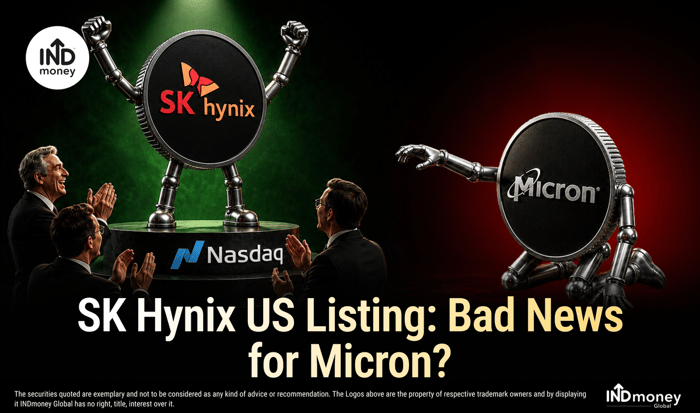
SK Hynix made its Nasdaq debut today, July 10, 2026. The stock jumped 14% on listing and the memory giant raised $26.5 billion, making it the second-largest US listing in history after SpaceX. The company had priced its American Depositary Shares (ADS) at $149 apiece on a book that was demanded at 7 times the available supply. SK Hynix stock began trading under the temporary ticker symbol SKHYV, before entering regular trading under SKHY beginning Monday.
The ADR priced at a 2.7% premium to SK Hynix's Seoul stock average, which is notable because foreign listings normally need a discount to attract buyers. Institutions including Baillie Gifford, Coatue, and Situational Awareness Partners alone signaled up to $7 billion in demand. And yet, Micron (MU), the stock supposedly most threatened by SK Hynix finally becoming directly buyable, rose 4.52% and SanDisk jumped 7.6%.
Let's break down why this is happening, what the SK Hynix listing actually does and does not change for existing memory investors, how the two stocks compare side by side at current valuations, and what memory stock investors should do with this development
Why SK Hynix's Nasdaq IPO Matters for AI Memory Investors
High-Bandwidth Memory (HBM) is the chip category that has turned SK Hynix, Micron, and SanDisk into some of the most talked-about stocks in the world. Standard computer memory sends data through a shared highway. HBM builds a dedicated express lane directly next to the processor, stacking memory dies vertically and connecting them through silicon vias. Every Nvidia GPU powering today's AI data centers runs on it. There is no alternative at scale.
And only three companies on the planet manufacture it at scale: SK Hynix, Samsung, and Micron. Of those three, SK Hynix was first to mass-produce HBM3, first with HBM3E, and as of Q1 2026, the holder of 56.4% of global HBM revenue, per IDC data cited directly in SK Hynix's own SEC F-1 filing. Micron holds roughly 20-25%.
Here is where the access problem comes in, and why it matters for understanding today's event. For the past three years, if an American investor wanted to own the HBM leader directly, they could not. SK Hynix's primary listing was on the Korea Exchange in Seoul. You could technically access it through thin OTC ADRs or a South Korean ETF like EWY and FLKR listed in the US, but the combination of currency settlement friction, limited US analyst coverage, and index exclusion kept it out of most US portfolios.
So Micron, the 3rd-largest HBM player by market share, became the de facto proxy for anyone who wanted pure-play HBM exposure in the US market. SK Hynix's Nasdaq listing has now given investors the opportunity to go for the HBM market leader directly.
Will SK Hynix's Nasdaq Listing Reduce Micron's Scarcity Premium?
The cleanest way to read this is through the Proxy Sunset Test. When a stock is bought mainly because it is the only easy way to invest in a theme, it carries two types of value:
- Fundamental value from the actual business
- Scarcity value from being the only listed proxy for that theme
For Micron, the fundamental story is still strong. Investors were paying up to 13x forward earnings on June 22, but that was not purely hype. Micron reported $41.5 billion in Q3 FY2026 revenue, up 346% year over year, with record gross margins of 84.9% and non-GAAP EPS of $25.11. It also guided Q4 revenue to $50 billion, with gross margins of around 86%.
The demand base also remains solid. Micron has signed 16 non-cancelable Strategic Customer Agreements worth about $22 billion in upfront commitments. It is the primary memory and storage supplier for Anthropic’s next-generation AI models and has committed over $250 billion to US manufacturing expansion through 2035. It also started construction at its New York fab this week.
But Micron also had a scarcity premium. For many investors, it was the only large-cap, liquid, US-listed way to invest in the HBM supply chain. That premium is now fading. Micron is down 22% from its post-Q3 earnings high of around $1,213 per share. The key question is whether this fall reflects a weaker earnings story or simply the market removing that scarcity premium.
At $991, with 45 analysts still rating the stock Buy and an average target of $1,486, consensus suggests the selloff may have gone too far. But in a cycle this hot, that consensus still deserves caution.
SK Hynix vs Micron: Revenue, Valuation and Market Share Compared
Here is a clean head-to-head comparison as of July 10, 2026:
| Metric | Micron (MU) | SK Hynix (SKHY) |
| Price (July 10, 2026) | $991.64 per share | $149 per ADS |
| HBM Market Share (Q1 2026) | ~20-25% | 56.4% |
| DRAM Market Share (Q1 2026) | ~25% | 29.1% |
| NAND Market Share (Q1 2026) | -- | 18.5% |
| Latest Quarter Revenue | $41.5B (Q3 2026, record) | $34.9B (Q1 2026, record) |
| Latest Quarter Operating Margin | 84.9% gross (record) | 72% operating (record) |
| Latest Quarter Net Profit | ~$27.9B* | $26.7B |
| Forward P/E | ~7x | ~6.2x |
| 2026 Full-Year Revenue (Est) | ~$130B | ~$231B |
| 2026 Full-Year Net Income (Est) | ~$83B | ~$144B |
| US Manufacturing Presence | Yes | No |
| Past 12-Month Return (stock) | ~711% | ~650% (Seoul-listed) |
(1 ADS = 1/10 common share) | *derived from $25.11 non-GAAP EPS
Sources: SK Hynix SEC F-1/A filing IDC data, Earnings releases, Fortune, Reuters/LSEG.
SK Hynix has nearly 2.5x more HBM market share than Micron, generates more total revenue and net income on an annual basis, and yet trades at a lower forward earnings multiple. This is the Korea Discount in numbers, a valuation gap that existed because most US investors simply could not access the Seoul listing without friction.
The thesis behind buying SKHY at $149 is not about earnings growth. It is about discount repair. If SK Hynix's multiple closes toward Micron's 7x forward PE from its current 6.2x, that alone is roughly 13% upside from the IPO price before any fundamental improvement. The complication for Micron is the reverse math. If SK Hynix's premium closes toward Micron from the bottom, Micron's premium can only move in one direction to meet it.
SK Hynix vs Micron: Analyst Views & Bull vs Bear Cases
Few large-cap stocks attract this wide a range of serious analyst opinions. The bull-bear spread on Micron alone spans $400 to $1,550, a range so wide that it effectively tells you the cycle debate is unresolved, not that the stock is mispriced.
| Analyst / Firm | Stock | View | Price Target | Core Argument |
| Vivek Arya, BofA Securities | MU | Buy | $1,550 | Memory is now 35-40% of cloud AI capex; recent pullback is "healthy reset, not structural change in AI demand" |
| UBS (Consensus) | MU | Positive | ~ $1,486 | Pullback is temporary; 16 non-cancelable SCAs provide earnings visibility; fundamentals intact |
| Goldman Sachs | MU | Bearish | ~$400 | Memory remains cyclical; 84.9% gross margins are a peak, not a floor; synchronized capex expansion will compress pricing |
| 24/7 Wall St | MU | Sell | $749.68 | Valuation vs. memory cycle history; risk-reward skews negatively from current levels; 33.89% implied downside |
| Michael Burry | MU | Short | Undisclosed | 13F disclosed short position; classic bubble-valuation thesis on cyclical overextension |
| Di Zhou, Thornburg Investment Mgmt | SKHY | Positive | N/A | Direct, frictionless exposure to one of the most compelling AI memory cycle plays |
| Giuseppe Sette, Reflexivity | SKHY | Positive | N/A | Purest large-cap way for US investors to own the AI-memory theme; companies coming after it may face tougher conditions |
| Kim Forrest, Bokeh Capital (owns MU) | SKHY | Sits out | N/A | Plans to skip SKHY due to ADR governance discrepancies; maintains Micron position |
| Matt Kennedy, Renaissance Capital | SKHY | Measured | N/A | "Oversupply fears are inherent to the industry; investors will weigh the rally against recent volatility" |
| Thomas Hayes, Great Hill Capital | Both | Cautious | N/A | Global semiconductors is the most crowded trade in the world right now; bankers and issuer are meeting demand where it is |
The 45-analyst Buy consensus on Micron at an average $1,486 target implies approximately 50% upside from current prices. But Goldman's $400 bear case, grounded in the historical mechanics of memory cycles, sits at exactly 60% downside from those same prices. Goldman is not wrong about the cycle argument. It is the argument that has been wrong about timing for 18 months, which is a very different thing.
Also worth noting: Bank of America analyst Vivek Arya's "healthy reset" framing is the most defensible near-term bull argument because it does not require believing the cycle is permanent. It only requires believing today's AI capex velocity holds for another 12-18 months while the long-term contracts run. Micron has $22 billion in non-cancelable commitments specifically designed to provide that buffer.
SK Hynix vs Micron: Which Stock Offers Better Value?
Here is a simple scenario matrix for Micron using FY2027 EPS consensus of approximately $97.77 per share:
| Scenario | Thesis | FY2027 P/E Applied | Implied Micron Price | vs. Current ~$991 |
| Strong Bull | AI capex sustains; margins structurally elevated; contracts hold through 2027-2028 | 13x | ~$1,271 | +28% |
| Base Case | Mild multiple compression as SK Hynix closes valuation gap | 10x | ~$978 | -1% |
| Bear Case (Goldman view) | Synchronized capex additions cause pricing compression in 2027 | 7x | ~$684 | -31% |
| Deep Bear | Cycle reverses hard; margins revert toward historical; Goldman's ~$400 territory | ~4x | ~$400 | -60% |
Source: FY2027 EPS consensus from multiple sell-side sources; current price as of July 10, 2026. This table is educational, not a forecast or recommendation.
At 10x forward FY2027 EPS, Micron is essentially flat from current prices. Buyers at $991 need something better than consensus to generate real returns. They need either multiple expansion (which requires the market to believe the cycle is structural) or earnings that beat an already very high consensus bar. The $50 billion Q4 FY2026 guidance, roughly 15-22% above what analysts were modeling, shows execution is strong. Whether that execution repeats into calendar 2027 is the entire bet.
For SK Hynix at $149 per ADS, a comparable analysis runs differently because the primary bull case is discount repair, not earnings beats. At a 6.2x NTM forward multiple versus Micron's 7x, SK Hynix's existing valuation gap still has room to close. The original Korea Discount was driven by access friction. That friction is now gone. The remaining question is how much of the discount reflected other structural factors, governance, Korean domicile, Nvidia concentration, that a Nasdaq listing does not fix.
Here’s what the SK Hynix ADS pricing implies: Company’s Q1 2026 quarterly revenue came in at $34.9 billion. With a 72% operating margin and 77% net margin in a single quarter, annualized 2026 earnings are on track to exceed Fortune's $144 billion full-year net income estimate. Against a $1.3 trillion total market cap, that is roughly 9x earnings, quite close to the 6-8x range, depending on which forward period you use.
The point: SK Hynix is not cheap on a standalone basis. But it is cheaper than Micron on the same metric, at a company that controls twice the HBM market share.
5 Key Risks for SK Hynix, Micron and AI Memory Stocks
1. The supply glut risk: Micron, SK Hynix, and Samsung are all expanding capacity at the same time. Micron’s New York fab will not add meaningful capacity until fiscal 2028. SK Hynix is pushing ahead with its Yongin Cluster, while Samsung is recovering after a difficult 2025.
The risk is that new supply arrives together in 2027–2028. Memory prices have historically not stabilized gently when supply caught up with demand. They collapsed. Patrick Moorhead of Moor Insights and Strategy noted that just a few years ago, memory makers had negative gross margins. That makes today’s margins, 84.9% for Micron and 72% operating margin for SK Hynix, look more like cycle-peak numbers than a normal baseline.
2. The antitrust lawsuit: SK Hynix, Micron, and Samsung face a price-fixing lawsuit alleging they coordinated the shift from standard DRAM to HBM capacity. Together, they control over 90% of the memory market. If the case gains traction, it could create legal liability and limit pricing flexibility in the sector’s most profitable product lines.
3. Nvidia concentration cuts both ways: UBS estimates SK Hynix will supply about 70% of HBM4 for Nvidia’s Vera Rubin platform. In Q1 2026, SK Hynix supplied around $5.2 billion of HBM to Nvidia. That gives SK Hynix strong pricing power today. But if Vera Rubin ramps slower than expected, custom silicon from Broadcom gains traction, or hyperscalers shift more work in-house, the same concentration could become a risk.
4. Institutional capital rotation: The real risk is not individual investors switching from Micron to SK Hynix. It is whether passive funds and ETFs start allocating money to SKHY if it enters relevant indices. That could gradually redirect flows that might otherwise have gone to Micron or SanDisk. This is not immediate, but it is the structural shift to watch.
5. ADR governance risk: Kim Forrest of Bokeh Capital, who owns Micron, said she is avoiding the SKHY offering because of governance concerns around ADR listings. SK Hynix sits inside the SK Group conglomerate structure, and the ADR format adds another layer between investors and direct corporate governance. Micron, as a US-domiciled primary listing, does not carry that same issue.
Should Investors Buy SK Hynix or Micron After SKHY Nasdaq Debut?
SKHY’s first-day move may not mean much. In oversubscribed deals, institutions often receive only 20–30% of the shares they requested, then buy more in the open market. That can create artificial Day 1 momentum. The better signal is where SKHY trades between sessions three and ten. Three signals matter more than the opening print:
- Korea Discount: SKHY priced at $149 per ADS, equal to $1,490 per common share, at about a 2.7% premium to its Seoul average. If its NTM forward multiple moves from 6.2x toward Micron’s 7x or higher, the US market listing thesis is working. If it stalls below Micron, the discount may be structural due to governance, domicile, or Nvidia concentration.
- Micron’s reaction: If Micron holds while SKHY rises, the market is treating this as a broader HBM opportunity. If SKHY rises and Micron keeps falling, the rotation risk is more real.
- Five-day close: Opening-day price action can be noisy. The five-day close will give a cleaner signal on whether investors are genuinely re-rating SK Hynix or just chasing allocation scarcity.
Final Verdict: SK Hynix or Micron - The Better AI Memory Bet?
SK Hynix’s Nasdaq listing does not change HBM demand or Micron’s earnings power. It changes access. Micron is no longer the only US-accessible HBM stock, so part of its scarcity premium can fade. Micron’s bull case remains strong.
The key risk is not Micron failing. It is Micron, SK Hynix, and Samsung all adding capacity by 2027–2028, which could pressure memory pricing and make 84.9% margins hard to sustain. For investors, holding both Micron and SK Hynix can make sense. Switching based only on opening-day price action does not. Watch the five-day close for the real signal.