

- What Exactly Happened With Oracle?
- Who Got Cut And From Where?
- Why Is Oracle Doing This?
- What Does Severance Look Like for Impacted Employees?
- What This Means for India's Tech Sector
- Why Is Oracle Stock Falling?
- Quick Summary On Oracle Corporation
- The Bigger Picture: AI Is Rewriting the Rules of Big Tech Employment
On the morning of March 31, 2026, tens of thousands of Oracle employees opened their inboxes to find a cold, five-line email from "Oracle Leadership." No warning. No call from HR. No conversation with their manager. Just a message informing them that their role had been eliminated and that today, that very day, was their last.
Access to company systems was cut off almost immediately after. What followed was a flood of posts on Reddit, LinkedIn, and Blind as affected employees in the US, India, Canada, and Mexico tried to make sense of what had just happened. In a single morning, Oracle had executed what analysts are already calling the largest layoff in the company's 48-year history.
Let's break down with this blog what triggered the cuts, who got hit, what it means for India, and what Oracle is really betting on and whether that bet is worth it.
What Exactly Happened With Oracle?
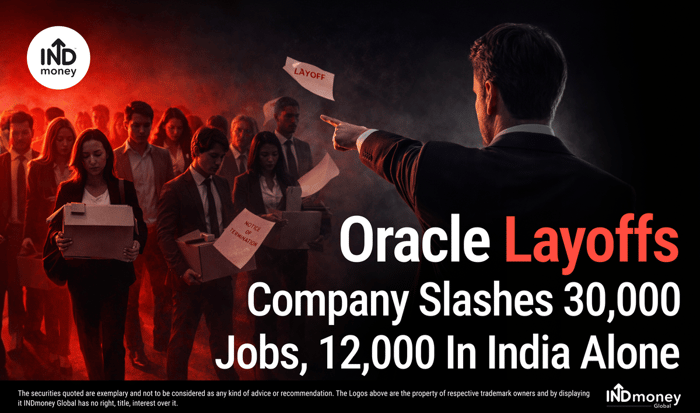
Oracle laid off an estimated 20,000 to 30,000 employees globally on March 31, 2026, representing roughly 18% of its total global workforce of around 162,000 people, per estimates from investment bank TD Cowen. India was hit the most, with approximately 12,000 employees cut from Oracle's operations there. According to Business Standard, which cited two impacted employees including one from Oracle's HR department, another round of layoffs in India is expected within a month.
The termination emails, sent at approximately 6 AM local time across time zones, read:
"After careful consideration of Oracle's current business needs, we have made the decision to eliminate your role as part of a broader organizational change. As a result, today is your last working day."
Employees were directed to sign separation documents via DocuSign and were told severance details would follow. Those who had vested restricted stock units were told they would retain them via Fidelity. Unvested RSUs, however, were forfeited immediately.
Who Got Cut And From Where?
The layoffs were not confined to a single product line. Reports from Reddit's r/employeesOfOracle and professional forum Blind pointed to cuts across:
- Revenue and Health Sciences (RHS), at least 30% team reduction
- SaaS and Virtual Operations Services (SVOS), similar 30%+ cuts
- NetSuite India Development Centre (IDC), engineers, product managers, and managers across multiple levels
- Cloud, engineering, enterprise, and operations teams, widespread across functions
Since Oracle email was targeted to impacted employees only, INDmoney can’t verify exactly which segments’ employees are laid off.
Senior employees including managers and directors were also not spared. Oracle's senior manager Michael Shepherd publicly stated on LinkedIn that the layoffs were "not performance based" meaning high performers and recently promoted employees were let go alongside others.
In India specifically, the cuts spanned Oracle's major development centres, with Bengaluru and Hyderabad operations significantly affected.
Why Is Oracle Doing This?
This is where it gets interesting and a little paradoxical.
Oracle is not in financial trouble. Last quarter, the company posted a 95% jump in net income, reaching $6.13 billion. Its remaining performance obligations, essentially its backlog of contracted future revenue, stood at a jaw-dropping $523 billion, up 433% year-over-year.
So why cut 30,000 people? The answer is AI infrastructure and the staggering cost of building it.
Oracle has committed to investing an estimated $156 billion in AI data centre expansion, as per TD Cowen's analysis. The company plans at least $50 billion in capital expenditure this fiscal year alone and has already raised an additional $50 billion in debt to fund its AI buildout. Its free cash flow last quarter was a negative $10 billion.
Oracle's co-CEO Mike Sicilia put it plainly earlier this year: "The use of AI coding tools inside Oracle is enabling smaller engineering teams to deliver more complete solutions… more quickly." Translation: AI is replacing headcount, and Oracle is restructuring around that reality.
The layoffs are expected to free up $8 to $10 billion in cash flow, according to TD Cowen; money that will go directly toward funding data centres, GPU clusters, and cloud infrastructure for clients including OpenAI, Meta, and Nvidia.
Oracle also disclosed a $2.1 billion restructuring plan in its March 2026 10-Q SEC filing, with nearly $1 billion already recorded in the first nine months of FY26.
What Does Severance Look Like for Impacted Employees?
For employees in India, the severance structure follows a standard formula: N+2, where N equals the number of years worked, paid out in months. According to People Matters, the package also includes notice pay, leave encashment, gratuity (where applicable), and an additional two-month salary top-up; though the top-up is reportedly contingent on voluntary resignation.
US employees noted that severance will be taxed as supplemental income at 30%. Some employees reported April 3 as their formal last working day, with a garden leave period of approximately one month following that date.
What This Means for India's Tech Sector
India is one of Oracle's largest global employment bases. With roughly 30,000 total employees in the country before the cuts, the 12,000 layoffs represent a 40% contraction of Oracle's India workforce in a single sweep.
The roles affected span engineers, architects, database administrators, ERP implementation specialists, cloud infrastructure professionals, and operations staff. These are not niche roles, they represent some of the most sought-after skill sets in enterprise tech.
The broader challenge: India's tech job market is already under pressure in 2026. Amazon, Meta, Pinterest, and Epic Games have all announced layoffs this year. The absorption of thousands of senior Oracle professionals will depend heavily on hiring activity at competing firms and that activity, for now, remains subdued.
Why Is Oracle Stock Falling?
Oracle's stock has been in a prolonged slide well before the layoff news hit. The company took on $58 billion in new debt in just two months to fund its AI data centre buildout, and its free cash flow turned deeply negative, hitting minus $10 billion last quarter. Multiple US banks have reportedly pulled back from financing some of its data centre projects, and the company is also facing securities class-action lawsuits over how its AI strategy was communicated to investors. Put simply, Wall Street is nervous that Oracle is spending faster than it can earn.
ORCL stock was trading down roughly 24% year-to-date as of March 31, 2026, underperforming all of tech's megacaps. The stock touched a peak in September 2025, then shed more than half its value.
On the day of the layoffs, the stock edged up approximately 5%, but analysts noted this bounce was driven more by broader market sentiment than any fundamental improvement in Oracle's outlook. The stock has repeatedly failed to hold above its 50-day moving average; a bearish signal.
Despite the volatility, Wall Street remains largely bullish. Of 41 analysts covering ORCL, 31 have a "Strong Buy" rating. The average price target sits around $245-$280, suggesting significant upside potential from current levels; if Oracle can successfully convert its $523 billion backlog into revenue while managing its growing debt load.
Quick Summary On Oracle Corporation
| Parameter | Detail |
| Total global layoffs | ~30,000 (est. 18% of workforce) |
| India layoffs | ~12,000 (another round expected) |
| Teams affected | RHS, SVOS, NetSuite IDC, cloud, engineering, ops |
| Reason | AI infrastructure buildout, cost realignment |
| Severance (India) | N+2 formula + notice pay + gratuity |
| Oracle's net income (last quarter) | $6.13 billion (+95% YoY) |
| Debt raised for AI | $50 billion |
| ORCL stock YTD | Down ~24% |
| Analyst consensus | Strong Buy; avg. target ~$245–$280 |
The Bigger Picture: AI Is Rewriting the Rules of Big Tech Employment
Oracle is not alone in this pivot. The 2026 tech layoff wave has a common thread running through it: companies are using AI not just as a product but as a reason to thin their own ranks.
Meta, Amazon, Block; their executives have all made versions of the same argument: AI tools now enable leaner teams to deliver more. What used to take 10 engineers can, in some cases, be done with five. Oracle is simply the most dramatic example of this logic playing out at scale.
The question for investors and job seekers alike is not whether this trend will continue. It almost certainly will. The real question is whether Oracle's $156 billion AI infrastructure bet will generate the returns its $523 billion backlog promises or whether it's overextended on debt and ambition in ways that will take years to unwind.
Disclaimer:
The content is meant for education and general information purposes only. Investments in the securities market are subject to market risks, read all the related documents carefully before investing. Past performance is not indicative of future returns. The securities quoted are exemplary and are not a recommendation. This in no way is to be construed as financial advice or a recommendation to invest in any specific stock or financial instrument. Readers are encouraged to verify the exact numbers and financial data from official sources such as company filings, earnings reports, and financial news platforms and to conduct their own research, and consult with a registered financial advisor before making any investment decisions. All disputes in relation to the content would not have access to an exchange investor redressal forum or arbitration mechanism. INDmoney Global (IFSC) Private Limited,Registered office address: Office No. 507, 5th Floor, Pragya II, Block 15-C1, Zone-1, Road No. 11, Processing Area, GIFT SEZ, GIFT City, Gandhinagar – 382355.