

- What is the NVIDIA and Hugging Face deal?
- What does Hugging Face actually do?
- Why is NVIDIA buying Hugging Face now?
- The real asset is an AI demand radar
- Why NVIDIA says Hugging Face will remain open
- Is the $12.93 billion valuation too high?
- A simple test for whether the deal can pay off
- Can NVIDIA comfortably afford the deal?
- What does the deal mean for NVIDIA revenue and earnings?
- How did NVIDIA stock react to the Hugging Face acquisition?
- Does the acquisition make NVDA stock more attractive?
- What could go wrong with the NVIDIA and Hugging Face deal?
- What should NVIDIA investors track next?
- Final verdict on NVIDIA's $12.9 billion Hugging Face acquisition
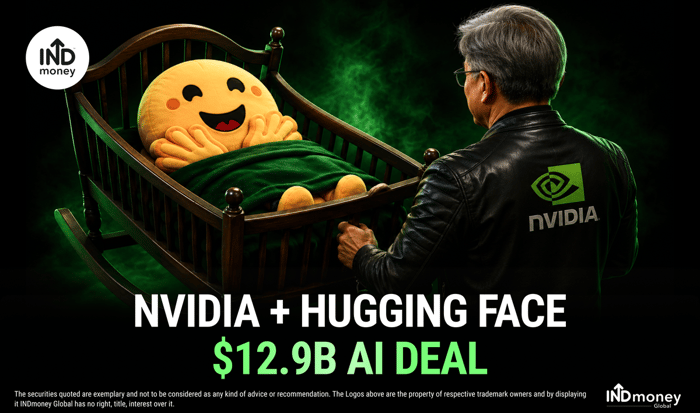
NVIDIA is spending $12.93 billion to acquire Hugging Face, the platform often described as the home of open AI. The price looks enormous for a company reportedly generating only about $150 million in annual revenue. Yet the acquisition is small relative to NVIDIA's financial scale. That tension explains the deal. NVIDIA is not mainly buying today's sales. It is buying the place where millions of developers choose, test and deploy tomorrow's AI models.
Let's break down what NVIDIA is buying, why Hugging Face matters, whether the valuation can be justified and what the deal could mean for NVIDIA stock.
What is the NVIDIA and Hugging Face deal?
NVIDIA entered a definitive agreement on September 2, 2026 to acquire Hugging Face. The transaction was announced publicly on September 3 and is expected to close in the first half of 2027, subject to customary conditions and regulatory approvals.
| Deal detail | Verified information |
| Purchase price payable to Hugging Face stockholders | About $11.9 billion |
| Employee retention programme | Up to about $1.0 billion in equity |
| Headline transaction value | About $12.93 billion |
| Expected closing | First half of 2027 |
| Hugging Face developers, researchers and creators | More than 18 million |
| Companies using the platform | More than 200,000 |
| Models shared on the platform | More than 3 million |
| Datasets | About 500,000 |
| Applications | About 1 million |
The unusual split matters. Roughly $11.9 billion is consideration for existing stockholders, while as much as $1 billion is intended to retain employees who join NVIDIA. In an open source business, the community and the engineers who maintain the ecosystem are central assets. NVIDIA is therefore paying separately to reduce the risk that key people leave after the acquisition.
What does Hugging Face actually do?
Hugging Face gives developers one place to discover, share, evaluate, customise and deploy AI models. It also hosts datasets, software libraries and applications called Spaces. A developer can find an existing model, adapt it for a specific task and connect it with computing infrastructure without starting from zero.
The simplest comparison is GitHub, but for AI. GitHub became important because software developers gathered there to store code and collaborate. Hugging Face occupies a similar position for models, datasets and AI applications.
That makes the platform more valuable than its current revenue suggests. A popular model repository can influence which models developers try, which software tools they adopt, which hardware they optimise for and where workloads eventually run.
Why is NVIDIA buying Hugging Face now?
NVIDIA already dominates the hardware used to train and run advanced AI. However, its largest cloud and technology customers, including Microsoft, Amazon, Google and Meta, are developing custom processors. Open model developers also have more hardware choices from AMD, cloud providers and specialised chip companies.
Hugging Face gives NVIDIA a position closer to the developer's first decision. Instead of meeting a customer only when the customer needs GPUs, NVIDIA can participate when that customer is still selecting a model, dataset, framework and deployment method.
The deal also strengthens NVIDIA's open model strategy. The company says it has already published more than 500 models and over 250 open datasets on Hugging Face. The two companies have also worked together on services that connect researchers with large NVIDIA powered training clusters.
The timing therefore looks defensive and offensive at the same time. It is defensive because NVIDIA's biggest buyers want alternatives to its chips. It is offensive because the company can use Hugging Face to make open AI easier to build and deploy, potentially expanding the total demand for accelerated computing.
The real asset is an AI demand radar
Most coverage treats Hugging Face as a model library. A more useful investor framework is to view it as an AI demand radar.
Millions of developers reveal their preferences through the models they download, the tasks they test, the datasets they use and the applications they deploy. That activity can show where demand is forming before it becomes large infrastructure spending.
The strategic loop could work like this.
- Developers discover and test open models on Hugging Face.
- NVIDIA sees which workloads and model architectures are gaining adoption.
- NVIDIA optimises its chips, CUDA libraries, inference software and cloud services for those workloads.
- Better performance and easier deployment attract more developers and enterprise users.
- More real world AI usage creates additional demand for computing capacity.
This does not mean NVIDIA can or should exploit private customer information. The value comes from broader ecosystem signals, product integration and developer distribution. If managed responsibly, Hugging Face can help NVIDIA shorten the distance between an emerging model and the infrastructure needed to run it.
Why NVIDIA says Hugging Face will remain open
NVIDIA has committed to keeping Hugging Face open and consistent with its existing practices. The company says developers will remain free to choose their models, frameworks, cloud providers, inference services and computing platforms. NVIDIA hardware will not be required.
That promise is not a charitable gesture. Neutrality is part of Hugging Face's economic value. The platform became important because users of different models, clouds and chips could meet in one place. If developers believe rival hardware will receive worse support, they could move their work elsewhere or build alternatives.
This creates the deal's central contradiction. NVIDIA receives more strategic value if Hugging Face subtly favours its technology, but Hugging Face retains more community value if it does not. The acquisition succeeds only if NVIDIA can benefit from the ecosystem without damaging the neutrality that created it.
Is the $12.93 billion valuation too high?
On conventional financial measures, the price is aggressive. Hugging Face was valued at $4.5 billion in its last publicly disclosed funding round in August 2023. Reports have estimated its current annual revenue at about $150 million, but the private company has not publicly disclosed a complete set of audited financial statements.
| Valuation test | Simple calculation | Result |
| Headline value versus 2023 valuation | $12.93B divided by $4.5B | 2.87 times |
| Increase over 2023 valuation | $12.93B minus $4.5B, divided by $4.5B | About 187% |
| Implied price to estimated sales | $12.93B divided by $0.15B | About 86 times |
| Deal as a share of NVIDIA market value | $12.93B divided by about $5.55T | About 0.23% |
The comparison with the 2023 valuation is not a clean takeover premium because the headline value includes up to $1 billion of employee retention equity. The estimated sales multiple is also approximate because Hugging Face's revenue is not officially disclosed. Even with those qualifications, the conclusion is unchanged. NVIDIA is paying for strategic position and future optionality, not present earnings.
An 86 times sales multiple would be difficult to justify if Hugging Face remained only a standalone subscription and hosting business. The valuation becomes more understandable if the platform helps NVIDIA protect or create several billion dollars of annual chip, networking, software and cloud revenue.
A simple test for whether the deal can pay off
NVIDIA reported a 75% gross margin in its latest quarter. Using that margin only as a rough benchmark, recovering $12.93 billion through additional gross profit would require about $17.24 billion of cumulative incremental revenue.
| Strategic return hurdle | Approximate amount |
| Acquisition value | $12.93 billion |
| Revenue required at a 75% gross margin | $17.24 billion |
| Annual incremental revenue required over 5 years | $3.45 billion |
| Annualised latest Data Center revenue | About $356 billion |
| Required annual uplift versus that run rate | About 1.0% |
This is not a forecast and it excludes operating expenses, taxes, integration costs, discount rates and the timing of cash flows. It is a scale test. Hugging Face would need to help create an annual revenue uplift equal to roughly 1% of NVIDIA's latest annualised Data Center run rate over five years for the headline purchase price to be covered at the gross profit level.
That is possible, but not automatic. The platform must convert community activity into more enterprise deployments, inference workloads, software consumption or GPU demand without losing developer trust.
Can NVIDIA comfortably afford the deal?
Yes. Affordability is not the main investor concern.
| NVIDIA financial measure, Q2 FY2027 | Amount | Deal comparison |
| Quarterly revenue | $96.22 billion | Deal equals about 13.4% |
| Quarterly GAAP net income | $59.69 billion | Deal equals about 21.7% |
| Quarterly free cash flow | About $21.34 billion | Deal equals about 60.6% |
| Cash plus marketable debt securities | $56.59 billion | Deal equals about 22.9% |
| Capital returned to shareholders in the quarter | About $26.0 billion | Roughly twice the deal value |
NVIDIA generated enough free cash flow in one quarter to cover the acquisition price about 1.65 times. It also returned approximately $26 billion to shareholders during the quarter. The transaction is therefore unlikely to strain the balance sheet, although the final funding mix and accounting treatment will matter after closing.
For context, the acquisition is less than 0.25% of NVIDIA's market capitalisation. It is strategically large but financially digestible.
What does the deal mean for NVIDIA revenue and earnings?
The immediate earnings contribution is likely to be small. Using the reported $150 million revenue estimate, Hugging Face would add less than 0.2% to NVIDIA's latest quarterly revenue even if that annual figure were incorrectly treated as a single quarter. On an annualised comparison, the contribution is even less meaningful relative to NVIDIA's current scale.
The more important opportunities sit outside Hugging Face's existing income statement.
| Potential value driver | How NVIDIA could benefit | What investors should verify |
| Model discovery | Earlier view of fast growing AI workloads | Continued developer activity and model growth |
| Training | Easier access to NVIDIA clusters and cloud capacity | More paid training usage |
| Inference | Optimised deployment through NVIDIA software and chips | Rising enterprise inference consumption |
| Software | Adoption of CUDA, NIM and related tools | Recurring software revenue and wider attachment |
| Enterprise conversion | More companies moving from experiments to production | Growth in paid enterprise customers |
| Open model distribution | Broader reach for NVIDIA's own models | Adoption without crowding out neutral choices |
The bull case is not that Hugging Face suddenly becomes a large reported segment. It is that the platform increases the probability that AI workloads eventually land on NVIDIA's stack.
The bear case is that NVIDIA pays a strategic premium but cannot monetise the platform aggressively because doing so would undermine its neutrality. In that scenario, Hugging Face remains influential but produces little measurable return for shareholders.
How did NVIDIA stock react to the Hugging Face acquisition?
NVIDIA shares closed at $228.45 on September 3, 2026, up 1.80% for the session. The stock traded between $224.75 and $230.40 and remained close to its 52 week high of $236.54.
| September 3 market measure | Performance |
| NVIDIA | Up 1.80% |
| Nasdaq Composite | Up 1.40% |
| S&P 500 | Up 1.06% |
The reaction was positive but should not be attributed entirely to the deal. The broader US market also rallied. NVIDIA outperformed the S&P 500 by about 0.74 percentage points and the Nasdaq by about 0.40 percentage points, which suggests approval rather than euphoria.
At a market value of roughly $5.55 trillion, a 1.80% move represents close to $100 billion of market capitalisation. That is many times the acquisition price, but it would be misleading to claim investors added that value solely because of Hugging Face. Interest rate expectations, the market rally and momentum following NVIDIA's recent earnings also influenced the session.
Does the acquisition make NVDA stock more attractive?
The deal improves NVIDIA's strategic position but does not materially change near term earnings estimates. Investors should separate the quality of the acquisition from the valuation of the stock.
At about $228.45, NVIDIA carried a market value near $5.55 trillion and a trailing price to earnings ratio of roughly 28.7 times. That multiple is not low in isolation, but NVIDIA's latest quarterly revenue rose 106% year on year and Data Center revenue increased 117%. The more important question is how long extraordinary growth can continue as NVIDIA reaches a much larger base.
Hugging Face offers a hedge against one of the biggest threats to that growth. If large technology companies shift more workloads to custom chips, NVIDIA can still strengthen its relationship with the wider developer and open model ecosystem. However, the acquisition cannot by itself offset slower AI infrastructure spending or a major loss of chip market share.
Our view is cautiously positive. NVIDIA has the financial capacity to absorb the deal and the strategic logic is stronger than the target's standalone numbers. The price is too high to call the acquisition low risk, but the required ecosystem driven revenue uplift is achievable relative to NVIDIA's enormous Data Center business.
What could go wrong with the NVIDIA and Hugging Face deal?
Regulatory scrutiny could delay or reshape the transaction
The deal requires regulatory approvals and is expected to close in the first half of 2027. Regulators may examine whether the leading AI chip supplier could disadvantage competing hardware providers through ownership of a central model platform.
Developers could lose trust
Hugging Face's value depends on community participation. If users believe the platform is no longer neutral, the network effect could weaken. NVIDIA's public commitments reduce this risk but execution will matter more than promises.
Open model regulation could reduce activity
NVIDIA's SEC filing specifically warns that governments may impose restrictions on the development, release, distribution or use of open models. It also notes that many popular open models originate in China. New controls could limit models and datasets available on Hugging Face, raise compliance costs or slow adoption.
The purchase price leaves little room for weak execution
An estimated sales multiple near 86 times assumes a long runway. If enterprise monetisation slows or competing repositories gain traction, NVIDIA could face impairment risk and a disappointing return on capital.
Integration could damage the asset being acquired
Traditional integration focuses on combining products and cutting duplicated costs. That approach would be dangerous here. Hugging Face's independence and broad ecosystem support are central to its appeal. NVIDIA must integrate infrastructure while leaving the community enough freedom to remain credible.
What should NVIDIA investors track next?
Investors should watch measurable indicators rather than broad statements about open AI.
- Whether the transaction receives approvals and closes on schedule.
- Growth in active developers, companies, models, datasets and applications.
- Expansion of paid enterprise services, inference endpoints and training clusters.
- Evidence that AMD, cloud and other non NVIDIA infrastructure remain well supported.
- Adoption of NVIDIA models, NIM services and deployment tools through the platform.
- Any new disclosures on Hugging Face revenue, margins and acquisition related expenses.
- Developer response to changes in ranking, recommendations, pricing, access and governance.
These indicators will reveal whether Hugging Face remains an open ecosystem that happens to be owned by NVIDIA or gradually becomes a distribution channel for NVIDIA products. The first outcome protects the community. The second may create more direct commercial value but carries a much higher risk of user defection.
Final verdict on NVIDIA's $12.9 billion Hugging Face acquisition
NVIDIA is paying a software style valuation for something closer to AI infrastructure. The headline price is hard to defend using Hugging Face's reported revenue alone, but the acquisition is affordable for NVIDIA and potentially valuable as a developer distribution network, demand radar and bridge between open models and computing infrastructure.
For NVDA shareholders, this is strategically positive but not an immediate earnings catalyst. The deal will matter if Hugging Face helps NVIDIA capture more training and inference demand while remaining genuinely open to rival chips and clouds. If neutrality survives, NVIDIA may have bought the front door to open AI. If neutrality erodes, it may have paid $12.93 billion for a community that can leave.
Readers interested in the wider earnings backdrop can also review this NVIDIA Q1 FY2027 analysis and explore the broader US stocks market.