

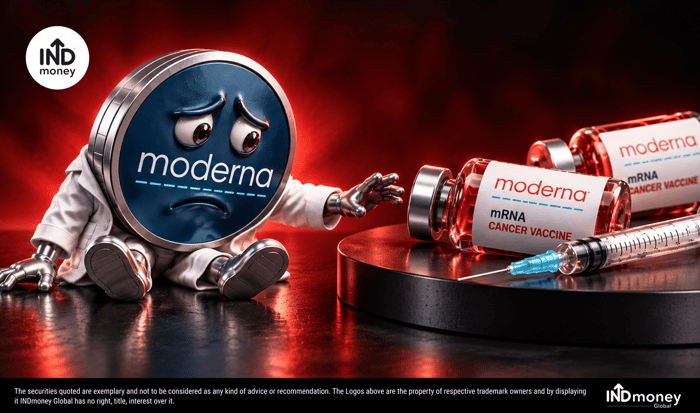
- What Happened to Moderna Stock on October 22?
- What Did Moderna and Merck's Cancer Vaccine Actually Show?
- Why Did MRNA Stock Plunge If the Trial Succeeded?
- Why the Cancer Vaccine's Benefit After Six Months Matters
- How Big Could Moderna's Cancer Vaccine Business Become?
- How Much of That Business Would Belong to Moderna?
- What Share Price Could a Successful Cancer Vaccine Support?
- Can Moderna Fund the Journey to Cancer Vaccine Profits?
- Is the Moderna Stock Fall an Accumulation Opportunity?
- What Would Make the Moderna Investment Case Stronger?
Two months ago, a successful cancer vaccine trial sent Moderna shares soaring 176.97% in a single day. On October 22, investors finally received the detailed results behind that breakthrough. The vaccine worked. Moderna stock fell 17.57%.
That sounds difficult to reconcile until you look at what happened between the two announcements.
In August, Moderna showed that its personalised cancer treatment could clear an important clinical hurdle. By October, its share price reflected hopes that the same approach could become a large business across several cancers. The detailed melanoma results gave investors a much firmer basis for judging those hopes.
For anyone who missed the earlier rally, the temptation is understandable: a promising treatment, followed by a sharp price correction. But the useful question is how much commercial success the lower price still requires.
What Happened to Moderna Stock on October 22?
The results were supposed to receive their formal presentation on Saturday, October 24, at the European Society for Medical Oncology's ESMO Congress in Madrid.
Instead, Oncology Central published information ahead of the agreed release time. The material was removed, but it had already circulated. ESMO confirmed an embargo breach, and Moderna and Merck subsequently released the results officially. The Saturday presentation remains scheduled. This was premature publication of trial information; the companies' subsequent announcement provides an official dataset to assess.
Here is the share-price journey that puts the fall in perspective:
| Date | Moderna share price | What happened |
| August 18 close | $62.96 | Before the positive Phase 3 announcement |
| August 19 close | $174.38 | Shares jumped 176.97% |
| October 21 close | $245.81 | Before the detailed data emerged |
| October 22 close | $202.63 | Shares fell 17.57% |
| October 22, 8 p.m. EDT | $196.34 | A further 3.10% decline in after hours trading |
Sources: MarketScreener's timestamped prices. The after-hours quote corresponds to 5:30 a.m. IST on October 23; quotes vary with the observation time.
Including that after-hours snapshot, the decline from the previous regular-session close was approximately 20.13%.
Yet the October 22 closing price remained about 16.2% above the closing price on the day of the August breakthrough, and more than three times the price before that announcement.
The correction therefore removed part of a much larger revaluation. It did not take investors back to where the story began.
What Did Moderna and Merck's Cancer Vaccine Actually Show?
The treatment is called intismeran autogene, also known as V940 or mRNA-4157. It is designed for people who already have cancer, using information from their own tumour to help the immune system recognise cancer cells. Each patient's version can encode up to 34 tumour-specific targets.
In this study, the visible melanoma had been surgically removed. The question was whether adding intismeran to Merck's existing immunotherapy, Keytruda, could reduce the chance of the disease returning. The randomised Phase 3 INTerpath-001 trial enrolled 1,137 patients with stage IIB-IV melanoma.
The detailed results were positive:
| Measure | Intismeran plus Keytruda | Keytruda alone |
| Alive without melanoma recurrence at two years | 82.2% | 70.0% |
| Alive without distant metastasis at two years | 88.5% | 80.2% |
| Grade 3-5 treatment-related adverse events | 14.2% | 13.4% |
Across follow-up, the hazard ratio for recurrence or death was 0.58, equivalent to a 42% reduction in the event hazard. For distant metastasis or death, it was 0.62, a 38% reduction. Median follow-up was 24.6 months. Overall survival data remain immature.
The first row offers an easier way to understand the benefit. The difference is 12.2 percentage points, so basically approximately 12 more people out of every 100 similar patients were estimated to be alive without recurrence at two years.
That is a meaningful improvement over an active treatment. The 42% headline describes a comparison of event hazards over time. It does not mean an additional 42 people out of 100 were cured, or that the study has established a 42% reduction in deaths alone.
Why Did MRNA Stock Plunge If the Trial Succeeded?
Four developments help explain the reaction. Together, they suggest an expectations reset.
1. Investors already knew the trial had succeeded
The August announcement had disclosed that the combination met its recurrence-free survival and distant metastasis-free survival endpoints. What investors were waiting for in October was the size of those improvements and the detail behind them.
That changes how good news affects a stock. If an investor already expects a treatment to work, confirming that expectation may add little value. A further increase in valuation needs evidence that the eventual business could be larger, more profitable or less risky than previously assumed.
Moderna had already enjoyed an enormous increase before the detailed figures arrived. The market was judging the results against that starting valuation.
2. One important result looked less spectacular than earlier data
At five-year follow-up in the smaller Phase 2b study, the combination had shown a 49% reduction in recurrence or death and a 59% reduction in distant metastasis or death. That study enrolled 157 patients with stage III/IV melanoma.
The larger Phase 3 study's distant-metastasis result fell short of expectations formed around the earlier study, according to Fierce Biotech's reporting on analyst commentary.
The comparison needs care. The studies involved different populations, follow-up periods and sample sizes. They do not establish that the treatment suddenly became less effective. They do explain why investors hoping for an equally dramatic result across every measure could reassess their assumptions.
3. Patients may have other effective treatment pathways
Cancer care has also been changing around the vaccine programme. In some patients with operable stage III/IV melanoma, the SWOG S1801 trial demonstrated better event-free survival when Keytruda began before surgery and continued afterwards, compared with starting it only afterwards. This approach is called neoadjuvant treatment.
That creates a commercial question: how much additional benefit would a personalised vaccine offer against the best available treatment pathway, and what would insurers pay for it? RBC flagged this issue in its assessment of the new data.
The trials involved different populations and endpoints. Their results cannot establish that the approaches are equivalent, and the before-surgery population does not cover everyone in Moderna's trial. The comparison raises questions about adoption and pricing power that the vaccine's own trial was not designed to settle.
4. The valuation depended on success beyond melanoma
BMO Capital Markets said investors wanted the results to strengthen confidence in other tumour types as well as melanoma.
A successful trial in one cancer creates a stronger reason to investigate others. Each additional indication still needs its own evidence, regulatory review and commercial case.
Our interpretation is that the market lowered the value it was assigning to those future possibilities. The scientific result and the stock reaction can therefore coexist: melanoma treatment advanced, while investors became less willing to pay for the entire hoped-for expansion in advance.
Why the Cancer Vaccine's Benefit After Six Months Matters
There is a potentially important timing effect inside the results.
During the first six months, the recurrence-or-death hazard ratio was 0.99. After six months, following the immunisation regimen, a pre-specified sensitivity analysis showed a hazard ratio of 0.42, or a 58% reduction. The companies also reported no new safety signals.
One plausible interpretation is that the treatment's added benefit takes time to emerge. That makes longer follow-up valuable and gives supporters a reason to examine the survival curves carefully.
However, an analysis covering a later period answers a narrower question than the main analysis covering the full trial period. The headline primary result remains the appropriate starting point; the stronger later-period result helps explain its timing.
This is why a complete presentation and discussion with investigators matter. A single percentage cannot capture when benefits emerge, how durable they become or which patients are most likely to benefit.
How Big Could Moderna's Cancer Vaccine Business Become?
The commercial opportunity starts with postsurgical melanoma patients covered by an eventual approved label. Intismeran remains investigational; the companies are engaging regulators.
RBC has discussed possible US approval in 2027, according to BioSpace. That is an analyst expectation, rather than a confirmed approval or launch date.
It would be misleading to multiply the number of all cancer patients by an assumed vaccine price.
Consider the filters between a diagnosis and a commercial treatment: the cancer type and stage must qualify; sufficient tumour material must be available; a personalised product must be manufactured and delivered; the patient must receive treatment; and the healthcare system must pay for it. Better clinical results can help adoption, but do not determine every step.
For context, the American Cancer Society estimates 112,000 new melanoma cases in the US in 2026. That includes patients outside this trial's postsurgical, higher-risk population. It is a US incidence figure, not a count of patients eligible worldwide.
A simple commercial calculation is:
Annual programme sales = patients treated × average net revenue per complete treatment course.
At an illustrative net price of $100,000 per course, annual sales of $2.5 billion would require 25,000 patients. Sales of $10 billion would require 100,000; $30 billion would require 300,000. These are arithmetic examples, not disclosed prices or patient forecasts. A course price also covers the treatment course, rather than each injection.
The bigger numbers require much broader access, higher pricing, more indications, or some combination of the three. Prices would also differ across countries.
The partners are pursuing that expansion. Their programme includes nine Phase 2 and Phase 3 trials across several cancers, including lung, kidney and bladder cancer. Nine trials should not be mistaken for nine proven cancer markets.
There is also a manufacturing challenge. A personalised medicine requires a repeatable process for many different patient-specific products. Moderna says its Marlborough facility began supplying clinical batches in September 2025. Reliable commercial scale could become an advantage; it also requires investment and evidence on costs.
Approval would open the door. Profitable delivery at scale would determine how valuable that door becomes.
How Much of That Business Would Belong to Moderna?
This is where a straightforward-looking valuation can go badly wrong.
Moderna's latest quarterly filing says development costs and any profits or losses are generally shared equally with Merck worldwide, subject to contractual exceptions. Merck's partnership announcement also describes equal sharing of costs and profits.
Investors should therefore begin with the programme's economics before estimating Moderna's earnings. Assigning all global intismeran sales to Moderna would overstate its economic interest. Adding Keytruda sales to Moderna's opportunity would introduce another error as Keytruda is Merck's product.
Here is an example using explicit assumptions. Suppose every $1 of intismeran sales produces 50 cents of programme operating profit after manufacturing, commercial expenses and ongoing programme costs. Moderna's half would be 25 cents before tax. At an assumed 25% tax rate, approximately 18.75 cents would remain.
On those assumptions, $10 billion of annual programme sales would generate $1.875 billion of annual profit attributable to Moderna, before the separate economics of the rest of the company.
That would be a substantial business. Its value still depends on how long reaching that scale takes and how durable those earnings become.
What Share Price Could a Successful Cancer Vaccine Support?
At $202.63, Moderna's equity value was approximately $80.9 billion, using the 399.24 million shares reported outstanding as of July 24. This estimate uses the latest quarterly share disclosure; subsequent changes in the share count would change it.
To examine that valuation, we need a dated future outcome. A price that might be supported in 2032 has a different meaning from a price supported today.
The following is an illustrative earnings model. It assumes:
- Intismeran reaches the stated annual sales level in 2032. This timing is our modelling assumption, not company guidance.
- A 50% programme operating margin, followed by Moderna's 50% profit share and an assumed 25% tax rate.
- A valuation of 25 times Moderna's resulting annual programme profit in 2032: $25 of programme value for each $1 of annual profit.
- Another $15 billion of equity value in 2032 for the remaining businesses, other pipeline assets and net cash, after allowing for their costs, debt and funding needs.
- 400 million shares, rounded for readability, with no further issuance.
- A 12% annual required return over six years to translate the 2032 price into a present equivalent.
The $15 billion residual is a scenario assumption, not an independently established valuation of the rest of Moderna. It already includes net cash; cash must not be added again. The model assumes cash generated before 2032 is reinvested or reflected in that residual, with no separate shareholder distributions.
| Illustrative commercial outcome | Annual global intismeran sales in 2032 | Annual profit attributable to Moderna | Modelled 2032 share price | Present value equivalent at a 12% required return |
| Smaller initial franchise | $2.5 billion | $0.47 billion | $67 | $34 |
| Substantial franchise | $10 billion | $1.88 billion | $155 | $78 |
| Large expansion across cancers | $20 billion | $3.75 billion | $272 | $138 |
| Very large oncology franchise | $30 billion | $5.63 billion | $389 | $197 |
Calculations use unrounded profits. These are conditional scenarios, not probability-weighted price targets. We have assumed the clinical, regulatory and commercial success necessary for each sales outcome; we have not applied additional probabilities of failure.
The calculation behind the $20 billion row is:
$20bn sales × 50% margin × 50% Moderna share × 75% after tax = $3.75bn annual profit.
At 25 times earnings, that is $93.75 billion of programme value. Add the assumed $15 billion residual and divide by 400 million shares: approximately $272 in 2032.
Discounting that price for six years at 12% gives approximately $138 today.
Under this framework, supporting the October 22 closing price requires approximately $31 billion of annual intismeran sales by 2032.
The answer changes with the assumptions. Keeping everything else constant, a 60% margin and a 30-times earnings multiple reduce the closing-price requirement to approximately $21 billion of annual sales. A 40% margin and a 20-times multiple raise it to approximately $48 billion. Every additional $10 billion assigned to the residual business adds about $25 to the 2032 share price, or $13 to its present equivalent.
Faster commercialisation, valuable additional medicines or stronger margins would improve the outcome. Delays, lower reimbursement, expensive manufacturing, competition or additional shares would weaken it. A high earnings multiple would also need a sufficiently long period of profitable growth beyond 2032; brief peak earnings would be less valuable.
The model cannot establish one precise fair price. It makes clear how much broader success is required under a transparent set of assumptions.
Can Moderna Fund the Journey to Cancer Vaccine Profits?
The balance sheet matters because commercial success would arrive after further spending.
| Latest reported financial measure | Figure |
| Q2 2026 revenue | $145 million |
| Q2 2026 net loss | $782 million |
| Cash, cash equivalents and investments, June 30 | $6.9 billion |
| Long-term debt, June 30 | $591 million |
| Litigation settlement paid in July | $950 million |
| Guided year-end 2026 cash and investments | 4.7-5.2 billion |
Source: Moderna's Q2 financial release. The year-end cash guidance excludes additional drawings from the remaining credit facility.
The June cash balance predates the July settlement and subsequent spending. It should not be treated as today's surplus cash. Borrowing capacity also provides financing rather than free additional equity value.
Respiratory vaccines have seasonal demand, so one quarter's revenue should not be multiplied by four to estimate annual sales. Nevertheless, the reported losses explain why cost control, existing vaccine revenue and the timing of new launches matter alongside the cancer results.
Cash spent before profitability can reduce future net cash or create a need for financing. Our valuation's residual value must absorb that funding burden. Crediting all current cash while ignoring future losses would make the stock appear artificially cheaper.
Moderna is scheduled to report Q3 results on November 6, 2026, providing a nearer opportunity to update these assumptions.
Is the Moderna Stock Fall an Accumulation Opportunity?
Our view is that the fall has improved the entry valuation, but has not established an obvious valuation cushion.
Around $200, the investment case still needs substantial success beyond the initial melanoma opportunity under the scenarios above.
For someone whose conviction rests mainly on this melanoma trial, waiting for more commercial evidence or a more forgiving valuation is financially reasonable. The detailed results strengthen the treatment's clinical case, but do not on their own demonstrate the scale of earnings needed to support the current equity value.
Someone with a stronger, independently researched view on expansion across cancers could reach a more optimistic conclusion. That view should specify the indications, likely patient numbers, pricing, margins and timing. Confidence in mRNA technology alone is too broad to substitute for those assumptions.
For an investor choosing to build exposure, staging it around evidence can limit dependence on a single judgment: the full clinical discussion, regulatory progress, manufacturing economics, reimbursement and results in additional cancers. Each stage should strengthen the commercial case or improve the price paid for it. A further fall by itself would not establish either.
There is also a cost to waiting. If future evidence is stronger than expected, the shares could rise before every uncertainty is resolved. The relevant choice is how much evidence and valuation protection an investor needs, rather than whether a perfectly settled share price will eventually appear.
What Would Make the Moderna Investment Case Stronger?
The next developments should answer specific questions:
| Development | What it would help establish |
| October 24 ESMO presentation | How investigators interpret the curves, subgroups, durability and treatment pathway |
| Regulatory submissions and decisions | Which patients could receive the treatment and under what conditions |
| Pricing, reimbursement and manufacturing disclosures | How many patients can be served profitably |
| Results in additional cancers | Whether the platform can support a much broader franchise |
| November 6 financial update | How quickly existing products and spending are changing the funding outlook |
The most valuable new information may therefore come from the economics of delivery and evidence beyond melanoma. Those developments would help bridge the gap between a successful treatment and the large future business embedded in the share price.
Our August analysis on Moderna Cancer Vaccine raised that same valuation question after the 177% rally. The detailed results now give investors more to work with, while leaving a substantial part of the commercial expansion to be demonstrated.
For people who missed the rally, the earlier share price is an unhelpful anchor. The decision starts with what roughly $200 requires from here: the earnings Moderna can realistically capture, the years needed to generate them and the return left for shareholders along the way.