

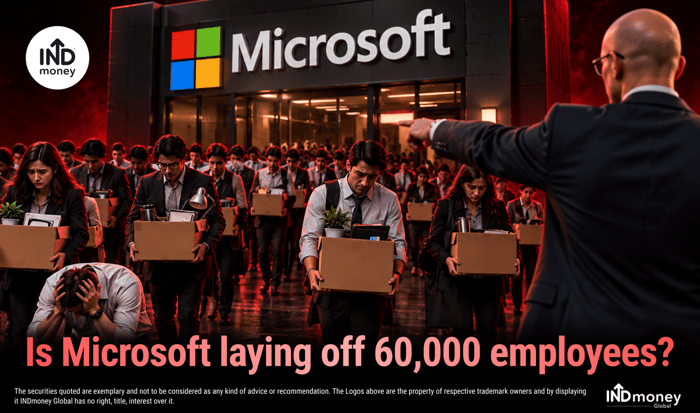
- Is Microsoft Laying Off 60,000 Employees?
- Why is Microsoft Offering Buyouts Despite Record Profits?
- How Much Money Could Microsoft Save From the Buyouts?
- Why the Savings Will Not Arrive Immediately
- Can Employee Buyouts Meaningfully Fund Microsoft's AI Spending?
- What Does the Buyout Offer Mean for MSFT Stock?
- What Should Microsoft Investors Watch Next?
Microsoft made $133.7 billion in net profit in its last financial year. Now it is offering thousands of employees money to leave.
At first glance, those two things do not belong in the same story. If the business is doing so well, why reduce its workforce? And if Microsoft can afford enormous investments in artificial intelligence, why is it trying to save on people?
The answer becomes clearer when we separate the business Microsoft already has from the business it is building.
Its established products generate enormous profits. Its next phase of growth requires expensive computing infrastructure, with bills arriving before all the returns do. Management has reasons to examine spending even while revenue grows.
But the headline needs one correction before we get to the money: Microsoft has offered voluntary buyouts to around 60,000 eligible employees. It has not announced that 60,000 people are leaving.
That distinction changes both the savings calculation and what investors should make of the news.
Is Microsoft Laying Off 60,000 Employees?
On October 26, Microsoft introduced a Voluntary Exit Offer, or VEO. Chief People Officer Amy Coleman said eligible employees in participating teams across the US, Canada, the UK and India could choose to leave with financial support and career-planning resources. Eligibility extends to internal level 70 and below, but participation varies by organisation.
The roughly 60,000 eligible employees represent about 27% of the 223,000 full-time workers Microsoft reported at June 30, 2026. That percentage measures the reach of the offer against its last reported workforce; it does not measure an actual reduction.
A voluntary buyout works differently from an involuntary layoff. Microsoft presents eligible employees with an exit package, and employees decide whether to accept. The eventual headcount change depends on participation, hiring and other departures.
Reuters reported that participating divisions include AI experiences, Copilot, finance, human resources, Xbox, and Windows + Devices. Marketing, commercial business and security were among the excluded units, according to its source.
India is included, but that does not mean every Microsoft employee in India qualifies. Nor has Microsoft disclosed an India-specific departure target in its public announcement.
Business Insider, which reviewed individual offers, reported that packages vary by seniority, location and tenure. US offers include base-pay severance and continued benefits and stock vesting. Employees reportedly have until early December to decide, with exits at year-end.
Why is Microsoft Offering Buyouts Despite Record Profits?
Microsoft's financial year ended June 2026 with revenue of $331.8 billion, up 18%, and operating profit of $155.2 billion, up 21%. Its latest quarterly results also showed Azure and other cloud-services revenue growing 43%.
Those figures make a broad business collapse an unconvincing explanation. The financial question is how much Microsoft must spend to keep growing, and where that spending should go.
Think about the difference between delivering another software licence and answering an AI request.
Software is expensive to develop, but distributing another copy can cost relatively little. Cloud services already required Microsoft to operate physical infrastructure. AI adds another demanding workload: requests consume processing capacity, memory and electricity. More usage creates more revenue opportunities, but it also creates running costs.
Microsoft therefore has to build capacity, pay for it, and then earn an adequate return from customers using it. Strong demand alone does not settle that calculation.
On its July earnings call, CFO Amy Hood put calendar-2026 capital expenditure expectations at approximately $175 billion. This is company-wide capex, not a separately disclosed AI-only budget. The measure includes finance leases; it is not simply cash paid during the year, and operating leases sit outside it.
This changes the choices facing management. A profitable company can still decide that money committed to one activity would earn a better return elsewhere. It can expand infrastructure while reducing selected teams, consolidate overlapping responsibilities, or stop work that no longer fits its priorities.
Our interpretation is that the buyout offer gives Microsoft another way to change its spending and staffing mix. The company has not published a breakdown showing how much of the programme relates to each business objective.
There is also an important limit to the AI explanation. A Microsoft spokesperson told KUOW that AI was not driving the buyout programmes. Separately, in July, Coleman said the roles eliminated in that earlier restructuring were not being replaced by AI, while acknowledging that AI was changing how work gets done.
So the evidence supports examining workforce changes alongside Microsoft's AI investment. It does not establish that an AI tool can now perform every departing employee's job.
The voluntary structure has its own business logic. It can provide an exit for people already considering leaving and reduce the need for some compulsory departures. The trade-off is that employees with valuable experience and attractive opportunities elsewhere may also accept. Whether Microsoft retains the skills it needs matters as much as the number of exits.
How Much Money Could Microsoft Save From the Buyouts?
Microsoft has not provided enough information for a dependable savings forecast. We can, however, calculate what different outcomes would mean.
Three inputs matter: how many employees leave, the recurring cost of their positions, and how much Microsoft must spend to cover the work afterwards.
For an illustration, assume an annual employer cash cost of $200,000 per departing position, covering cash pay, benefits and employer payroll costs. This is a modelling input, not Microsoft's disclosed average salary or a verified average for the eligible group.
Also assume that replacement hiring, contractors, additional tools and other continuing costs absorb 20% of the gross saving. Again, this is an assumption. Some work may disappear; some may need expensive replacements.
That produces the following scenarios:
| Illustrative participation | Employees leaving | Gross annual cash-cost reduction | Annual saving after 20% replacement costs |
| 10% of eligible employees | 6,000 | $1.20 billion | $0.96 billion |
| 20% of eligible employees | 12,000 | $2.40 billion | $1.92 billion |
| 30% of eligible employees | 18,000 | $3.60 billion | $2.88 billion |
Author calculations. These are full-year, recurring, pre-tax scenarios after departures, before upfront exit payments. They exclude equity-compensation effects and are not Microsoft guidance or predicted participation rates.
The middle example is straightforward: 12,000 departures multiplied by $200,000 removes $2.4 billion of annual cash costs. Spending $480 million to cover continuing needs leaves $1.92 billion.
But the cost assumption matters enormously. If the average is $150,000 rather than $200,000, the same participation and replacement assumptions produce $1.44 billion. At $250,000, they produce $2.40 billion.
The geographic and seniority mix could move the outcome substantially. Applying a US senior-engineer compensation package to every departure across four countries would be a poor shortcut.
Participation is uncertain too. Microsoft said more than 30% of eligible employees joined its earlier voluntary retirement programme. KUOW reported that Microsoft expects lower participation in this broader offer. That makes the previous programme useful context, but an unreliable forecast for this one.
Replacement spending could be equally decisive. If it consumes half the gross reduction instead of one-fifth, the middle example saves $1.2 billion annually.
The defensible takeaway is conditional: the assumptions above produce roughly 1-3 billion in recurring annual savings. The actual outcome could fall outside that range. Microsoft has not disclosed a savings target that makes any one scenario the expected result.
Why the Savings Will Not Arrive Immediately
To remove a recurring cost, Microsoft first has to pay people to leave. That creates a gap between a smaller future payroll and the cash benefit shareholders actually receive.
Business Insider reported that US severance for levels 67 and below is capped at 39 weeks of base pay, while the standard level-68 offer includes 12 months of salary.
Consider another explicitly hypothetical input: an average cash exit cost of $100,000 per departing employee. At 12,000 departures, the bill would be $1.2 billion. This is a sensitivity test, not an estimate of Microsoft's offers.
Against the middle scenario's $1.92 billion annual recurring saving, recovering that cost takes about 7.5 months after departures. Across the first full 12 months, the cash benefit after that assumed exit bill would be $720 million, before tax and other transition costs.
A larger package lengthens the recovery period. So does retaining contractors for longer than expected. Conversely, lower exit costs or less replacement spending improve it.
The reported year-end departure timing also matters. If exits occur at December 31, January-June 2027 provides only half a year of savings within Microsoft's June-ending fiscal year. Under the middle scenario, that is approximately $960 million before exit payments and tax, rather than the full $1.92 billion annual amount.
Accounting profit may follow a different timetable. Microsoft could recognise exit-related expenses before the corresponding cash payments or future payroll savings occur. Continued stock vesting can also affect reported compensation expense without matching an immediate cash outflow.
Investors should therefore keep three figures separate: the upfront charge, the cash paid, and the recurring saving once the transition is complete. A programme can improve future economics while initially reducing reported profit or cash flow.
Can Employee Buyouts Meaningfully Fund Microsoft's AI Spending?
They can contribute, but the scale needs perspective.
In fiscal 2026, Microsoft generated $182.9 billion in operating cash flow and paid $115.9 billion for property and equipment, supporting both AI and other activities. Subtracting the latter from the former gives approximately $67.0 billion in free cash flow under that conventional definition.
The middle scenario's $1.92 billion annual saving is equivalent to about 1.7% of that historical annual cash investment in property and equipment. It is about 2.9% of the resulting free cash flow. These are scale comparisons, not a reconstruction of Microsoft's past accounts.
The money would be useful. But it would cover only a small part of the infrastructure bill.
There is another reason to avoid treating payroll reductions and capital spending as interchangeable. Payroll generally reduces operating profit as employees work. Infrastructure purchases often use cash upfront, with their cost charged against profit over time through depreciation. Leases add further timing differences.
Microsoft could therefore show stronger operating discipline while cash spending remains elevated. It could also report rising profit while a larger share of cash goes into infrastructure.
For investors, the bigger question is whether the additional capacity earns enough from customers to justify its cost. Workforce savings can improve that equation at the margin. They cannot establish that the investment itself will deliver an attractive return.
What Does the Buyout Offer Mean for MSFT Stock?
Microsoft stock closed at $532.60 on October 26, up 1.54%. That is the completed US session's performance; it does not prove the buyout announcement caused the entire move.
There are two ways this programme could influence the share price: through additional earnings, and through what it tells investors about management's control of spending.
Start with earnings. Suppose the middle scenario's $1.92 billion cash saving also becomes an equivalent reduction in recurring operating expenses. Apply an assumed 20% tax rate and roughly 7.45 billion diluted shares, close to Microsoft's fiscal-2026 weighted average.
The result is approximately $1.54 billion in additional annual after-tax earnings, or $0.21 per share. This calculation excludes the initial exit charge, changes in equity compensation and other accounting differences.
For perspective, the operating-profit improvement would equal about 1.2% of Microsoft's fiscal-2026 operating profit. At unchanged revenue, it would lift the operating margin by roughly 0.6 percentage points. Useful, certainly, but modest beside the size of the business.
We can also test the valuation effect without pretending to predict the stock.
At an illustrative 30 times earnings, investors would attach about $6 per share to that additional recurring earnings stream.
The exercise helps put the headline in proportion. A smaller payroll could make Microsoft more valuable, but the direct earnings contribution in this example is limited. A much larger stock-market response would require investors to change other expectations too.
That could work in either direction. Confidence may improve if Microsoft preserves customer service, releases products on schedule and grows revenue without rebuilding the removed costs. The programme would then provide evidence that management can expand the business efficiently.
Confidence could weaken if experienced employees leave, delivery slows, or replacement hiring reverses the savings. A lower employee count by itself reveals little about those outcomes.
Our assessment is that the offer provides a potential, modest earnings benefit. The stronger case for MSFT still depends on the growth and profitability of its cloud and software businesses, and the returns from its infrastructure commitments. The buyouts add a cost-control measure to that story; they do not resolve its central uncertainties.
What Should Microsoft Investors Watch Next?
Microsoft's next earnings release is scheduled for October 28, 2026. The relevant information will be any new guidance, restructuring disclosures and management commentary. Four questions deserve attention.
1. How many people actually accept? Eligibility is the headline number. Accepted offers and eventual departures determine the starting point for the savings calculation. Even then, the cost of those positions matters more than the count alone.
2. How much will Microsoft spend to achieve the savings? Investors need the exit bill, its payment timing and any expected replacement costs. A large recurring saving with a manageable transition cost is financially different from an expensive reorganisation that must soon be repeated.
3. Does spending fall relative to the business it supports? Total operating expenses may continue rising as Microsoft invests elsewhere. That would not automatically mean this programme failed. The useful test is whether revenue and service quality improve without costs rising just as quickly, and whether management can explain the contribution from the exits.
4. Are the infrastructure investments producing profitable growth? Watch cloud revenue alongside margins and cash spending. Growth with stabilising costs would support the investment case. Faster spending without a corresponding improvement in business economics would leave the main concern unresolved.
There is a practical way to read the eventual results. Healthy growth, controlled replacement spending and improving cash generation would make the programme evidence of better execution. Weaker delivery or a rapid rebuilding of payroll would make the apparent savings less convincing. A restructuring charge alone cannot distinguish between those outcomes.
Microsoft can afford to pay employees to leave. Whether doing so creates value depends on what happens afterwards: which work disappears, which skills remain, and whether the company earns more from the resources it keeps investing in.
For now, the meaningful numbers are still ahead. The 60,000 figure tells us how widely Microsoft has opened the offer. Departures, transition costs and sustained savings will tell us what it is worth.