

- Meta-CRED Deal Explained: Size, Valuation and Stake
- Why CRED’s Premium Users Matter for Meta
- How NPCI’s 30% Cap Could Help CRED, WhatsApp Pay
- Why Kunal Shah’s WhatsApp Role Matters for Meta
- The Bottom Line: Does This Move the Needle on Meta Stock?
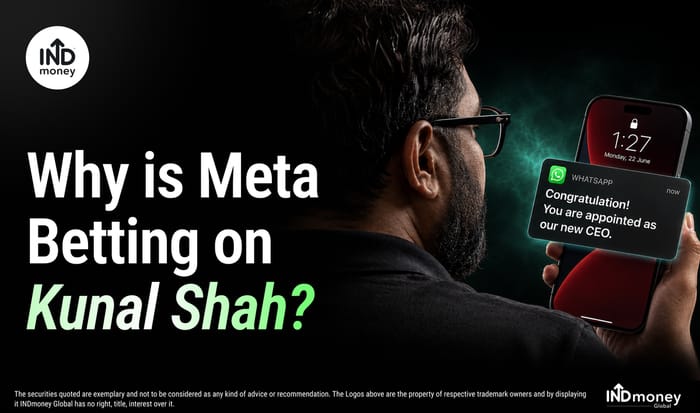
Meta on On June 22, 2026 announced it was investing $900 million in CRED. In the same breath, it announced that CRED's founder Kunal Shah would leave his own company to run WhatsApp globally. Will Cathcart, who spent seven years building WhatsApp from one billion to three billion users, was stepping aside. On paper, this looked like a standard corporate investment with a leadership bonus. It was not.
Meta has spent six years and over $6.6 billion trying to crack India's payments market. All of it has failed to move the needle. This deal is the course correction.
Let's break down what really happened here, why Meta structured a deal this way, what makes CRED worth buying at a discount, why the world's biggest tech companies keep turning to Indians like Kunal Shah to fix their hardest problems, and why the timing of this announcement is not accidental.
Meta-CRED Deal Explained: Size, Valuation and Stake
Meta gets roughly a 20% minority stake in CRED. No board seat. No access to CRED member data. CRED gets fresh capital to fund its path to IPO. Kunal Shah, who started CRED with $1 million of his own money in 2018, steps down as CEO and joins Meta full time. Miten Sampat, head of strategy since 2020, steps in as interim CEO.
| Deal Term | Details |
| Meta investment | $900 million (primary + secondary) |
| Meta stake in CRED | ~20% minority |
| CRED post-money valuation | $4.5 billion |
| CRED peak valuation (2022) | $6.4 billion |
| Valuation discount to peak | ~30% |
| CRED monthly active users | 1.7 crore |
| CRED FY25 revenue | Rs 2,735 crore (~$325 million) |
| CRED FY25 net loss | Rs 1,457 crore |
| Total payment value on CRED (FY25) | Rs 8.5 lakh crore |
Meta is buying into CRED at a 30% discount to its 2022 peak. For Meta, this is not a charity check. It's a discounted entry into one of India's most profitable user cohorts, people with a credit score above 750.
Meta was early to India's UPI story. WhatsApp Pay launched in beta in 2018, the same year CRED was founded. But India's regulator, the National Payments Corporation of India (NPCI), imposed strict onboarding caps to prevent any single app from monopolizing payments. WhatsApp was capped at one million users to start. By the time the cap was fully removed in late 2024, the race was over.
Here is where India's UPI market stands as of May 2026:
| UPI App | Market Share (May 2026) |
| PhonePe | 46.2% |
| Google Pay | 32.7% |
| Paytm | 7.9% |
| CRED | 0.68% |
| WhatsApp Pay | 0.65% |
WhatsApp has more than 500 million users in India. Its UPI app has 0.65% market share. Zoom out and that number tells you everything. PhonePe and Google Pay together processed close to 79% of India's UPI volume even after losing ground. India processed 18 billion UPI transactions in June 2025 alone. WhatsApp's slice of that is, by any measure, negligible.
The reason isn't a product problem. It's a trust and habit problem. People in India adopted UPI through Google Pay and PhonePe in 2017 and 2018 when WhatsApp Pay was stuck waiting for regulatory clearance. By the time the gates opened, the habits were baked in.
Meta tried to solve this with its 2020 $5.7 billion investment in Jio Platforms, buying a 10% stake to accelerate WhatsApp commerce through JioMart. JioMart on WhatsApp is live, but it did not shift WhatsApp Pay's market position in any meaningful way. CRED is the third attempt at this problem.
Why CRED’s Premium Users Matter for Meta
CRED does not want everyone. That is the model. You need a credit score above 750 to join. As of FY25, it had 17 million monthly active users who collectively processed Rs 8.5 lakh crore worth of payments through the platform in a single year. Around 45% of active members used three or more products. Average revenue per user (ARPU) reached approximately Rs 2,000 annually.
Compare that to India's general UPI population. The average UPI transaction value across all apps in early 2026 was around Rs 1,348. CRED's members process three times BHIM's transaction volumes in rupee terms despite having comparable user counts, because CRED users are by design high-value earners who pay rent, EMIs, insurance premiums, and large merchant bills through the platform.
| Metric | CRED (FY25) |
| Monthly transacting users | 1.26 crore |
| Transaction frequency | 14.4x per user per month |
| Total payment value processed | Rs 8.5 lakh crore |
| Lending AUM | Rs 22,000 crore |
| Gross margin | ~70% |
| ARPU | ~Rs 2,000 |
| Members using 3+ products | 45% of active members |
For Meta, whose core business generated $196 billion in advertising revenue in 2025 (roughly 98% of total revenue), CRED's users are not interesting because of payments. They are interesting because of targeting. India's creditworthy, high-spending users are exactly who global brands, insurance companies, mutual funds, and premium consumer goods companies want to reach.
CRED's behavioral data on what these users buy, how they spend, and what they owe does not transfer to Meta under this deal. But proximity matters. Meta now has an executive relationship with the platform that has earned that trust, and a strategic alignment that may, over time, shape how CRED and WhatsApp products connect.
How NPCI’s 30% Cap Could Help CRED, WhatsApp Pay
Most Meta-CRED deal coverage has focused on the CEO swap. The more important story is the regulatory calendar. The NPCI is planning to enforce a 30% market cap per UPI application. PhonePe today holds 46.2% market share. Google Pay holds 32.7%. Both are above the proposed cap. When enforcement lands, PhonePe and Google Pay will be structurally required to shed volume. That volume has to go somewhere.
WhatsApp is the only mass-market app in India with enough distribution (500 million users) to absorb a meaningful chunk of that overflow. CRED, now strategically aligned with Meta and WhatsApp, adds the premium user layer. A user who currently pays through Google Pay might land on WhatsApp Pay by default as NPCI forces rebalancing.
A CRED user making high-value payments might get a seamless WhatsApp integration. The combination, timed right, could move WhatsApp from 0.65% to something significantly higher without requiring Meta to fight for every customer individually. This timing is not coincidental.
Meta has watched the UPI market from the outside for six years. It is making its biggest India move now, right before the regulatory landscape is set to reshuffle the deck.
Why Kunal Shah’s WhatsApp Role Matters for Meta
The appointment of Kunal Shah to run WhatsApp continues a pattern that has been building for two decades. India has produced the CEOs of Google, Microsoft, Adobe, IBM, YouTube, Cognizant, Palo Alto Networks, and now WhatsApp. But there is something different about what just happened.
| Company | Indian-Origin Leader | Background |
| Google/Alphabet | Sundar Pichai | Rose through Google (Chrome, Android) |
| Microsoft | Satya Nadella | 22 years at Microsoft before becoming CEO |
| Adobe | Shantanu Narayen | Joined Adobe 1998, became CEO 2007 |
| IBM | Arvind Krishna | 30+ years at IBM |
| YouTube | Neal Mohan | VP at Google before YouTube CEO |
| Cognizant | Ravi Kumar S | Former President of Infosys |
| Kunal Shah | Founded FreeCharge (sold), founded CRED |
Every name above except Shah is a corporate lifer, someone who spent decades inside one company and was elevated to the top. Satya Nadella spent 22 years at Microsoft before Ballmer left. Sundar Pichai built Chrome and Android before getting the keys to Google. They are extraordinary operators who understood their companies from the inside.
Kunal Shah is the first major Indian startup founder to be recruited externally to lead one of the world's most-used technology platforms. Mark Zuckerberg explicitly described him as someone with a "builder mentality and global perspective." Meta's chief product officer Chris Cox recruited him directly. The signal from Meta is deliberate: WhatsApp needs to be rebuilt, not just managed.
Why does India keep producing this caliber of leadership? Technology entrepreneur Vivek Wadhwa, who has studied this for decades, puts it this way: Indian professionals are "triply selected", they made it through one of the world's most competitive education systems, then cleared US visa requirements that filter for high-end skills, and then climbed corporate ladders in companies where the best rise regardless of origin.
The IITs alone, despite their reputation, accounted for only 15% of Indian founders in Silicon Valley in survey data cited in Fortune, most of the talent came from a wide range of Indian institutions. What connects them is not the school. It is the combination of resource scarcity, competition, and adaptability that India's environment builds into anyone who succeeds there.
The Bottom Line: Does This Move the Needle on Meta Stock?
The short answer is: not this quarter. Possibly over the next two to three years if the India payments thesis plays out. What this deal does, is add a strategic layer to a stock that is already cheap relative to its own history.
| META Valuation Metric | Current (June 2026) |
| Stock price | ~$569 |
| Market cap | ~$1.43 trillion |
| TTM P/E ratio | ~21x |
| Forward P/E ratio | ~17.3-20x |
| 10-year average P/E | ~26.9x |
| Discount to 10-year average P/E | ~23% |
| Analyst consensus price target (1-year) | $827 |
| 52-week high | $796.25 |
| TTM revenue | $214.96 billion |
| TTM net profit | $70.59 billion |
| Operating margin (Q1 2026) | 41.21% |
Source: Google Finance, INDmoney, GuruFocus, Meta Earnings Report (10-Q)
Meta is trading 23% below its 10-year average P/E. That is not because the business has gotten worse. Revenue is $214.96 billion. Net profit is $70.59 billion. Operating margins are above 40%. The stock has pulled back roughly 27% from its 52-week high because of heavy AI capex commitments and uncertainty about when that spending pays off. The CRED deal does not solve that question, but it does add a second thesis.
| Bull Case | Bear Case |
| Meta’s Asia-Pacific ARPU is around $22 per user annually, versus $233 in the US and Canada, showing a nearly 10x monetization gap. | WhatsApp Pay had unrestricted access to India after NPCI removed user caps in late 2024, but still has only 0.65% UPI share. |
| India likely sits at the lower end of Asia-Pacific ARPU, which means even small monetization gains can be meaningful. | WhatsApp Pay’s UPI share is even lower than CRED’s 0.68%, despite WhatsApp having a much larger user base. |
| CRED’s premium users generate around ₹2,000, or $24, per user annually, showing that high-value Indian users can be monetized. | Meta’s $5.7 billion Jio investment in 2020 was also built around WhatsApp commerce, but has not produced material India payments revenue. |
| If WhatsApp India adds just $5 ARPU across 500 million users, it could mean around $2.5 billion in incremental annual revenue. | Meta’s core ad business is already strong: Q1 2026 EPS beat estimates by 9.6%, ad impressions grew 19%, and average price per ad rose 12%. |
| WhatsApp Pay crossing 3-5% UPI share could be the key signal that India monetization is finally working. | The risk is that CRED becomes another India payments bet that consumes capital and attention without changing user behaviour. |
| The CRED deal is an upside option. The main META thesis remains valuation, margins and the AI-led ad tailwind. | India may remain Meta’s biggest WhatsApp user market, but not a major revenue driver. |
Meta's market cap is approximately $1.4 trillion. The $900 million CRED investment is 0.06% of that. It will not show up in Meta's revenue, margins, or EPS in any meaningful way in the near term.
Meta next reports earnings on July 29, 2026. Analysts will ask about this on the call. Zuckerberg will frame it as a long-term India bet. The stock will not move because of CRED alone.