

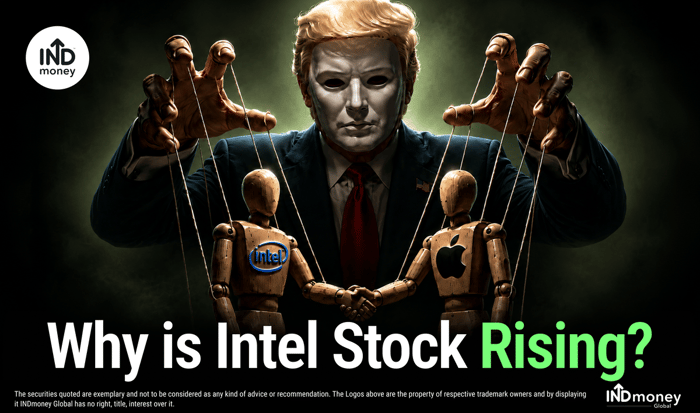
- What Trump Announced About Intel-Apple Chip Deal
- How the Intel-Apple Deal Would Actually Work
- Why Apple Needs Intel as a Second Chip Supplier
- The Government as Intel Co-Investor and Deal Broker
- Intel's Financial Reality: Revenue, Foundry Losses and Free Cash Flow
- Can Intel Handle Apple’s Chip Manufacturing Needs?
- What the Stock Has Already Priced In
- Is Intel Stock a Buy After the Apple Deal?
One post from Donald Trump’s Truth Social on June 18, 2026, and Intel's stock shot up over 9% in pre-market trading, pushing it back toward its all-time high. A company that was trading near $19 a year ago now carries a market cap approaching $600 billion, and the man who just handed it its biggest potential commercial win owns a 10% stake in it.
Let's break down what this Intel stock jump means, how the US government became Intel's most powerful promoter, what the real financial picture looks like behind the excitement, and how investors should think about a stock that has already climbed over 200% this year before today's move.
What Trump Announced About Intel-Apple Chip Deal
The full text of Trump's Truth Social post reads: "Stupid Presidents took our Economy for granted, and let Taiwan and others steal our Semiconductor Factories. When I won my Second Term (Third, actually!), it was clear America needed its Semiconductor Industry to come back to the U.S.A. We design everything, but we need to BUILD it here, NOW! So I decided to help Intel because we need to design and build our Chips right here in America. Apple has agreed to work with Intel to design and build its Chips in America."
Before reading anything further, one fact is worth sitting with: as of June 18, 2026, neither Apple nor Intel has issued any official statement confirming this deal. The Wall Street Journal first reported a preliminary agreement between Apple and Intel in early May 2026, after more than a year of closed-door discussions.
What Trump posted today is a presidential restatement of that still-unconfirmed preliminary deal. The market reacted with a 9% pre-market pop. Apple stock moved about 0.6%. That gap tells you who the market thinks benefits more.
How the Intel-Apple Deal Would Actually Work
Apple designs every chip it puts inside its devices like. The A-series in iPhones, the M-series in MacBooks and iPads, the chips inside Apple Watch, all designed in-house by Apple's silicon team. What Apple has never done is run a chip factory. It outsources all manufacturing, and for its most advanced chips, that has always meant one company: TSMC in Taiwan.
What Intel would do under this arrangement is manufacture chips to Apple's specifications. Intel runs the factory; Apple stays the designer. This is called "foundry" or "contract manufacturing".
Think of it the way large Indian clothing brands design everything in-house but send manufacturing to specialized units in Tirupur or Surat. The brand owns the design; the factory gets the order.
Analysts who have tracked the talks expect the arrangement to start with relatively simpler chips: M-series processors for entry-level iPads and Macs, rather than iPhone chips. iPhone chips sit at the absolute frontier of manufacturing complexity, and Intel's credibility on ARM-based chip production (the architecture Apple uses) is still being established.
Intel's current most advanced manufacturing node, called 18A, entered volume production at its Arizona fab in December 2025. The next-generation 18A-P only entered what's called "risk production", an early validation stage, at the VLSI Symposium in Honolulu on June 16, just two days before Trump's announcement.
That timing is not accidental.
Why Apple Needs Intel as a Second Chip Supplier
Apple CEO Tim Cook, on the company's most recent earnings call, told analysts that iPhone 17 production had been "constrained during the quarter" because TSMC could not produce enough A19 chips to meet demand. That wasn't a quality problem. It was a queue problem.
TSMC makes chips for Nvidia, AMD, Google, Amazon, and every other company racing to build AI infrastructure. Apple is TSMC's second-largest customer by revenue, after Nvidia. But when the factory is overbooked, everyone waits, and Apple left iPhone sales on the table because its sole supplier was overwhelmed.
According to analyst Ben Bajarin of Creative Strategies, "Intel is the only place that can scale up capacity as a viable second source."
The geopolitical element compounds this. TSMC's most advanced fabs sit in Taiwan. The US government's anxiety about a potential China-Taiwan conflict disrupting global chip supply has been building for years. Apple diversifying to a domestic US manufacturer is both a business hedge and a political inevitability given the current environment in Washington.
The Government as Intel Co-Investor and Deal Broker
In August 2025, the Trump administration converted approximately $8.9 billion of previously allocated CHIPS Act grants into a 10% equity stake in Intel. The government's Intel position is now worth more than $50 billion, a roughly 5x return in under a year. Trump himself said publicly he "should have asked for more."
That one fact reframes today's announcement entirely.
When a sitting president is simultaneously a major equity holder in a company, has committed $10 billion in factory expansion funding to that company, and then uses the presidential platform to announce the company's biggest potential customer relationship, that is not standard industrial policy.
That's something closer to a government-backed investor using its highest-profile channel to announce a commercial deal. The distinction matters for investors.
This is structurally different from the US government's GM rescue in 2009 or the Chrysler support in 1979, which were reactive bailouts of companies in distress. With Intel, the government bought in proactively, then used its platform to attract the most coveted chip contract in the consumer electronics industry.
There is an implicit floor under Intel's strategic relevance for as long as this administration and this policy direction hold. But there is also an implicit risk: what happens to that floor if the political calculus changes?
Intel's Financial Reality: Revenue, Foundry Losses and Free Cash Flow
The turnaround story has genuine substance. Intel's Q1 2026 results were the sixth consecutive quarter of revenue beats, and several numbers stood out.
| Key Metrics | Result | Context |
| Total Revenue | $13.58 billion | Beat Wall Street estimate by 9% |
| Data Center & AI (DCAI) Revenue | $5.05 billion | +22% year over year |
| Intel Foundry Revenue | $5.42 billion | +16% year over year |
| External Foundry Revenue | $174 million | Small fraction of total foundry revenue |
| Intel Foundry Operating Loss | -$2.4 billion | Still losing money per quarter |
| Non-GAAP EPS | $0.29 | vs consensus of roughly $0.02 |
| Free Cash Flow | -$2.54 billion | Heavy capital expenditure phase |
| Q2 2026 Revenue Guidance | $13.8B-$14.8B | Above Street expectations |
The number that matters most for the Apple thesis is the external foundry revenue: $174 million out of $5.42 billion total foundry revenue. Nearly everything Intel's foundry currently makes is for Intel's own products. The entire Apple partnership story, and the bull case for the stock, rests on whether that $174 million can grow into something that actually changes Intel's economics.
Intel CEO Lip-Bu Tan, who took over the company in 2025, told analysts on the Q1 earnings call that he expects formal foundry customer commitments to arrive in the second half of 2026. Q2 earnings are scheduled for July 23. That external foundry revenue line will be the first concrete check on whether the Apple discussions are translating from conversations into contracted production.
Can Intel Handle Apple’s Chip Manufacturing Needs?
Intel's 18A node gets most of the attention. It is genuinely impressive: the 18A-P variant delivers 9% higher performance or 18% lower power consumption compared to standard 18A, and it's 20% more heat resistant. Yield rates, according to Intel CFO David Zinsner on the Q1 call, are running ahead of internal targets, roughly two quarters ahead of schedule.
But there are two hurdles the hype tends to skip over:
- Intel must prove it can manufacture Apple’s ARM-based chips at scale, even though its core expertise has historically been x86 chips. The biggest test will be achieving strong yield rates consistently.
- The timeline is still early. Intel’s 18A-P node has only entered risk production, so Apple chip production at meaningful volume is unlikely before 2027.
Today's stock move is pricing in a future that may be 12 to 18 months away from generating any meaningful revenue.
What the Stock Has Already Priced In
Intel's run in 2026 has been one of the most dramatic in large-cap US market history.
| Intel Stock Milestones | Price / Event |
| 52-week low (one year ago) | ~$18.97 |
| January 1, 2026 opening price | ~$36.90 |
| Post-Q1 2026 earnings (April 23) | +23.6% single-day surge |
| Bloomberg report on Apple discussions (May 5) | +14% single-day surge |
| All-time high (May 11, 2026) | $132.75 |
| Close on June 17, 2026 | $121.10 |
| Pre-market move on June 18, 2026 | ~+9% |
| Analyst consensus price target | ~$82-$93 |
Sources: MacroTrends, 24/7 Wall St., Investing.com, TIKR
The Apple story was already partly in the stock. Bloomberg reported Apple-Intel discussions on May 5; the stock jumped 14% that day. The Wall Street Journal reported a preliminary deal in early May; the all-time high followed on May 11. Today's 9% is a presidential restatement of news that markets had already begun pricing in six weeks ago.
The analyst consensus price target sits around $82-$93, depending on the source. Bank of America maintained an Underperform rating, while Evercore ISI moved to Outperformand Mizuho raised its target to $124. None of those targets is remotely close to where the stock is trading today.
| Analyst | Rating / View | Price Target |
| INDmoney Analyst consensus | Hold | $93.12 |
| Bank of America | Underperform | $56 |
| Evercore ISI | Outperform | $111 |
| Mizuho | Raised target | $124 |
That doesn't mean the stock is wrong. It means the stock is pricing in a successful foundry transformation that is directionally real but unproven at scale. The gap between the stock price and the analyst targets reflects that gap between the direction and the proof.
Is Intel Stock a Buy After the Apple Deal?
The Apple deal may be directionally positive, but it does not fix Intel overnight. The real question is whether foundry interest turns into meaningful revenue. For investors who bought Intel (INTC) stock in May at $100+ or who are considering entering at $130, the more relevant question is: what's the next catalyst that isn't yet in the price?
Bull Case vs. Bear Case for Intel Stock
| Bull Case | Bear Case | |
| Apple Deal | Transformative contract that anchors foundry credibility and attracts more customers | Still unconfirmed officially; even if real, volume revenue is 12-18 months away |
| Foundry Business | Yields ahead of schedule, pipeline includes Nvidia, Tesla/Terafab, Google | External revenue is just $174M/quarter; foundry loses $2.4B per quarter |
| Government Backing | 10% US equity stake + $10B investment creates a structural floor competitors don't have | Political floor can shift; Intel's success becomes a policy debate, not just a business one |
| Technology | 18A and 18A-P ahead of internal targets; 14A already outpacing 18A at comparable stage | Intel has never manufactured ARM chips at scale; final qualification on 18A-P not complete |
| Financials | Six straight revenue beats; DCAI revenue +22% YoY; Q2 guidance above consensus | Free cash flow negative $2.54B; stock trades 30-45% above analyst consensus |
For long-term investors, Intel’s foundry turnaround story looks more credible than before. But the next catalyst is not the Apple headline. It is external foundry revenue. That number was just $174 million. If it starts rising meaningfully, it would show that Apple and other customer discussions are turning into actual production.
The opportunity is real, but entry needs discipline. Intel still has negative free cash flow, no confirmed Apple deal, and a valuation already pricing in a successful turnaround.