

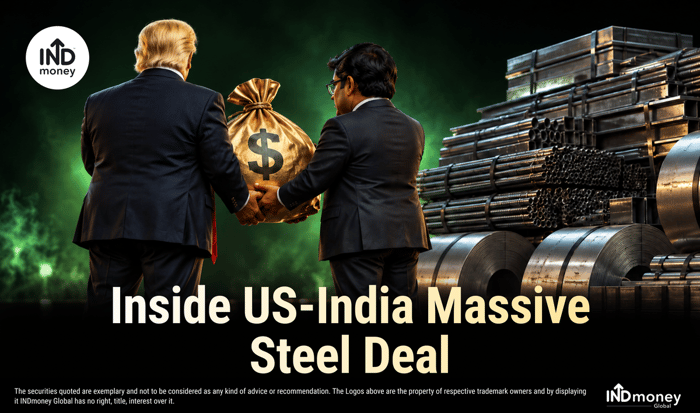
- What is Essar's $18 billion US steel project?
- Why would an Indian group build steel in America?
- How large could the economics be?
- Has the $15 billion Iowa plant been financed?
- Can Indian investors buy shares in this deal?
- What does the project mean for US steel stocks?
- So how big is this for Indian investors?
An Indian industrial group has announced one of the biggest steel investments in the United States. Essar-backed Mesabi Metallics plans a $15 billion steel complex in Iowa linked to its Minnesota iron ore operation. The combined figure is $18 billion. For an Indian investor, though, the first question is less exciting and more useful: which company's shareholders actually own the project's future profits?
Let's break down what Essar has announced, why it wants to produce steel inside the US and how large the opportunity could become. The ownership and financing details matter as much as the proposed factory's size.
What is Essar's $18 billion US steel project?
Essar Group is sponsoring Mesabi Metallics, a US company developing an iron ore mine and direct-reduction-grade pellet plant in Minnesota. Mesabi announced on September 28 that it would connect that operation to a new steelmaking complex in Iowa. The proposed mill would use iron derived from Minnesota ore alongside scrap steel in an electric arc furnace, or EAF, to produce finished steel for American customers.
| Announced component | Amount | What the number means |
| Minnesota mine and pellet operation | About $3 billion | Investment being spent to complete the upstream operation; a substantial part relates to work already undertaken |
| Proposed Iowa steel complex | $15 billion | The new mill investment announced at the White House |
| Combined project | $18 billion | Minnesota plus Iowa, not $18 billion of newly announced Iowa spending |
| Iowa phase-one output | 7.5 million tons a year | Planned annual capacity, not present production |
| Iowa eventual output | About 10 million tons a year | Expansion ambition beyond phase one |
Sources: Mesabi Metallics' September 28 announcement and project page; White House announcement dated September 28, 2026. “Tons” follows the White House wording; no conversion to metric tonnes is assumed.
Mesabi says the Minnesota operation is entering start-up and the US Export-Import Bank, or EXIM, says the mine and pellet plant could produce up to 7 million tons of high-grade pellets a year. The first steel from Iowa is targeted around 2030, according to the project timetable reported at the announcement. That is a multi-year build: the mine is further along than the planned steel complex.
The distinction is important because the headlines can make this sound like a completed $18 billion transaction or an operating 10-million-ton steelmaker. It is neither. The announced size is meaningful, but construction, financing, commissioning and sales still have to follow.
Why would an Indian group build steel in America?
The commercial logic has three linked parts: make the key iron input locally, convert it into steel locally and sell to US users. Mesabi expects to supply industries such as automobiles, infrastructure, energy, shipbuilding and defence. Domestic production can appeal to buyers concerned about delivery times, import dependence and supply-chain requirements.
US trade policy strengthens that logic. The United States increased its Section 232 tariff on many imported steel products to 50% in 2025 and later modified the regime for various steel and derivative categories. The exact duty depends on the product and applicable rules; it should not be treated as a universal 50% charge on every related item. A mill physically producing in Iowa is positioned differently from an Indian mill exporting finished steel into that tariff framework.
Think of the plan as an effort to put an Indian-owned business inside the protected market, rather than to ship Indian steel through the border. That can improve access to US customers while making the group's returns dependent on US steel prices, energy costs, labour, construction costs and policy. If tariffs change over the project's long operating life, one part of the investment case changes too.
The mine-to-mill design is also more specific than a generic “green steel” claim. Direct reduction removes oxygen from iron ore to make metallic iron. Feeding it while hot into an electric arc furnace together with scrap can lower energy use relative to some conventional routes. Actual emissions will depend on the plant's fuel, electricity, scrap mix and operating performance. The announcement provides a technology plan, not verified future emissions or a guaranteed cost advantage.
How large could the economics be?
The proposed Iowa spend works out to roughly $2,000 per ton of phase-one annual nameplate capacity: $15 billion divided by 7.5 million tons. At the eventual 10-million-ton ambition, the same arithmetic would be $1,500 per ton, but that assumes the stated $15 billion covers the additional capacity. No detailed phase-by-phase capital budget has been published, so the latter figure is only a scale illustration.
A steel plant does not earn money from capacity alone. It must run at high utilisation and earn a margin after paying for iron units, scrap, energy, labour, transport and other operating costs. The following thought experiment shows how sensitive a $15 billion investment could be to those two variables. It uses phase-one capacity only and an assumed integrated EBITDA per ton, so it does not add a separate mine profit on top.
| Illustration, not company guidance | Low case | Middle case | Strong case |
| Phase-one capacity | 7.5 million tons | 7.5 million tons | 7.5 million tons |
| Assumed utilisation | 70% | 80% | 90% |
| Illustrative steel sold | 5.25 million tons | 6.00 million tons | 6.75 million tons |
| Assumed integrated EBITDA per ton | $100 | $200 | $300 |
| Illustrative annual EBITDA | $525 million | $1.20 billion | $2.03 billion |
| $15 billion Iowa spend divided by annual EBITDA | About 28.6 years | 12.5 years | About 7.4 years |
This framework makes the opportunity understandable without inventing a valuation for private Mesabi. In the middle illustration, a mill operating at 80% of initial capacity and earning $200 per ton generates $1.2 billion in annual EBITDA. That sounds substantial, but a $15 billion build still represents 12.5 times that annual figure before the real costs excluded above. A weaker price-cost spread can change the picture quickly. Conversely, higher utilisation, more profitable products and a durable cost advantage could make the economics much stronger.
Mesabi and the White House also project $95 billion in economic output during construction and the first ten years of full operation. This is an estimated ripple effect across suppliers, jobs and other activity. It is not $95 billion of Mesabi revenue, profit, shareholder value or signed orders. Investors should not put it into a company sales model.
Has the $15 billion Iowa plant been financed?
The project already has financing activity around Minnesota, but it is essential to read the amounts correctly. EXIM said on September 28 that its board had approved a $770 million direct loan for Mesabi's Minnesota iron ore mine. Earlier EXIM material discussed support of up to $10 billion for the development and expansion of the Minnesota mining and processing operation. “Up to” is a potential ceiling or support framework; the $770 million approval is a specific announced transaction. Neither number demonstrates that the entire $15 billion Iowa mill has a closed financing package.
Mesabi had also announced private financing for the mine earlier in 2026. Those disclosures show that the upstream project is moving forward. They do not answer how much equity Essar will ultimately contribute to Iowa, what debt terms the mill will secure or whether partners will share the capital burden. These are central questions because a large plant can be commercially attractive yet deliver weak equity returns if construction overruns or expensive debt absorb the cash generated later.
There is an operating question as well. EXIM describes up to 7 million tons of annual Minnesota pellet production, while the White House gives the Iowa plant an initial 7.5 million tons of steel capacity. Those figures refer to different products and are not a one-for-one material balance. Mesabi says its furnaces will use both direct-reduced iron and scrap. The final feedstock proportions, additional sourcing needs and delivered costs will determine how much of the mill's output is economically covered by the group's own mine. It is premature to infer complete input self-sufficiency from the two headline capacities.
Can Indian investors buy shares in this deal?
Essar Group is privately held and Mesabi Metallics is not an Indian listed steel company. Buying a share with “Essar” in its name does not automatically give the shareholder ownership of the Minnesota mine or Iowa mill. This is the most important distinction for anyone trying to translate the announcement into a trade.
| Investor route or company | Connection to the announcement | What would establish a financial benefit? |
| Essar Group and Mesabi Metallics | Project sponsor and developer | Direct economics, but no straightforward Indian exchange-listed share in the project |
| Essar Shipping | A separately listed Essar-linked shipping company | A disclosed shipping contract, investment or other material economic interest; the shared group name is insufficient |
| Black Box | A separately listed Essar-linked digital infrastructure business | A disclosed technology or infrastructure contract; no automatic right to Mesabi earnings |
| Indian steel producers such as Tata Steel or JSW Steel | Industry comparators, not announced project owners | Evidence that US trade and capacity changes affect their own sales, prices or margins |
| Indian engineering or equipment suppliers | Possible future bidders, not confirmed beneficiaries | A named order, its value, margin and expected delivery schedule |
The historical name can be confusing too. The former Essar Steel India business was acquired by ArcelorMittal and Nippon Steel in 2019 and became part of AM/NS India. That Indian plant is not this Essar-sponsored US venture. Essar Shipping and Black Box are listed businesses associated with the broader group, but a corporate relationship is not the same thing as owning Mesabi's cash flows.
For Tata Steel, JSW Steel and other Indian steel stocks, this is mainly a long-term market signal. It shows the attraction of manufacturing close to US buyers when trade barriers are high. If the Iowa plant reaches scale, it may eventually compete in some US product markets or change import demand. It does not immediately change the earnings of an Indian producer without evidence of a relevant market overlap. Indian steel companies' domestic demand, raw-material costs and their own international assets remain more direct drivers of their valuations.
Could an Indian contractor win work on a $15 billion build? Of course it could bid. But the proposal stresses local US supply chains and contractors. An investor in Larsen & Toubro or another engineering firm needs an actual exchange filing naming the project and contract value before putting revenue into an estimate. Counting the entire US capex as an opportunity for Indian listed companies would be a category error.
What does the project mean for US steel stocks?
American producers offer a more direct listed-company lens on the future competitive effect. Nucor and Steel Dynamics operate large electric arc furnace businesses. Cleveland-Cliffs has substantial iron ore and steel exposure. Mesabi's planned mine-to-mill model sits between those approaches: control over an ore input combined with EAF steelmaking.
| Business model | What it could gain or face if Iowa is built |
| Mesabi / Essar | Access to a protected domestic market, but a very large financing and construction burden |
| Established US EAF producers | More domestic capacity could bring competition for customers and scrap, though the effect depends on products and the pace of ramp-up |
| Integrated ore and steel producers | A new competitor for high-quality steel and a change in demand for domestic iron units |
| US steel buyers | Potential additional local supply; lower prices are possible if capacity grows faster than demand, but they are not guaranteed |
The key timing point is that today's incumbents sell steel now while Mesabi's Iowa plant is aimed at production years from now. A proposed 2030 start means current-quarter earnings at Nucor, Steel Dynamics or Cleveland-Cliffs should not be mechanically revised as if new supply had already arrived. The longer-term issue is whether the market will absorb the new capacity at attractive prices.
So how big is this for Indian investors?
For Indian industry, it is a major demonstration that Indian-controlled capital can sponsor a US mine-to-steel supply chain at global scale. For the typical Indian listed-stock portfolio, the immediate direct impact is much narrower. The project's equity value sits with its private sponsor and future financial partners, while listed-company spillovers depend on contracts, export exposure and eventual steel-market competition.
There are four milestones worth following. First, whether Mesabi brings the Minnesota pellet operation to stable commercial output. Second, the financing, site approvals, construction contracts and final design for Iowa. Third, the actual steel product mix and feedstock economics. Fourth, after start-up, utilisation and integrated EBITDA per ton. These are the steps that can turn an $18 billion announcement into a profitable business rather than an impressive capital-spending figure.
The investor takeaway is straightforward: the scale is real as a proposal, but the India-market opportunity cannot be read from the headline dollar amount. Check ownership first, confirmed orders second and steel economics third. Only then can the announcement be connected responsibly to a listed share.