

- What Happened to Gold Prices in August 2026?
- Why Did Gold Rise So Much in August?
- What Suddenly Changed at the End of August?
- Why Do Higher Interest Rates Hurt Gold?
- Why Is Gold Falling When the Middle East Conflict Is Getting Worse?
- Profit-Taking Made the Fall Faster
- Is the Gold Rally Over?
- What Could Move Gold Prices Next?
- Final Take
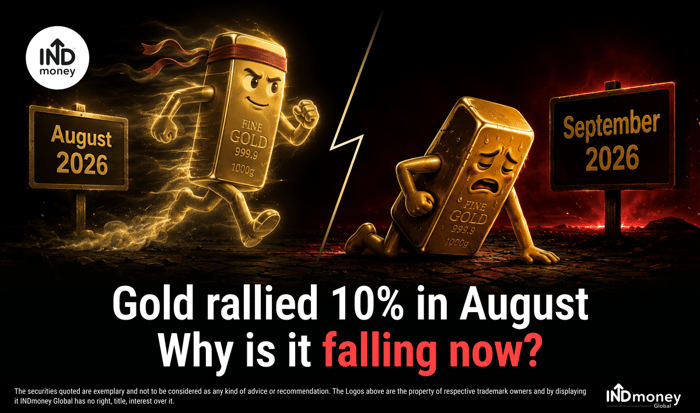
Gold had a huge August. Its price rose by about 10% during the month and briefly touched $4,696.18 per ounce, its highest level in more than three months. Then the mood changed. Gold fell more than 3% on August 28 and was trading near $4,430 per ounce on September 1.
This means gold lost about 5.7% from its August peak in less than a week. The surprising part is that global tensions have not eased. In fact, the conflict between the US and Iran has intensified and oil prices have moved higher.
So why is an asset that people normally buy during uncertain times falling?
Let's break down what pushed gold higher in August, what suddenly changed and why US interest rates are now having a bigger effect on gold than war headlines.
What Happened to Gold Prices in August 2026?
Gold recorded its strongest monthly performance since January, but the rally and the reversal were both unusually fast.
| Date | What happened | Why it mattered |
| August 19 | Spot gold jumped 3.5% to about $4,487 | A US Treasury announcement pushed bond yields and the dollar lower |
| Late August | Gold touched $4,696.18 | This was its highest level in more than three months |
| August 28 | Gold fell more than 3% | The US Federal Reserve sounded more open to another interest-rate hike |
| September 1 | Gold traded near $4,430 | It was about 5.7% below its August peak but still about 10% higher over August |
The story is simple. Gold rose when investors thought US interest rates would remain unchanged. It started falling when the market suddenly believed another rate hike had become much more likely.
Why Did Gold Rise So Much in August?
Gold did not rise because of one event. Three forces came together.
Investors Expected US Interest Rates to Stay Unchanged
Gold does not pay interest. This makes it more attractive when interest rates are expected to stay low or fall.
During the middle of August, weaker US employment data and softer inflation reduced expectations of another rate hike. On August 17, markets placed the chance of a September hike at only 31%, down from 51% a month earlier.
The US dollar also weakened. Gold is priced in dollars, so a weaker dollar makes it cheaper for buyers using currencies such as the euro, yen or rupee. This can increase demand for gold.
A US Treasury Announcement Gave Gold a Big Push
On August 19, the US Treasury said it would at least double the size of its buybacks for certain longer-term government bonds. The maximum amount was raised from $2 billion to at least $4 billion per operation, starting September 9.
A bond buyback means the government purchases some of its older bonds from the market. This can improve trading in the bond market and support bond prices. When bond prices rise, their yields normally fall.
That is exactly what happened. Long-term US bond yields and the dollar fell after the announcement. Gold jumped 3.5% on the same day.
The move also created a bigger worry. Some investors saw the buybacks as a sign that the US bond market needed extra support. This increased concerns about heavy government borrowing and the long-term value of the dollar. Gold often attracts buyers when confidence in paper currencies weakens.
War and Central-Bank Buying Added Long-Term Support
The conflict in the Middle East, worries about government debt and uncertainty about inflation also encouraged demand for gold.
This demand was not coming only from short-term traders. Central banks purchased 289 tonnes of gold during the second quarter of 2026. That was 62% more than a year earlier. However, their total purchases of 345 tonnes in the first half were the lowest for a first half since 2022.
Central banks normally buy gold to diversify their reserves and protect them during financial or political shocks. Their buying does not stop gold from falling for a few days, but it can support demand over a longer period. The slower first-half total also shows that this support should not be treated as a guarantee that prices will keep rising.
What Suddenly Changed at the End of August?
The turning point came on August 28, when Federal Reserve Chair Kevin Warsh spoke at the Jackson Hole conference.
He said that inflation was still too high and that the Fed had more work to do if inflation did not move clearly towards its 2% target. This sounded like a warning that another interest-rate hike could be needed.
The concern was supported by actual data. The Fed's preferred inflation measure was running at 3.7%, well above the 2% target. The US economy and job market were also holding up, giving the central bank more freedom to raise rates without immediately damaging growth.
The market reaction was sharp. The estimated chance of a September rate hike rose from about 36% before the speech to roughly 65% by September 1.
Gold fell more than 3% on the day of the speech. It was the metal's biggest one-day decline since June 10.
Why Do Higher Interest Rates Hurt Gold?
The reason is easier than it sounds.
Gold may rise in value, but it does not pay regular interest. US government bonds do pay interest. When bond yields rise, investors can earn a better return from bonds without taking the price risk of holding gold.
| When US rates are lower | When US rates are higher |
| Bonds offer less interest | Bonds offer more interest |
| Gold looks more attractive | Gold looks less attractive |
| The dollar may weaken | The dollar may strengthen |
| Gold prices often receive support | Gold prices may face pressure |
Think of it as choosing between two lockers. One locker holds gold but gives you no regular payment. The other holds a US government bond and pays interest. When that interest payment rises, more investors may choose the second locker.
This is known as the opportunity cost of holding gold. In simple terms, investors give up more interest income when they choose gold instead of bonds.
US bond ETFs are exchange-traded funds that hold US government or corporate bonds. Unlike gold, these funds can earn interest income, although their prices can also fall when bond yields rise.
The US 10-year Treasury yield rose to about 4.78% on September 1, its highest level since January 2025. The dollar also remained firm, with the US Dollar Index near 99.5. Both developments made it harder for gold to recover.
Why Is Gold Falling When the Middle East Conflict Is Getting Worse?
This is the most confusing part of the story, but it has a simple explanation.
War can affect gold through two different routes.
| Route | What happens | Effect on gold |
| Safe-haven route | Investors become nervous and buy gold for protection | Positive |
| Inflation route | War pushes oil prices higher, inflation rises and rate-hike expectations increase | Negative in the short term |
The safe-haven route is the one most people know. When the world becomes more uncertain, investors often buy gold.
But the inflation route is currently stronger. Brent crude moved above $91 per barrel on September 1 as the US and Iran exchanged fresh attacks around the Strait of Hormuz. Higher oil prices can increase transport, manufacturing and household costs. That can keep inflation high and encourage the Fed to raise rates.
So the market is not ignoring the war. It is reacting to the war differently. Instead of seeing only a reason to buy gold, investors also see a reason for inflation and interest rates to stay higher.
For now, the negative interest-rate effect is stronger than the positive safe-haven effect.
Profit-Taking Made the Fall Faster
Gold had moved from around $4,000 earlier in the summer to almost $4,700 by late August. That gave many short-term traders a large profit.
When the Fed Chair delivered a tougher message, traders had a clear reason to lock in gains. Once prices began falling, short-term selling likely made the decline faster.
Profit-taking was not the main reason gold started falling. The change in interest-rate expectations was the real trigger. Profit-taking simply made the fall faster and larger.
Is the Gold Rally Over?
Our view is that the recent decline looks more like a sharp correction than clear proof that the larger gold story has ended. However, the short-term environment has become less favourable.
Gold now has two separate sets of drivers.
| Short-term pressure on gold | Long-term support for gold |
| Higher rate-hike expectations | Central-bank buying |
| US 10-year yield near 4.78% | Concerns about US government debt |
| A firm US dollar | Geopolitical uncertainty |
| Profit-taking after a fast rally | Demand for protection against currency weakness |
The short-term drivers can move the price sharply over a few days. They explain why gold is falling now.
The long-term drivers move more slowly. They explain why central banks and long-term investors may continue holding gold even during a correction.
This distinction is important. A strong long-term case does not mean gold must rise every week. Similarly, a short-term fall does not automatically mean that long-term demand has disappeared.
Gold exposure is available through different products, including Indian gold ETFs, gold mutual funds and US-listed gold ETFs. These products are not identical. US-listed gold ETFs trade in dollars, so their returns in rupee terms can also be affected by currency movements.
What Could Move Gold Prices Next?
The next major move is likely to depend on US economic data and the Federal Reserve decision in September.
| What may happen next? | How markets may react? | Possible effect on gold |
| US employment data weakens | Rate-hike expectations may fall | Gold may receive support |
| US inflation stays high | A September rate hike may look more likely | Gold may remain under pressure |
| Oil prices continue rising | Inflation and bond yields may rise | Negative unless safe-haven buying becomes stronger |
| The dollar weakens | Gold becomes cheaper for non-US buyers | Gold may receive support |
| Central banks keep buying | Long-term demand remains firm | Supportive over a longer period |
The most useful numbers to watch are the chance of a September Fed hike, the US 10-year Treasury yield and the US Dollar Index. If all three rise together, gold may remain under pressure. If they begin falling, gold may find room to recover.
Final Take
Gold is not falling because investors have stopped seeing it as a safe asset. It is falling because the market now believes another US interest-rate hike has become much more likely.
The Fed Chair's tougher inflation message pushed bond yields and the dollar higher. Rising oil prices then added to inflation worries. This turned the Middle East conflict into both a reason to seek safety and a reason to expect higher interest rates.
At the moment, the interest-rate effect is winning.
If US economic data weakens and rate-hike expectations fall, gold may regain support. If inflation, oil prices, bond yields and the dollar remain high, gold may stay under pressure even if global tensions continue.
That is the main lesson from the August rally and the sudden reversal. Gold responds to fear, but it also competes with assets that pay interest. To understand its next move, investors need to watch both.