

- What Does the Amazon–Uber Eats Partnership Include?
- How Does This Change Amazon’s Existing Grubhub Benefit?
- Why Does Amazon Want Uber Eats Inside Prime?
- Why Is the Partnership Important for Uber?
- How Does the Deal Fit Into the Wider Delivery Competition?
- Could More Orders Fail to Produce Higher Profits?
- What Should Investors Do Next to Assess the Partnership?
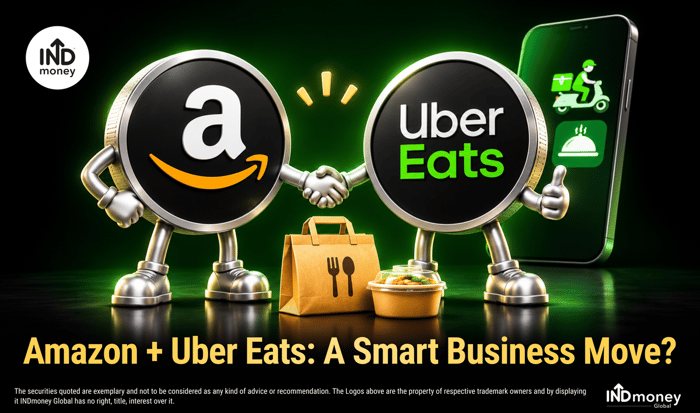
Dinner could become another reason to open Amazon and another reason to keep paying for Prime. Its new partnership with Uber Eats brings restaurant ordering directly into Amazon’s website and shopping app, using the account and payment methods customers already have.
For Amazon, the opportunity is to make Prime more useful. For Uber, it is a chance to reach customers through another major platform. The investment question is whether that convenience creates lasting, profitable business once the launch discounts fade.
The deal also comes with an important change: Uber Eats is replacing Amazon’s Grubhub arrangement. Understanding what customers gain, what changes and who pays for the benefits is essential to judging the announcement.
What Does the Amazon–Uber Eats Partnership Include?
Announced on November 5, the partnership lets US Prime members order restaurant meals through Amazon.com and the Amazon Shopping app, powered by Uber Eats. Customers can use their existing Amazon login and payment methods without downloading another app or creating an Uber account.
The benefit applies to qualifying restaurant orders placed through Amazon. It should not be treated as a general waiver of delivery charges on every order made directly through Uber Eats.
| Detail | What has been announced |
| Eligible customers | US Prime members, including Prime for Young Adults and Prime Access |
| Delivery benefit | $0 delivery fee on qualifying restaurant orders of $25 or more |
| Ordering channel | Amazon.com and the Amazon Shopping app |
| Coverage | Nearly 10,000 US cities and towns, with hundreds of thousands of restaurants |
| Introductory promotion | $20 off each of the first two qualifying orders of $25 or more, subject to the launch offer’s eligibility and timing |
| Prime Visa promotion | Eligible cardmembers earn 5% back on Uber Eats orders through December 5, 2026 |
Sources: Amazon-Uber Eats Partnership announcement.
How Does This Change Amazon’s Existing Grubhub Benefit?
Amazon already offered restaurant ordering inside its website and app through Grubhub. The Uber Eats deal therefore changes the delivery partner and the offer; ordering food within Amazon is not itself a new capability.
The previous arrangement included a Grubhub+ membership. The new announcement describes delivery-fee benefits and promotions through Amazon, rather than a full Uber One membership.
| Feature | Previous Grubhub arrangement | New Uber Eats arrangement |
| Main benefit | Grubhub+ membership through Prime | Delivery-fee waiver and exclusive offers through Amazon |
| Advertised qualifying order threshold | Eligible orders over $12 | Qualifying orders of $25 or more |
| Ordering inside Amazon | Available | Available |
| Service fees | Lower service fees were included among Grubhub+ benefits | Service fees still apply |
| Current position | Amazon’s commercial arrangement has ended | New Prime restaurant-delivery partner |
Sources: Amazon US Press Center, Grubhub+ Prime benefit announcement, Amazon US Press Center, Uber Eats partnership announcement, GeekWire.
Previously activated Grubhub+ memberships can continue through December 31, 2027, according to a Grubhub spokesperson.
This comparison explains why the new offer will not necessarily be better for every customer. Restaurant selection and local availability matter, while a higher qualifying order threshold can make the benefit less useful for smaller meals.
It also prevents a misleading interpretation of the announcement: a $0 delivery fee does not mean a checkout total without other charges. The final bill remains more relevant to customer behaviour than the delivery-fee headline alone.
Why Does Amazon Want Uber Eats Inside Prime?
The clearest business reason is to give customers another recurring use for their membership. Restaurant meals can become part of a household’s weekly routine, potentially making Prime useful between shopping purchases.
For Amazon, that creates two possible advantages:
First, members who regularly use several benefits may have more reasons to renew. The partnership’s value could therefore extend beyond any money Amazon earns directly from food orders: it may help preserve the wider customer relationship.
Second, restaurant ordering gives people another reason to visit Amazon. Those visits could create opportunities to discover groceries or household products, although the announcement does not establish that customers will make additional purchases.
The financial context shows why membership engagement deserves attention. Amazon reported $14.006 billion in subscription-services revenue in Q3 2026, up 11% year over year. This category includes Prime fees alongside other subscriptions; it is not a separate measure of Prime revenue.
Using Uber Eats also lets Amazon offer access to an existing restaurant-delivery network. The strategic attraction is straightforward: Amazon can strengthen its customer offering through a partner that already handles restaurant delivery.
These are potential benefits, not disclosed financial outcomes. Amazon has not quantified how much the partnership could improve renewals, shopping activity or earnings.
Sources: Amazon’s Q3 results and SEC financial disclosure.
Why Is the Partnership Important for Uber?
For Uber, Amazon provides another place for customers to discover restaurants and place orders. Removing the need for a separate account could help reach people who would otherwise hesitate to start using another service.
That could support growth in a business already operating at substantial scale.
| Uber Delivery metric | Q3 2025 | Q3 2026 | Reported year-over-year growth |
| Gross bookings | $23.322 billion | $28.539 billion | 22% |
| Revenue | $4.477 billion | $5.488 billion | 23% |
| Segment operating income | $811 million | $1.057 billion | 30% |
Sources: Uber’s Q3 results and corresponding SEC disclosure. Here, Gross bookings measure the value of transactions handled through the platform, rather than revenue retained by Uber.
The opportunity is to add customers and orders to that existing business. If additional orders make better use of the delivery network, Uber could spread some operating costs across more transactions.
However, an Amazon customer placing an Uber Eats order is not automatically a new customer for Uber. Some people may simply move orders they already placed through Uber Eats into Amazon to receive the benefit.
That distinction determines how much growth the partnership actually creates. New demand would expand the business; moving existing demand between channels could produce a smaller benefit, particularly if it adds promotional costs.
The quarterly figures above also predate the partnership. They provide a baseline for future comparisons and cannot demonstrate the deal’s impact.
How Does the Deal Fit Into the Wider Delivery Competition?
The partnership arrives as retailers and delivery platforms increasingly compete to handle more of a household’s everyday spending.
DoorDash has announced an agreement to acquire Instacart, potentially combining restaurant-delivery capabilities with a broader grocery business. Walmart has also introduced restaurant ordering within its shopping experience.
| Development | Confirmed position | Why it matters |
| DoorDash-Instacart | Proposed acquisition with an equity value of approximately $17 billion | Could strengthen a combined restaurant-and-grocery offering |
| Transaction timing | Expected to close at the end of 2027 or in the first half of 2028, subject to approvals and other conditions | The businesses remain separate until closing |
| Walmart restaurant delivery | Restaurant integrations include Subway and Dunkin’ | Retailers are adding prepared meals alongside other shopping needs |
Sources: DoorDash-Instacart announcement, Walmart’s Subway launch and Dunkin’ expansion.
The competitive question is becoming broader than who delivers dinner. Companies want customers to use their platform for meals, groceries and other recurring purchases.
Amazon and Uber are addressing that opportunity through a partnership. DoorDash is pursuing a major acquisition, while Walmart is adding restaurant integrations to its retail offering.
Those developments explain the strategic importance of the announcement. They do not prove that the Amazon-Uber agreement was negotiated in response to the Instacart transaction or that competitors will automatically lose customers.
Could More Orders Fail to Produce Higher Profits?
Yes. Customers can receive a valuable benefit while the financial return for the companies remains uncertain.
The launch announcement does not disclose revenue-sharing arrangements, how promotional costs are divided or the expected earnings contribution. Those missing details prevent a reliable calculation of what either company might earn from an additional order.
| Unanswered questions | Why investors should care |
| Who funds delivery benefits and discounts? | Higher order volumes may come with higher costs |
| How much demand is genuinely additional? | Orders transferred from an existing channel may add less value |
| Do customers return after introductory offers end? | Repeat use is more informative than discounted trial orders |
| Does the deal improve Prime retention? | Usage alone does not show whether Amazon earns an adequate return |
| How does the Amazon channel affect Uber One? | Overlapping benefits could influence subscription choices |
These are analytical questions arising from the offer. The launch announcement does not provide partnership-specific results or financial terms answering them.
There is also a difference between customer savings and company earnings. The advertised potential saving of more than $175 a year is an estimate based on ordering patterns and available offers, compared with ordering directly through Uber Eats without Uber One. It is not guaranteed for every member.
A strong outcome would involve customers continuing to order without requiring ever-larger incentives. A weaker outcome would involve substantial promotional spending mainly shifting existing orders between platforms.
The difference will emerge through customer behaviour and financial disclosures over time.
What Should Investors Do Next to Assess the Partnership?
My take is to set a higher evidence standard than launch activity. A successful promotion can generate trial orders quickly; a valuable partnership must give customers reasons to return and leave the companies with an acceptable financial return.
Before the next earnings review, write down what would strengthen or weaken the investment argument for each business.
For Amazon, look for management commentary on repeat use, Prime engagement and whether restaurant ordering supports the wider shopping relationship. Subscription-services revenue can provide context, but it includes several businesses and cannot isolate this partnership’s contribution.
For Uber, compare Delivery bookings growth with segment operating income and management’s explanation of promotional spending. Faster bookings growth accompanied by improving profitability would be more encouraging than growth that depends on increasingly expensive incentives.
A practical review can use the following questions:
| Evidence to look for | How to interpret it |
| Repeat ordering after launch promotions | Helps distinguish a lasting habit from discount-driven trials |
| Disclosure of new or reactivated customers | Helps assess whether the partnership expands demand |
| Delivery profitability alongside bookings | Tests whether growth produces an adequate return |
| Clearer commercial terms or management guidance | Makes the earnings opportunity easier to estimate |
| Partnership-specific evidence | Helps separate the deal’s effect from broader business trends |
If the companies do not disclose these details, keep the earnings contribution uncertain. Broader quarterly growth cannot establish that this particular deal is working.
The next useful step is to record the existing financial baseline and update it as evidence arrives. That gives investors a disciplined way to assess the partnership without turning a promising announcement into an assumed earnings upgrade.