

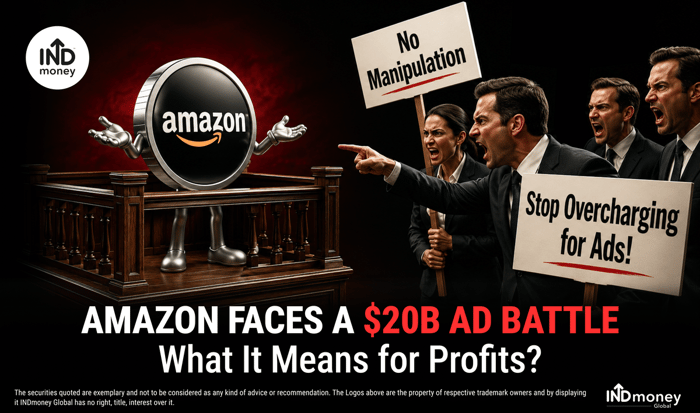
- Amazon’s $20 Billion Ad Lawsuit
- How Amazon Ad Auctions Work
- What the FTC Alleges
- Amazon’s Response
- Why Amazon Ads Matter
- The Real Risk Is Not Just the Fine
- How Amazon Stock Reacted
- What Could Happen Next?
- What Investors Should Track
- Should Amazon Investors Worry?
Amazon has built a nearly $80 billion annual advertising business by showing sponsored products to shoppers who are already ready to buy. Now, US regulators allege that part of this growth came from hidden charges added to advertising auctions. The alleged amount is more than $20 billion.
The immediate financial hit may be manageable for a company of Amazon’s size. The bigger risk is whether a court forces Amazon to change how it prices ads, weakening one of its fastest-growing and likely most profitable businesses.
Let’s break down what the lawsuit alleges, how Amazon’s ad auctions work, what the company says in its defence and why the long-term risk matters more than the possible fine.
Amazon’s $20 Billion Ad Lawsuit
On August 31, 2026, the US Federal Trade Commission, or FTC, and 22 states sued Amazon over its advertising practices.
The regulators allege that Amazon secretly increased the prices paid by advertisers through undisclosed charges in its ad auctions. According to the complaint, these practices may have extracted more than $20 billion from advertisers since 2019.
These are allegations, not proven findings. Amazon has denied wrongdoing and called the case misguided.
| Key lawsuit detail | What it means |
| Alleged overcharges | More than $20 billion |
| Advertisers allegedly affected | Around 1.2 million |
| Small and medium businesses affected | More than 500,000 |
| Period covered | Since 2019 |
| Regulators involved | FTC and 22 US states |
| Relief being sought | Business changes, refunds and other monetary relief |
The final amount Amazon may have to pay has not been decided. Regulators are seeking monetary relief and changes to Amazon’s practices, but the case could take years to resolve.
How Amazon Ad Auctions Work
When someone searches for a product on Amazon, different sellers compete to place their sponsored product near the top of the results.
Advertisers enter the maximum amount they are willing to pay for a click. Amazon then considers both the bid and how relevant the product is to the shopper.
Amazon historically described this as a second-price auction. In simple terms, the winner should pay only slightly more than the next-highest competing bid.
A Simple Auction Example
Suppose two headphone sellers compete for the same advertising position.
| Auction detail | Amount |
| Seller A’s maximum bid | $2.00 |
| Seller B’s bid | $1.20 |
| Normal second-price charge | Around $1.21 |
| Hypothetical Amazon reserve price | $1.70 |
| Final charge after reserve | $1.70 |
In this simplified example, Seller A expected to pay around $1.21 but paid $1.70 because of a reserve price. That is $0.49, or roughly 40%, above the auction-only price.
This is only an illustration, not an actual Amazon auction. However, it shows why sellers need to understand the pricing rules before deciding how much to bid.
What the FTC Alleges
According to the FTC, Amazon began adding a “soft reserve price” to its advertising auctions in 2019.
A soft reserve is a minimum price calculated by Amazon for a particular ad position. The FTC alleges that Amazon used this internally calculated amount instead of allowing the real second-highest bidder to determine the price.
The complaint says this effectively allowed Amazon to act like an extra bidder in its own auction. Regulators argue that advertisers were not clearly told how the system worked.
The FTC also alleges that, by 2024, Sponsored Products advertisers were paying their full winning bid close to 80% of the time. That would make many auctions behave more like first-price auctions, where the winner pays the full amount offered.
Why does this distinction matter? An advertiser may bid aggressively in a second-price auction because it expects to pay less than its maximum bid. If the same advertiser knows it may pay the full bid, it could offer a lower amount.
The FTC’s argument is that Amazon benefited from advertisers bidding under one assumption while the company priced the ads using another system.
Amazon’s Response
Amazon strongly disputes the FTC’s version of events.
The company says advertisers never pay more than their maximum bid. It also argues that reserve prices are commonly used and are needed to reflect the value of premium advertising positions.
Amazon says it increasingly prioritises ad relevance instead of simply selecting the advertiser offering the highest amount. In 2024, approximately 92% of selected Sponsored Products ads were not the highest bids, according to the company.
| FTC’s argument | Amazon’s response |
| Amazon secretly inflated auction prices | Reserve prices reflect the value of each ad placement |
| Advertisers misunderstood what they would pay | Campaign tools clearly state that bids are maximum possible charges |
| Advertisers suffered more than $20 billion in harm | Advertisers received better results and were not harmed |
| Auction charges increased unfairly | Inflation-adjusted cost per click remained flat from 2019 to 2024 |
| Sellers paid more because of hidden pricing | Average winning bids fell 50% from 2019 to 2024 |
Amazon also says advertiser conversion rates improved by more than 24% between 2021 and 2025. A conversion happens when someone clicks an ad and then buys the advertised product.
Amazon’s argument is straightforward. Even if the auction became more complicated, advertisers received stronger sales results for their money. The FTC’s case is that better performance does not remove Amazon’s responsibility to explain its pricing accurately.
Why Amazon Ads Matter
Advertising is no longer a small side business for Amazon.
Amazon generated $68.6 billion in advertising revenue during 2025, an increase of 22%. In the second quarter of 2026, ad revenue rose 26% to $19.8 billion.
| Amazon metric | Latest figure | Growth |
| Q2 2026 total revenue | $200.6 billion | 20% |
| Q2 2026 ad revenue | $19.8 billion | 26% |
| Ad share of Q2 revenue | Around 9.9% | Not applicable |
| 2025 ad revenue | $68.6 billion | 22% |
| 2025 operating income | $80.0 billion | 17% |
Amazon’s ad business is growing faster than the overall company. Its Q2 advertising revenue also translates into an annualized run rate of roughly $79.2 billion.
More importantly, advertising does not require Amazon to buy products, store them in warehouses or deliver packages. Amazon does not separately disclose advertising profit, but the business likely earns attractive margins compared with traditional online retail. This is an analyst inference based on the digital nature of the business.
That is why the lawsuit matters to Amazon stock (AMZN) investors. It is targeting a business that may contribute much more to profit than its roughly 10% share of revenue suggests.
The Real Risk Is Not Just the Fine
Investors should separate this case into three different risks.
1. The One-Time Payment
If Amazon eventually has to refund advertisers or pay penalties, the charge could affect profit and cash flow in that period.
However, Amazon had approximately $78.2 billion in cash and $44.8 billion in marketable securities at the end of Q2 2026. Together, that was around $123 billion.
A hypothetical $20 billion payment would equal around 16% of this amount. It would be painful, but it would not threaten Amazon’s survival.
The $20 billion figure is the FTC’s estimate of alleged past overcharges. It is not the confirmed amount Amazon will pay.
2. The Recurring Revenue Loss
This is the more important risk.
If Amazon is forced to remove or reduce reserve pricing, the effect could continue every year. Advertisers may also lower their bids once they better understand the auction rules.
Here is a simple sensitivity model.
| Illustrative calculation | Result |
| Alleged overcharges | More than $20 billion |
| Approximate period | Seven years |
| Average alleged annual amount | Around $2.9 billion |
| 2025 Amazon ad revenue | $68.6 billion |
| Average annual amount as a share of ad revenue | Around 4.2% |
| Estimated profit impact at a 50% margin | Around $1.4 billion |
| Estimated profit impact at a 70% margin | Around $2.0 billion |
Amazon does not disclose advertising margins, so the 50% to 70% range is an illustrative assumption, not a forecast.
Even under this model, the recurring operating profit impact could equal roughly 1.8% to 2.5% of Amazon’s 2025 operating income. That is manageable, but it is large enough to affect earnings growth.
3. The Trust Cost
The third risk is difficult to calculate.
If sellers believe Amazon’s auction system is unpredictable, they may reduce bids, move advertising budgets elsewhere or demand greater transparency. That could slow ad revenue even without a large court penalty.
Amazon’s advantage is that customers visit the platform with an intention to shop. A seller advertising headphones on Amazon is reaching people who may already be searching for headphones. That makes Amazon ads difficult to replace completely.
This gives Amazon pricing power, but it also explains why regulators are paying attention to how that power is used.
How Amazon Stock Reacted
Amazon shares fell for two consecutive sessions after the lawsuit was announced.
| Date | Amazon share price | Daily move |
| August 28, 2026 | $266.43 | 3.97% |
| August 31, 2026 | $259.77 | -2.50% |
| September 1, 2026 | $254.92 | -1.87% |
| Two-session decline | Not applicable | Around -4.3% |
The latest complete closing price available as of September 2 was $254.92.
Not all of the second day’s decline can be blamed on the lawsuit. The Nasdaq also fell around 1% on September 1 as higher oil prices and bond yields pressured technology stocks.
Still, Amazon underperformed the broader index, suggesting that investors were placing some additional risk on the advertising case.
What Could Happen Next?
| Scenario | Possible outcome | Likely investor impact |
| Limited impact | Amazon wins or agrees to clearer disclosures | Legal costs rise, but ad economics remain largely intact |
| Moderate impact | Amazon pays refunds and reduces reserve pricing | One-time charge plus slower ad revenue growth |
| High impact | Court orders major auction changes and advertisers cut bids | Advertising margins and Amazon’s valuation could face pressure |
The middle scenario appears more realistic than either extreme at this early stage. Amazon has the resources to fight the case, while regulators have detailed internal documents and support from a bipartisan group of states.
The outcome will depend on whether the court believes Amazon clearly disclosed its pricing system and whether advertisers would have bid differently with better information.
What Investors Should Track
Amazon investors should monitor five indicators.
- The court’s view of reserve prices: Reserve pricing itself may not be illegal. The key question is whether Amazon described the auction accurately.
- Any estimated legal charge: A provision in Amazon’s financial statements could offer the first indication of management’s expected liability.
- Advertising growth: Q2 ad revenue grew 26%. A sharp slowdown after auction changes would suggest that pricing contributed more to growth than expected.
- North America operating margin: Amazon does not report ad profit separately. A decline in North American margins could provide an indirect warning.
- Advertiser performance: Cost per click, conversion rates and return on advertising spending will show whether sellers continue to see value in Amazon ads.
Should Amazon Investors Worry?
The lawsuit is not an immediate threat to Amazon’s overall business. AWS grew 37% in Q2 2026, retail sales remained strong and the company had around $123 billion in cash and marketable securities.
But dismissing the case as “just another fine” would also be a mistake.
The most important question is not whether Amazon can afford a settlement. It can. The real question is whether part of its advertising growth came from pricing methods that may now have to change.
My view is that the one-time financial risk is manageable, but the recurring profit risk deserves attention. Amazon’s advertising business has become an important part of its earnings story, and investors should no longer assume that its recent 20%-plus growth can continue without regulatory changes.
The case does not break the long-term Amazon investment thesis. It does, however, raise the level of proof investors should demand from the company’s future advertising results.