

- Why Did TMPV Shares Fall Today?
- What Does JLR’s FY27 Outlook Show?
- Why Revenue Growth Was Not Enough
- Why FY26 Base Matters
- Growth Story Is Still There
- Why Execution Risk Is High
- What Are Investors Worried About?
- What Is Positive In JLR’s Plan?
- What Should Investors Watch Next?
- Author’s Take
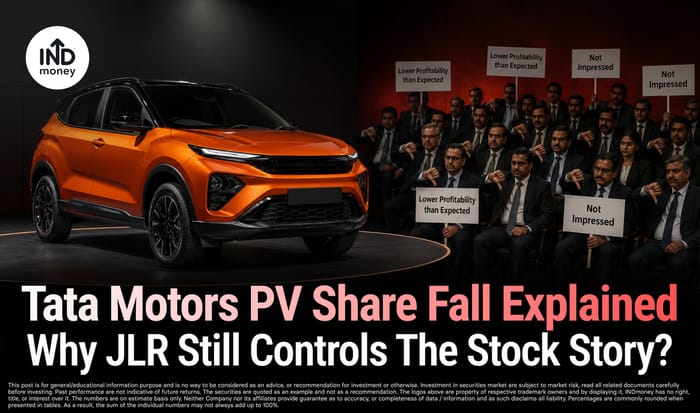
Tata Motors Passenger Vehicles, or TMPV shares fell by more than 8% today after Jaguar Land Rover’s Investor Day presentation.
The fall may look surprising because JLR did not present a no-growth story. It spoke about higher revenue, premium brands, North America expansion, electric vehicles, cost savings and better customer experience.
But investors focused on a bigger question: how much profit and cash JLR can actually generate from this growth.
JLR’s FY27 outlook showed improvement from a weak FY26, but the recovery in margins and cash flow looked slower than expected. That is why the market reacted negatively. For investors, JLR’s growth plan was visible, but the cash-flow proof was still missing.
Why Did TMPV Shares Fall Today?
TMPV shares fell mainly because investors were disappointed with JLR’s FY27 guidance.
This matters because JLR is not a small part of TMPV. Roughly 82% of TMPV’s consolidated revenue comes from JLR. So, even if Tata’s India passenger vehicle business is stable, any disappointment in JLR’s margin or cash-flow outlook can directly impact investor sentiment around TMPV.
JLR expects revenue to improve in FY27, but its profitability and cash flow guidance did not look strong enough for the market. For a premium auto business like JLR, investors usually look for healthy margins and strong cash generation. Revenue growth alone is not enough.
JLR’s guidance showed that revenue may rise from £23 billion in FY26 to £26 billion in FY27. But EBIT margin is expected to be only around 4%. Operating cash flow is expected to improve from negative £2.3 billion to breakeven.
That is an improvement, but not a strong cash-generation story.
This is why investors reacted negatively. The market wanted a sharper recovery after a weak FY26. Instead, JLR’s outlook suggested that FY27 may still be a transition year.
What Does JLR’s FY27 Outlook Show?
The most important part of JLR’s Investor Day presentation was its FY27 financial outlook.
| Metric | FY26 | FY27 Outlook | What It Means |
| Revenue | £23 billion | £26 billion | Revenue growth is expected |
| EBIT margin | More than 0% | Around 4% | Profitability is improving, but still limited |
| Investment | £3.6 billion | £3.7 billion | Spending remains high |
| Operating cash flow | Negative £2.3 billion | Breakeven | Cash flow recovery is still weak |
This table explains the market reaction clearly.
The revenue number looks positive. But the margin and cash flow numbers are not strong enough to make investors comfortable. A company can grow revenue, but if that growth does not convert into higher margins and cash flow, investors may still remain cautious.
That is exactly what happened with TMPV.
Why Revenue Growth Was Not Enough
At a basic level, JLR is saying that FY27 revenue can improve. But the market is asking a different question.
Will that revenue growth become strong profit? At this stage, the answer is not very clear.
JLR expects EBIT margin of around 4% in FY27. This means the company is still recovering from a difficult period. For a luxury auto business, investors generally expect better margin strength, especially when brands like Range Rover and Defender have strong pricing power.
The concern is that several costs are still high. JLR continues to invest heavily in new products, electric vehicles, technology, software, customer experience and market expansion. These investments may help in the long term, but in the near term they can keep cash flow under pressure.
So, investors did not ignore the growth plan. They simply questioned how quickly that growth can become profitable growth.
Why FY26 Base Matters
FY26 was a difficult year for JLR.
The company’s revenue fell to £23 billion from £29 billion in FY25. Adjusted EBIT margin also dropped sharply. Free cash flow turned negative. JLR also faced a cyber incident, which affected production during the year, though the company said Q4 FY26 showed a recovery.
This is important because FY27 is being judged against a weak base.
When a company comes out of a difficult year, investors usually expect a stronger rebound. In JLR’s case, the FY27 outlook does show recovery, but not a sharp one. Revenue is expected to improve, but operating cash flow is only expected to reach breakeven.
That means JLR may be stabilising, but it is not yet showing a strong cash recovery. This gap between market expectation and company guidance became the key reason behind the TMPV share fall.
Growth Story Is Still There
The negative market reaction does not mean JLR has no growth story.
JLR still owns strong premium brands. Range Rover and Defender remain important profit drivers. The company’s revenue per unit has also increased over the years, reaching £74.4k in FY26. This shows that JLR has been able to improve pricing and brand positioning.
JLR is also focusing on its House of Brands strategy. This means Range Rover, Defender, Discovery and Jaguar are being treated as separate brand platforms, each with its own positioning and growth plan.
This can help JLR in the long run because luxury car buyers do not buy only based on features. They buy based on brand, design, experience and identity. If JLR can keep strengthening these brands, it can continue to command premium pricing.
But again, the market wants to see this brand strength flow into margins and cash flow.
Why Execution Risk Is High
The bigger issue is execution. JLR has set an ambitious cost-saving plan. It wants to deliver £1.7 billion of cumulative savings over two years and bring cash breakeven volumes back towards 300,000 units.
This is important because a lower breakeven level can make the business more resilient. In simple words, JLR wants to reach a point where it can remain financially stable even if volumes are not very high.
But delivering this is not easy.
JLR has to reduce costs, improve warranty performance, launch new products, invest in technology, manage supply chains, improve customer experience and expand in North America at the same time.
That is a lot to execute together. This is why investors may be cautious. The plan looks good on paper, but the market may wait for proof in quarterly numbers before becoming more positive.
What Are Investors Worried About?
- The first concern is margin recovery. JLR’s revenue may grow, but an EBIT margin of around 4% shows that profitability is still not back to a strong level.
- The second concern is cash flow. Moving from negative operating cash flow to breakeven is better, but it does not yet show strong cash generation.
- The third concern is high investment. JLR expects investment of £3.7 billion in FY27, higher than FY26. This can limit free cash flow in the near term.
- The fourth concern is execution. JLR has to deliver cost savings, new product launches, quality improvement and North America growth together.
- The fifth concern is the external environment. JLR itself pointed to industry challenges such as geopolitics, inflationary pressure, supply chain and logistics issues, and regulatory volatility.
Together, these concerns explain why the stock reacted negatively despite the company talking about growth.
What Is Positive In JLR’s Plan?
There are positives as well. JLR is not cutting back from growth. It is investing in new products, technology and customer experience. Its premium brands still have strong pricing power. The company is trying to build a more resilient business by reducing breakeven volumes and improving cost efficiency.
The North America strategy can also become a major long-term growth driver if executed well. The US luxury SUV market is large, and JLR already has products that fit that customer base.
JLR’s focus on accessories, services, parts and bespoke offerings can also support margins over time. These areas can help the company earn more from each customer beyond just selling the vehicle.
So, the market reaction is not saying JLR is a weak business. It is saying that investors need more proof before they give the stock a higher valuation.
What Should Investors Watch Next?
For investors, the next few quarters will be important.
- The first thing to watch is JLR’s EBIT margin. If margins improve faster than expected, the market may regain confidence.
- The second thing to watch is operating cash flow. This is the most important signal. If revenue rises but cash flow remains weak, investor concerns may continue.
- The third thing to watch is the £1.7 billion cost-saving plan. JLR needs to show steady progress here because this plan is central to bringing breakeven volumes down.
- The fourth thing to watch is North America. If JLR can grow in the US without hurting margins, it can become a strong long-term driver.
- The fifth thing to watch is new product execution, especially electric models and premium launches. Delays, quality issues or weak demand can affect the recovery story.
Author’s Take
TMPV’s fall is not only about one guidance number. It is about the gap between JLR’s long-term ambition and near-term financial recovery.
JLR is still a strong luxury auto business. It has premium brands, rising revenue per unit and a clear growth plan for North America. But the market wanted stronger proof of margin recovery and cash generation.
That proof was missing in the FY27 outlook. So, the real story is simple: JLR is promising growth, but investors are asking for cash flow.
Until JLR shows stronger margins, better cash generation and successful execution of its cost-saving plan, TMPV shares may remain sensitive to any disappointment from JLR.