

- Understanding How a Naval Blockade Works
- The Forces Behind the Strategy
- Where the Blockade Will Be Enforced
- The Real Strategy Behind the Move
- Iran’s Position in Global Oil Markets
- Why Iran is Being Targeted
- Iran Blockade: What It Means for India
- The Global Economic Impact
- Will the Blockade Actually Work
- Final Takeaway
- Disclaimer
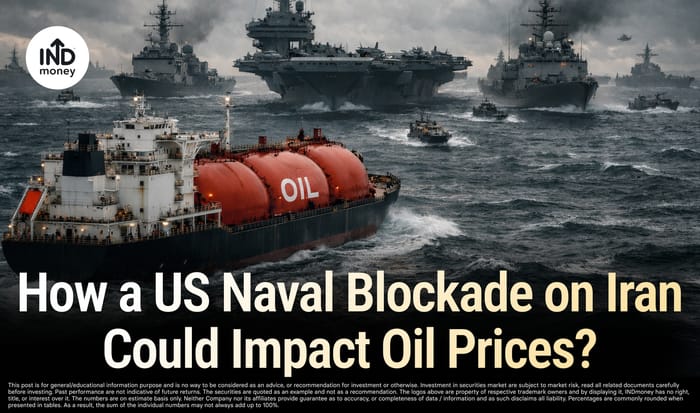
The United States is preparing a strategy to restrict ships traveling to and from Iranian ports. Instead of direct military action, this move focuses on limiting Iran’s ability to trade with the rest of the world, especially its oil exports.
This is called a naval blockade. In simple terms, it means controlling movement at sea to make it difficult for a country to sell goods internationally.
At first glance, this may look like a geopolitical development far away from daily life. But because oil, trade routes, and shipping costs are involved, the impact can reach global markets and even affect your finances.
Understanding How a Naval Blockade Works
A blockade is not about attacking ships. It is about control and restriction. Naval forces monitor shipping routes using satellites and tracking systems. When a vessel is suspected of carrying goods linked to Iran, it can be intercepted. The ship may be asked to stop, change direction, or allow inspection. If it does not cooperate, trained teams can board it.
The goal is not to stop every single ship. The goal is to create enough uncertainty that shipping companies and traders start avoiding Iranian routes altogether.
The Forces Behind the Strategy
The US has deployed a mix of naval assets in the region, each playing a specific role.
- Aircraft carriers like the USS Abraham Lincoln act as floating airbases. They allow helicopters and aircraft to cover large areas and quickly reach targeted ships.
- Amphibious assault ships like the USS Tripoli carry Marines and are designed for close operations. These ships can launch helicopters and small boats to intercept vessels.
- Guided missile destroyers help control movement at sea. They can track ships, issue warnings, and support boarding operations.
In situations where a vessel refuses to comply, highly trained teams such as Navy SEALs and Marines are prepared to carry out forced boarding.
Where the Blockade Will Be Enforced
One important aspect of this strategy is where the US plans to operate.
Instead of positioning naval forces close to Iran’s coastline, the US is likely to enforce the blockade farther away in international waters, including regions like the Arabian Sea and the Indian Ocean.
This approach serves two purposes. First, it reduces the risk of direct military confrontation with Iran, which would be much higher near its territorial waters. Second, it allows the US to monitor and intercept ships across a much wider area, rather than relying on a single chokepoint.
As a result, this is not a traditional blockade confined to one location. It is a distributed and flexible enforcement strategy, where ships can be intercepted at multiple points along their journey.
The Real Strategy Behind the Move
The effectiveness of this strategy is not based on physically stopping every ship, but on altering market behavior through risk creation.
Global shipping operates on cost, predictability, and legal certainty. By introducing the possibility of interception, delays, or regulatory complications, the US increases the risk premium associated with trading with Iran. As this risk rises, shipping companies, insurers, and traders begin to reassess the viability of these routes.
This shift has second-order effects. Insurance costs increase, compliance requirements tighten, and financing for such shipments becomes more difficult. Over time, these factors make Iranian trade less attractive, even without direct intervention in every transaction.
As a result, the strategy functions less as a traditional blockade and more as a market disruption mechanism, where the goal is to reduce participation in Iranian trade. Even limited enforcement can therefore lead to a disproportionate impact, as the system adjusts to higher perceived risk rather than actual physical restrictions.
Iran’s Position in Global Oil Markets
Iran exports roughly 1.5 to 2 million barrels of crude oil per day, with recent data showing levels even crossing 2 million barrels per day. While this accounts for only about 2% of global oil supply, it is still significant in a market where supply and demand are closely balanced.
In terms of global ranking, Iran sits in the mid-tier of exporters, well below leaders like Saudi Arabia, Russia, and the United States. However, its importance is not defined by size alone, but by its position in the system. Oil markets are highly sensitive to marginal changes, meaning even relatively small supply disruptions can influence pricing and trade flows.
This is where Iran becomes relevant. Its exports act as part of the flexible or marginal supply that helps balance the market. When this supply is disrupted, even partially, it tightens overall availability and can push prices higher. In that sense, Iran may not dominate global supply, but it plays a critical role in maintaining stability at the margin.
Why Iran is Being Targeted
The rationale for targeting Iran goes beyond its oil exports and lies in how its economy and geopolitical strategy are structured.
Oil is the backbone of Iran’s economy, contributing more than 50% of its export earnings and generating tens of billions of dollars annually. This makes crude exports the primary source of foreign exchange and a critical driver of government finances. Any disruption to these flows directly weakens economic stability.
At the same time, Iran has demonstrated its ability to use energy routes as a strategic lever. During the recent conflict, Iran effectively restricted movement through the Strait of Hormuz, a critical chokepoint through which a significant portion of global oil trade passes. This move highlighted how control over trade routes can be used to influence global markets and exert pressure on other countries.
This is where the US strategy becomes more targeted. Instead of allowing Iran to control a chokepoint, the US is attempting to shift pressure back onto Iran by targeting its export flows. Iran’s oil trade is already concentrated, with a large share going to China through indirect and discounted routes, making it sensitive to disruption.
By intervening in these flows, the US does not need to completely stop exports to create impact. Even partial disruption can increase uncertainty, raise transaction risks, and reduce effective revenues. In that sense, the blockade is designed as an economic countermeasure, aimed at weakening Iran’s financial capacity while avoiding direct military escalation.
Iran Blockade: What It Means for India
India is particularly vulnerable in this situation, especially with existing disruptions in the Strait of Hormuz, a key route through which a large portion of global oil trade passes. Since India imports nearly 85% of its crude oil, any disruption in this region can directly impact supply and pricing. If the blockade further tightens oil availability and pushes prices higher, India’s import bill will rise significantly, increasing pressure on the fiscal balance.
Higher oil prices also lead to greater dollar outflows, which can weaken the rupee and make imports more expensive. This eventually feeds into inflation, as fuel and transportation costs rise, affecting the overall cost of living. From a market perspective, sectors like aviation, paints, and chemicals may see margin pressure, while upstream oil companies such as ONGC and Oil India could benefit from elevated crude prices.
The Global Economic Impact
Even though this move is targeted at Iran, the effects can spread across the global economy.
- Oil Prices Could Rise: If Iranian oil supply is disrupted, global supply tightens. This can push oil prices higher. In many cases, prices rise even before actual disruption happens, simply because markets anticipate risk. Since Iran contributes around 2% of global supply, even partial disruption can create a noticeable price reaction.
- Shipping Costs May Increase: When geopolitical risks rise, insurance premiums for ships go up. Freight costs also increase. This makes global trade more expensive.
- Inflation Pressure Can Build: Higher oil and transport costs eventually increase the cost of goods. This can lead to rising inflation across countries.
Will the Blockade Actually Work
The effectiveness of a blockade is not immediate. It operates through a gradual buildup of economic pressure rather than instant disruption.
In the short term, trade flows are likely to continue, though with some friction. However, as enforcement signals become stronger and the probability of interception increases, market participants begin to adjust. Shipping companies, insurers, and traders factor in higher risks, which leads to rising costs and reduced willingness to engage in Iranian trade.
Over time, this shift in behavior becomes more impactful than direct intervention. Fewer ships are routed through Iranian channels, transactions become more complex, and export volumes start to decline.
The key driver here is perception. In global markets, the expectation of risk often leads to faster adjustments than the actual enforcement itself. Once the threat is seen as credible, behavior changes quickly, amplifying the overall impact of the blockade.
Final Takeaway
This is not a traditional military conflict. It is a strategic move to weaken an economy by controlling its access to global trade. The US does not need to stop every ship to make this effective. By increasing uncertainty and cost, it can reduce Iran’s ability to export oil and conduct business.
And even though Iran is not the largest oil exporter, its role as a meaningful marginal supplier means that any disruption can tighten global supply, push oil prices higher, and create ripple effects across economies. Because oil sits at the center of this situation, the ripple effects can reach global markets, influence inflation, and impact everyday expenses. This is why a naval move in one region can end up affecting economies around the world.
Disclaimer
Investments in the securities market are subject to market risks. Read all the related documents carefully before investing. The securities are quoted as an example and not as a recommendation. This is nowhere to be considered as advice, recommendation, or solicitation of an offer to buy or sell or subscribe for securities. INDStocks SIP / Mini Save is a SIP feature that enables Customer(s) to save a fixed amount on a daily basis to invest in Indian stocks. INDstocks Private Limited (formerly known as INDmoney Private Limited) 616, Level 6, Suncity Success Tower, Sector 65, Gurugram, 122005, SEBI Stock Broking Registration No: INZ000305337, Trading and Clearing Member of NSE (90267, M70042) and BSE, BSE StarMF (6779), SEBI Depository Participant Reg. No. IN-DP-690-2022, Depository Participant ID: CDSL 12095500, Research Analyst Registration No. INH000018948 BSE RA Enlistment No. 6428. Refer to https://indstocks.com/pricing?type=indian-stocks; https://www.indstocks.com/page/indian-stocks-sip-terms-and-condition for further details.