

- What Does the $9.5 Billion Figure Represent?
- What Will TCS Do at JFK’s New Terminal One?
- How Could the Deal Impact TCS’ Order Book?
- Is the JFK Deal Already Included in Q1 TCV?
- How Could the Deal Impact TCS Revenue?
- Will It Materially Change TCS’ Overall Revenue?
- Why the Deal Matters for TCS’ North America Business
- Could the Deal Support TCS Margins?
- Author’s Take
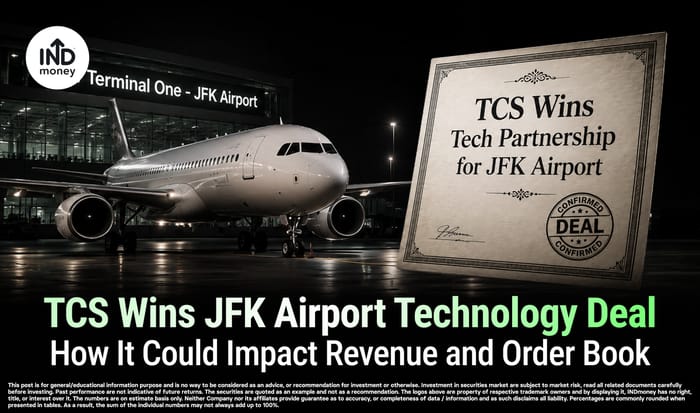
Tata Consultancy Services has become the strategic technology and innovation partner for the New Terminal One at New York’s John F. Kennedy International Airport.
Under the partnership, TCS will support passenger processing systems, AI-driven IT operations, infrastructure management, enterprise applications and cybersecurity.
The deal gives TCS a high-profile infrastructure project in North America, its largest market. However, investors must first understand what the widely reported $9.5 billion figure actually represents.
What Does the $9.5 Billion Figure Represent?
There are two separate $9.5 billion figures connected with this development. Neither has been disclosed as the value of TCS’ contract.
The first $9.5 billion refers to the estimated development cost of New Terminal One. This is the cost of developing the terminal, not the value of TCS’ technology contract.
New Terminal One is part of the wider $19 billion redevelopment of JFK Airport.
The second $9.5 billion refers to TCS’ total contract value, or TCV, reported for Q1 FY27. It represents the combined value of all contracts signed by TCS during the quarter, not just the JFK partnership.
| Figure | What it represents |
| $19 billion | Total redevelopment cost of JFK Airport |
| $9.5 billion | Estimated development cost of New Terminal One |
| $9.5 billion | TCS’ total contract wins during Q1 FY27 |
| Undisclosed | Value of TCS’ New Terminal One contract |
TCS has not disclosed the size or duration of the JFK contract. Therefore, it would be incorrect to call this a $9.5 billion TCS deal.
What Will TCS Do at JFK’s New Terminal One?
The partnership appears wider than a normal software implementation contract.
TCS will support technology systems across the terminal, including passenger processing, infrastructure management, enterprise applications, cybersecurity and AI-driven IT operations.
Its Cognix and ignio platforms will be used to provide better visibility across baggage handling, terminal security and passenger processing. The objective is to help airlines reduce operating costs and improve the passenger experience.
The deal combines initial implementation work with recurring technology services, which could provide TCS with revenue over several years.
How Could the Deal Impact TCS’ Order Book?
TCS reported a total contract value of $9.5 billion in Q1 FY27.
TCV represents the combined value of contracts signed during a period. It provides an indication of future revenue visibility, but the entire amount does not become revenue immediately.
Since TCS has not disclosed the value of the JFK contract, its exact contribution to the order book cannot be calculated.
The following scenarios show how different contract sizes would compare with TCS’ latest quarterly TCV.
| Illustrative contract value | Percentage of Q1 FY27 TCV |
| $100 million | 1.1% |
| $250 million | 2.6% |
| $500 million | 5.3% |
These are only illustrative scenarios and should not be treated as estimates of the actual contract value.
For comparison, TCS disclosed an $800 million SKF contract during Q1 FY27. That single deal represented around 8.4% of the quarter’s TCV.
Since the JFK contract value was not disclosed, investors should not automatically place it in the same financial category as the SKF mega deal.
Is the JFK Deal Already Included in Q1 TCV?
TCS’ Q1 FY27 reporting period ended on June 30, while the JFK partnership was announced on July 14.
If the agreement was signed after June 30, it may be included in TCS’ Q2 FY27 contract wins rather than the $9.5 billion reported for Q1.
However, the announcement date may differ from the actual signing date. Companies sometimes announce contracts several days or weeks after agreements are completed.
Investors should therefore wait for management clarification before assuming that the JFK partnership will add to Q2 order inflows.
How Could the Deal Impact TCS Revenue?
Contract value and revenue are not the same. Even when TCS wins a large multi-year contract, revenue is recognised gradually as the company delivers the services.
The JFK contract is also likely to generate revenue in phases because New Terminal One itself is being developed in phases. Operations are expected to begin in 2026, while full completion is targeted by 2030.
TCS may initially earn revenue from technology setup, system integration, cybersecurity and infrastructure implementation.
As the terminal expands, it could receive additional work related to new gates, airlines, passenger systems and infrastructure upgrades.
Once operations stabilise, recurring revenue could come from application support, infrastructure management, cybersecurity and AI-driven IT operations.
The recurring services component may be more important from an investor perspective because it can provide stable revenue over several years.
Will It Materially Change TCS’ Overall Revenue?
TCS generated quarterly revenue of around $7.6 billion in Q1 FY27 and more than $30 billion in FY26.
Even a reasonably large airport technology contract would have a limited direct impact on a company of this size.
For example, even a hypothetical $500 million contract spread over five years would add around $100 million in average annual revenue. This would equal roughly 0.3% of TCS’ FY26 revenue.
The JFK deal is therefore unlikely to materially change TCS’ consolidated growth by itself.
Its financial importance lies more in long-term revenue visibility, recurring managed services and the opportunity to win similar airport and transportation contracts.
Why the Deal Matters for TCS’ North America Business
North America contributes nearly half of TCS’ revenue, making it the company’s most important market.
However, the region reported a sequential decline in constant-currency revenue during Q1 FY27.
The JFK deal will not reverse this trend alone. But it gives TCS a major US infrastructure reference project that could support future wins from airports, airlines and transportation authorities.
A successful implementation may also create opportunities with airlines operating from New Terminal One. These companies could require services related to passenger processing, cloud infrastructure, cybersecurity, data analytics and AI-led operations.
The indirect business opportunity could eventually become more meaningful than the initial contract.
Could the Deal Support TCS Margins?
The implementation phase may carry relatively lower margins because it could involve on-site deployment, system integration, testing and coordination with different airlines and infrastructure providers.
Margins could improve later as the contract shifts towards automated managed services using TCS platforms such as Cognix and ignio.
Recurring infrastructure management and application support could also provide a more stable margin profile than one-time implementation work.
Author’s Take
The JFK partnership is strategically important, but the $9.5 billion terminal development cost should not be confused with the value of TCS’ contract, which remains undisclosed.
The deal is unlikely to materially change TCS’ near-term revenue on its own. Investors should therefore track whether it is included in future TCV, along with any disclosure on its size, duration, revenue structure and share of recurring services.
The bigger opportunity lies in creating a multi-year revenue stream, strengthening TCS’ presence in the US and helping the company win similar airport, airline and transportation technology contracts globally.