

- What the Q4 Numbers Actually Tell Us
- There Are Two Swiggys Inside One Swiggy
- Instamart Growth Slows as Company Focuses on Profitability
- Swiggy Share Price Is Falling, But Investor Interest Is Rising
- What Investors Should Track Going Forward
- The Verdict So Far
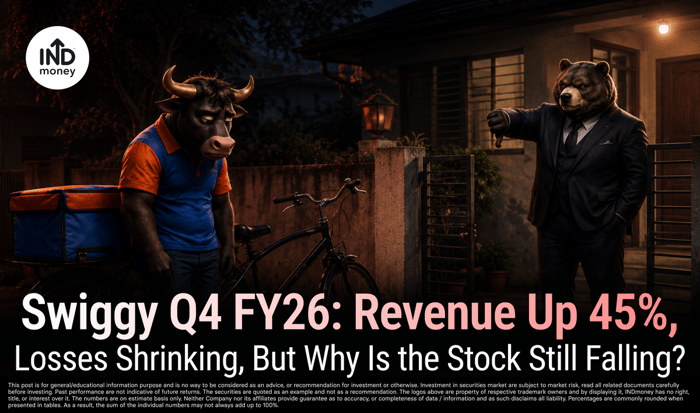
Swiggy just had one of its best quarters in a while. Revenue grew 45%. Losses came down by 26%. Food delivery saw its fastest growth in nearly four years. And the dining-out business? Profitable for the first time in a full year.
Sounds like things are going well, right? But the stock dropped over 5% on the very first trading day after these results came out.
So what is going on? If the business is getting better, why does the stock keep falling? The answer is not in any single number. It is in what is happening underneath.
What the Q4 Numbers Actually Tell Us
Revenue from operations came in at ₹6,383 crore, a solid 45% jump from last year. Net loss narrowed to ₹800 crore, down from ₹1,081 crore. Food delivery GOV (Gross Order Value, basically the total value of every food order placed on the app, including food cost, delivery fee, packaging, and taxes) hit ₹9,005 crore, growing 22.6%, the best in 15 quarters. For the first time ever, food delivery operating profit crossed ₹1,000 crore for the full year.
Now here is where it gets interesting. Instamart grew 68.8% year-on-year to a GOV of ₹7,881 crore. Sounds great, but compare it with the previous quarter: it actually dipped, from ₹7,938 crore. That is the first quarter-on-quarter decline Instamart has ever seen. Swiggy added just 7 dark stores during the quarter. Blinkit? 216.
So on one hand, food delivery is flying. On the other, quick commerce is slowing down. And that split reveals something deeper about how Swiggy actually works as a business.
There Are Two Swiggys Inside One Swiggy
This barely gets talked about, and it really should.
Swiggy recently moved its Instamart business into a separate company called Swiggy Instamart Private Limited. Because of this, we can now see the numbers for each part separately. And the picture is surprising.
Swiggy's food delivery, Dineout, and other platform businesses, everything except Instamart, made a profit of ₹416 crore in FY26. Instamart, on its own, posted a loss of ₹3,835 crore.
Let that sink in. The core Swiggy, without Instamart, is already making money.
Everyone sees a loss-making company. And on a combined basis, it is. But look closer and you find a profitable food and dining business sitting right there, alongside a young quick commerce bet that is still burning cash to find its footing. The question is: why is Instamart slowing down, and is it on purpose?
Instamart Growth Slows as Company Focuses on Profitability
Here is the thing. The Instamart slowdown was not an accident. Swiggy chose this.
CEO Sriharsha Majety was pretty direct in his shareholder letter. He called the pricing in quick commerce "irrational". Swiggy had tested a no-fee delivery campaign, saw volumes jump, and then pulled it back because those gains were not going to last. His point: growth should be measured by economics, not just by how many orders you push through.
So instead of chasing volume, Swiggy focused on making each Instamart order less loss-making. The contribution margin (how much the company loses on each order after direct costs) improved from -5.6% a year ago to -1.8% now, hitting -1.1% in March 2026. They are guiding for breakeven on this metric by Q1 FY27.
To understand this, think of a ₹100 Instamart order. A year ago, Swiggy was losing about ₹5.60 on every ₹100 worth of goods it delivered, after covering costs like delivery, packaging, and discounts. That loss has now come down to ₹1.80 per ₹100 order, and in March 2026, it was just ₹1.10.
But this discipline has a cost. Blinkit now operates 2,243 stores, nearly double Instamart's 1,143. That gap in network size is hard to ignore.
Swiggy says it wants to differentiate instead of competing on price, building around better products and exclusive offerings like their clean-label brand Noice. That sounds reasonable on paper. But six well-funded players, Blinkit, Zepto, Amazon Now, Flipkart Minutes, BigBasket, and Instamart, are all chasing the same customer with deep pockets. Pulling this off is going to be really hard. And that reality shows up directly in the stock price.
Swiggy Share Price Is Falling, But Investor Interest Is Rising
Swiggy share is now down about 44% from its 52-week high of ₹474, which it touched back in September 2025. The stock trades well below its IPO price of ₹390. As per INDmoney, search interest for Swiggy Limited has gone up 9% in the last 30 days. Investors are clearly watching closely, trying to figure out if this is a good entry point or a red flag.
So, Why Is Swiggy Share Falling Despite Improving Numbers?
Three things are working against the stock right now. First, even though quarterly losses are shrinking, the full-year loss actually grew from ₹3,117 crore in FY25 to ₹4,154 crore in FY26. Improving is not the same as being good enough. Second, foreign portfolio investors (FPIs) have been reducing their stake, which is at 14.59% as of March 2026, compared to 16.07% in the previous quarter. Third, and most importantly, the market is not judging Swiggy in isolation. It is judging Swiggy next to Eternal, and that comparison hurts.
Eternal's market cap is around ₹2.37 lakh crore. Swiggy sits at roughly ₹72,789 crore. The market values Eternal at about 3.3 times Swiggy. But is Eternal's business 3.3 times bigger? Not really. In Q4 FY26, Eternal's B2C net order value (NOV) was ₹26,880 crore versus Swiggy's B2C GOV of ₹18,131 crore. These are not perfectly apples-to-apples (GOV is before discounts, NOV is after), but broadly, Eternal's consumer business is about 1.5x the size of Swiggy's. Not 3.3x.
The extra premium comes from profitability. Eternal made ₹429 crore in adjusted EBITDA last quarter. Swiggy lost ₹652 crore. A ₹1,081 crore gap in one quarter. The market is not rewarding size alone. It is rewarding profitable size.
For Swiggy, narrowing this gap is not about growing faster. It is about showing that growth and profit can go together.
Also Read: Eternal vs Swiggy Q4FY26: Growth, Profitability and Key Comparison
What Investors Should Track Going Forward
If you are watching Swiggy, keep an eye on three things.
First, does Instamart hit contribution breakeven in Q1 FY27? This is the single biggest near-term test. Delivering on it would validate the whole discipline strategy. Missing it would raise real doubts.
Second, what comes next for the Instamart subsidiary? The spin-off is done, but the real question is whether it leads to separate fundraising, partnerships, or eventually its own listing.
Third, the cash situation. Swiggy has ₹15,053 crore in the bank and burned ₹3,302 crore through FY26. That gives it roughly 4-5 years of runway at the current pace. But if the burn does not slow down, the company may need to raise more money, which means dilution for existing shareholders.
The Verdict So Far
Swiggy's Q4 numbers are better than what the stock price suggests. Food delivery is profitable, growing at its best pace in years. Dineout has turned profitable. Quarterly losses are shrinking. But the gap with Eternal is widening. Instamart is giving up ground in a crowded, expensive fight. And full-year losses grew to ₹4,154 crore despite quarterly improvement.
The part most people are not seeing? The "old Swiggy" without Instamart already turns a profit. The "new Swiggy" with Instamart is still deep in investment mode. Which version defines the next few years depends on what happens in quick commerce from here.
The numbers are headed the right way. Whether they are moving fast enough, that is the real question.