

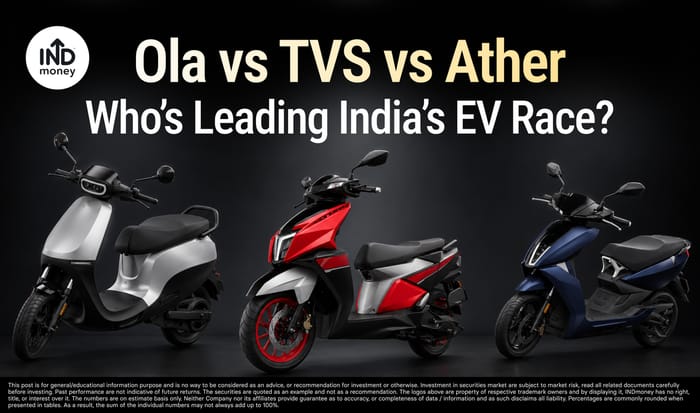
- India’s Electric Scooter Boom Is Just Getting Started
- How TVS and Bajaj Overtook Ola Electric in the EV Race
- Why Ather Energy Could Be India’s Smartest EV Company
- Ola Electric: India’s Biggest Startup Crash, and a Comeback Attempt
- The Profit Reality Check: Who Makes Money on Every Scooter Sold?
- Risks: What Could Go Wrong?
- Conclusion: What Should Investors Watch Next?
Ola Electric once looked unstoppable in India’s EV two-wheeler race. In Q1 FY25, it held a massive 48.6% market share and built the image of a bold, fast-moving disruptor. But in business, speed alone is not enough. Growing too quickly without building a strong foundation underneath can eventually start creating cracks.
Today, companies like TVS, Bajaj, and the quietly consistent Ather Energy are leading the market. Ola, meanwhile, is trying to recover after one of the sharpest slowdowns seen in India’s startup space. Interestingly, despite all the challenges, the stock has still rallied nearly 60% in the last two months.
So what is really going on here? For retail investors, sales numbers alone do not tell the full story. Profit numbers alone do not either. What really matters is the bigger picture: who is growing steadily, who is actually making money, who is building a business that can survive long-term, and what risks could still change the industry completely.
India’s Electric Scooter Boom Is Just Getting Started
Before comparing companies, one thing is clear. India’s electric two-wheeler market is growing strongly, and that is good for everyone in the space.
As per the Federation of Automobile Dealers Associations (FADA), retail sales in India reached around 14 lakh electric two-wheelers in FY26, a 21.81% jump from the previous year. In May 2026 alone, about 1.7 lakh scooters were registered, rising more than 8% after a small dip in April. Put simply, roughly 1 out of every 10 scooters sold in India today is electric.
So why is adoption rising so quickly? One big reason is economics. Electric scooters are much cheaper to run than petrol scooters on a daily basis, especially for people who travel regularly. At the same time, charging infrastructure is improving steadily across cities and highways, making range anxiety, the fear of running out of battery mid-ride, far less serious than before. Government support through schemes like PM E-DRIVE is also helping lower costs and improve EV infrastructure. On top of that, today’s electric scooters offer better range, features, and performance than they did even two or three years ago.
This is a growing market. The real fight is about who captures that growth and, more importantly, who actually makes money from it.
How TVS and Bajaj Overtook Ola Electric in the EV Race
TVS and Bajaj are not newcomers in this market. They already have decades of experience, wide service networks, and huge trust built through petrol bikes and scooters. That strong base is helping them in the EV space.
In May 2026, TVS Motor was India’s top electric scooter brand with 42,376 units and a 24.9% market share. Bajaj Auto, through Chetak, was close behind. It sold 39,104 units, up more than 13% month-on-month, and held a 22.9% share. Together, these two control nearly half the EV market, as per Vahan portal data.
But the bigger story is not only sales. It is the financial support behind those sales. TVS and Bajaj are not depending on investor money just to survive. Their EV businesses sit inside large, profitable petrol vehicle companies. TVS reported an operating EBITDA margin of 13.1% and its highest-ever quarterly revenue of ₹12,808 crore in Q4 FY26. That gives them a huge advantage. They can keep investing in EVs without worrying about whether the business is running out of cash.
Hero MotoCorp is also showing up strongly. Its EV brand, Vida, grew 196% in FY26 and nearly tripled sales to 1.44 lakh units. The old two-wheeler giants are clearly not sitting out this race. They are entering with scale.
Why Ather Energy Could Be India’s Smartest EV Company
While TVS and Bajaj grabbed most of the attention, Ather Energy quietly built what may be the most disciplined pure-EV business in India. A lot of people still think of Ather as a premium Bengaluru startup. That view is now outdated.
In May 2026, Ather stayed firmly at #3 with 28,190 units and about 16.5% market share. Even more impressive, its FY26 sales grew 82.3% year-on-year to 2.39 lakh units, one of the fastest growth among the established players.
How did it do that? By making two smart moves. First, Ather realised its sporty 450 series appealed mostly to younger, urban buyers. So it launched Rizta, a more comfortable family scooter, and opened the door to new markets like Gujarat, Odisha, Rajasthan, and Himachal Pradesh, where it was barely present earlier. Second, it doubled its experience centres from 351 to 700 in one year, making the brand far more accessible.
The numbers show this strategy is working. Ather’s production cost per scooter fell 9% year-on-year. Its loss narrowed from ₹812 crore in FY25 to ₹517 crore in FY26. In Q4 FY26, EBITDA margin improved to -2.5%, which means Ather is now very close to breaking even at the operating level.
That is why the Ather story matters. It is not just growing. It is becoming more efficient while it grows.
Ola Electric: India’s Biggest Startup Crash, and a Comeback Attempt
No company in India’s recent startup history has had a more dramatic rise and fall than Ola Electric.
At its peak, Ola was selling over 50,000 scooters a month and holding nearly 50% market share. By February 2026, that had collapsed to just 3,968 units. Market share dropped to just 4.6%. The stock, which touched ₹157 after listing in August 2024, fell to ₹22.25 in March 2026. That was an 85% crash. ICRA downgraded the company, and Emkay Global even issued a sell call with a ₹20 target, pointing to survival concerns.
So what went wrong? Think of a restaurant that suddenly opens hundreds of branches too quickly. The food may still be good, but the system breaks. Staff is not ready, supplies do not reach on time, and customers are left frustrated. That is what happened with Ola. It scaled too fast and ignored after-sales service. Scooters had issues, spare parts were not available, and repair delays went up to 9 days. Customers simply moved to TVS and Bajaj, where the experience felt more reliable. That hurt not only sales, but trust.
Still, the recovery is real. Ola did not just cut prices and hope for the best. It made a serious reset.
- It cut the operating expenses significantly to focus on services.
- Average repair time came down from 9 days to just 1 day.
- Its Gen 3 scooter platform received PLI certification, which can save around ₹40,000 to ₹45,000 per vehicle.
- It also started work on an in-house LFP (Lithium Iron Phosphate) battery cell to reduce dependence on expensive imports.
The result is visible. Ola bounced back from 3,973 units in February 2026 to 15,139 units in May 2026, almost a 4x recovery in three months. Operating cash flow also turned positive in Q4 FY26 for the first time. The stock has climbed 60% from its lows.
The big question now is simple. Is this a real comeback, or just a short-term rebound?
The Profit Reality Check: Who Makes Money on Every Scooter Sold?
Sales headlines are exciting, but investors should care about one thing more: is the business actually sustainable?
Two numbers matter most here.
Gross Margin means the profit left after covering the cost of making the scooter. It is like a food stall selling a plate for ₹50 when ingredients cost ₹35. The leftover ₹15 is the gross margin.
EBITDA Margin goes one step further. After paying rent, salaries, power bills, and other operating costs, how much is still left? That tells you whether the business is moving toward profit or still bleeding cash.
| Company | May 2026 Sales | Market Share | Gross Margin | EBITDA Margin |
| Ather Energy | 28,190 | 16.5% (#3) | 25% | -2.5% |
| Ola Electric | 15,139 | 8.9% (#5) | 38.5% | -123% |
Bajaj Auto and TVS are profitable at the company level, but separate EV margins are not disclosed.
The number many investors misread is Ola’s -123% operating EBITDA margin. It looks terrible, but context matters. Q4 FY26 was a reset quarter. Ola deliberately sold only 20,256 units while still carrying the cost of a much larger company. That is like running a factory built for 1,00,000 units a year, but using only a fifth of the capacity. Fixed costs hurt a lot in that situation.
The full-year FY26 operating EBITDA margin of around -53.4% is a better reflection of where Ola actually stood. The good part is that the trend is improving as volumes come back. At around 20,000 to 25,000 scooters a month, Ola Electric thinks that it can reach EBITDA breakeven.
One important point often missed is this: Ola’s gross margin of 38.5% is actually higher than Ather’s 25%. So on the product itself, Ola is stronger. The problem is operating leverage. When volumes are low, fixed costs crush the business. When volumes rise, that picture can improve sharply.
Risks: What Could Go Wrong?
The growth is real, but investors still need to watch the risks.
1. Commodity price pressure: Electric scooters rely heavily on materials like copper, aluminium, lithium, and rare earth metals for batteries and motors. Prices of these raw materials have remained volatile globally, and any sharp rise can quickly increase production costs for EV companies. If that happens, margins could come under pressure, and profitability may get delayed further.
2. Capacity wars: Everyone is expanding at the same time. Ather’s new 10-lakh-unit-per-year Factory 3.0 starts from Q3 FY27. TVS, Bajaj, Hero, and Ola are also adding capacity. If supply grows faster than demand, price wars could begin. That would squeeze margins across the industry.
Conclusion: What Should Investors Watch Next?
India’s EV two-wheeler race is no longer about the flashiest launch or the loudest brand. It is about who can deliver good scooters at scale, keep customers happy, and make real money over time.
Do not look only at sales rankings. TVS and Bajaj are leading in both sales and profitability, and that is a powerful combination. The only catch is that their EV upside sits inside much larger petrol businesses.
Keep tracking Ola Electric’s monthly sales closely. Breakeven is estimated at 20,000 to 25,000 units a month. Since May 2026 came in at 15,139 units, Ola is right at the edge. The next couple of months will show whether this is a real turnaround or just a temporary bounce.
Ather’s EL Platform launch is another big trigger to watch. Right now, Ather has no product in the ₹1-1.25 lakh range, which is the mass-market sweet spot. Its upcoming EL01 scooter is meant to enter that space for the first time. If it works, it could be Ather’s biggest expansion yet.
And finally, always check the valuation. Since Ola and Ather are still loss-making, Price-to-Sales is the cleaner way to compare them. Ather trades at around 10x P/S, Ola at about 7.7x, while TVS trades near 2.8x. That premium says the market expects strong growth, so there is little room for mistakes.
The established players are leading for now. But in a fast-changing market like EVs, the story can change quickly.