

- Where Is Ola Electric Investing ₹2,000 Crore?
- What Do OET and OCT Actually Do?
- What Is a Gigafactory and Why Is Ola’s a Big Deal?
- Ola Electric's Bigger Battery Ambition
- Why This Matters More Now
- The Bigger Picture for Ola Electric
- What Investors Should Watch Next
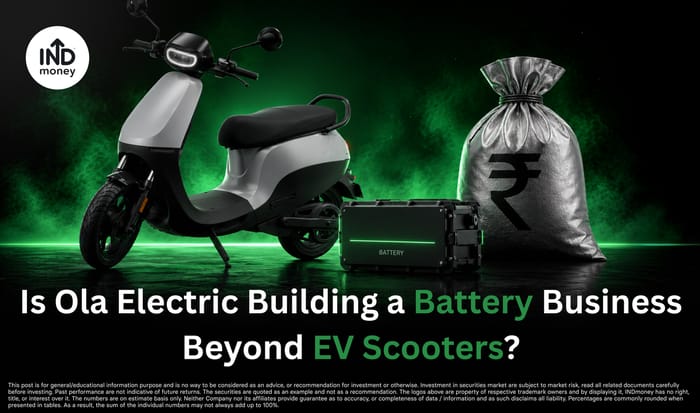
Ola Electric has announced a ₹2,000 crore investment. At first glance, it may look like a routine funding move within the company. But the timing and where the money is going tell a more interesting story.
Just a day before the announcement, reports claimed Ola Electric is in talks with Indian and global automakers to supply battery cells and battery packs from its Krishnagiri gigafactory. The company hasn’t officially confirmed these talks yet, but when you connect the dots, this investment starts looking much bigger than an EV scooter expansion.
In this article, we’ll break down why this ₹2,000 crore move matters and what investors should watch next.
Where Is Ola Electric Investing ₹2,000 Crore?
According to the exchange filing, ₹1,500 crore will go into OET (Ola Electric Technologies Pvt Ltd) and ₹500 crore into OCT (Ola Cell Technologies Pvt Ltd).
At first glance, this may look like a routine internal funding move. And in many ways, it is not new. OCT has been receiving funding from the parent company since 2022 because building a gigafactory at this scale requires huge long-term investment.
What makes this round important is the timing. It comes just after reports of automaker battery supply talks and at a time when Ola Electric’s core EV business is under pressure. Despite this, the company is continuing to invest aggressively in OCT, signalling that the battery business is central to its long-term strategy.
What Do OET and OCT Actually Do?
To understand why this matters, it helps to know how Ola Electric is structured. The listed company, Ola Electric Mobility Limited, mainly acts as a holding company. It owns and funds the businesses underneath it rather than directly making scooters or batteries itself.
OET is the vehicle business. It works on EV platforms, vehicle technology, software, and product development. Basically, this is the division responsible for building and improving Ola’s electric scooters and motorcycles.
OCT is the battery business. It manufactures lithium-ion cells and battery packs and operates the gigafactory. Its FY25 turnover was ₹73 crore, compared to just ₹0.02 crore two years earlier. That kind of jump usually signals that something inside the business is scaling up very quickly.
What Is a Gigafactory and Why Is Ola’s a Big Deal?
A gigafactory is basically a very large battery manufacturing plant designed to produce lithium-ion cells on a huge scale. Lithium-ion cells are the small units that store and supply power inside EV batteries.
OCT runs Ola’s gigafactory in Krishnagiri, Tamil Nadu, spread across 110 acres. The facility currently operates at around 6 GWh capacity, with plans to scale up to 12 GWh by mid-2027. The factory produces Ola’s 4680 Bharat Cell, a large-format battery cell designed to store more energy in a smaller space. The company has also recently announced a newer and lower-cost LFP battery cell called the 46100.
The important part is: Ola’s plant is currently India’s only operational gigafactory commercially producing lithium-ion cells. Under the government’s PLI scheme, which has allocated ₹18,100 crore to support 50 GWh of local battery manufacturing, only 1.4 GWh has been commissioned so far. And all of that capacity belongs to Ola Electric. Other players like Exide, Amara Raja, Reliance, and Tata’s Agratas are still building or testing their facilities.
Ola Electric's Bigger Battery Ambition
Ola has been selling its 4680 Bharat Cell to Indian enterprise customers since January 2026 for use in drones, robotics, defence, and healthcare. But for now, this remains a relatively small business.
What makes investors more interested is the larger opportunity hinted at in the Economic Times report. According to the report, Ola is in talks with both Indian and global automakers to supply battery cells and battery packs. The company is also reportedly planning to reserve around 6.5 GWh of future capacity specifically for third-party automaker sales. Management has projected that the cell business alone could eventually generate ₹15,000 crore to ₹20,000 crore in revenue.
None of these supply deals has been officially confirmed yet. But even if a part of these plans materialises, it could significantly change how the market looks at Ola Electric.
Right now, Ola is largely seen as a loss-making EV two-wheeler company. A successful B2B battery supply business could open up an entirely new revenue stream, reduce dependence on scooter sales, and position the company as a much bigger part of India’s EV supply chain. If Ola is able to scale this over time, it could gradually evolve from just an EV scooter brand into a broader battery and EV technology company.
Why This Matters More Now
This shift becomes even more important because Ola Electric’s core vehicle business has been facing pressure lately. The company’s Q3 FY26 revenue fell 55% year-on-year as competition increased sharply in the EV market.
That’s why the battery business could matter so much. Depending only on scooter sales may not be enough in the long run. A successful cell manufacturing business could become Ola’s second major growth engine.
The Bigger Picture for Ola Electric
There are definitely positives building around the company. Ola’s vehicle registrations rose 20% month-on-month in April 2026, helping it capture an 8.18% market share even while the broader EV two-wheeler market declined 22%. The company has already invested more than ₹5,300 crore into manufacturing, battery technology, and R&D (research and development), while building a vertically integrated setup that covers everything from battery cells to vehicles.
But the risks are still very real. Ola reported a net loss of ₹2,276 crore in FY25. Battery cell manufacturing is extremely difficult to execute consistently at global quality standards. And most importantly, the reported automaker supply discussions are still not officially confirmed.
On the stock market side, Ola Electric’s share currently trades around ₹34.77, compared to a 52-week range of ₹22.25 to ₹71.25. INDmoney data also shows something interesting: investment activity dropped 37.76% over the last 30 days, and search interest also dropped by 18%. In simple words, fewer investors are actually interested in the share right now. Investors seem to be waiting for stronger proof before becoming more confident.
What Investors Should Watch Next
The company’s Q4 FY26 earnings on May 20 will likely be the next major trigger for investors to focus on. Beyond that, three things will matter most:
- Any official confirmation of battery supply agreements with automakers
- Progress on gigafactory expansion targets, especially the planned 12 GWh milestone by July 2027
- How the ₹2,000 crore investment actually gets deployed across OET and OCT over the next year
Right now, scooters are still Ola Electric’s main business. But this latest ₹2,000 crore investment suggests the company may be preparing for a much larger role in India’s EV supply chain. Whether that eventually turns into a profitable and scalable battery business is probably the biggest question investors should keep watching.