

- What Is Happening In Mumbai?
- Why Construction Sites Need Water
- Why This Becomes An Investor Issue
- Real Estate Companies With Mumbai And MMR Exposure
- Which Developers May Be More Sensitive?
- Will This Impact Mumbai Property Prices?
- Why This Matters More For Premium Developers
- What Investors Should Track Next
- Author’s Take
Mumbai is facing fresh water stress after reservoir levels fell sharply and the monsoon failed to recover quickly enough. At first, this may look like a normal civic issue. But for investors, there is a deeper real estate angle.
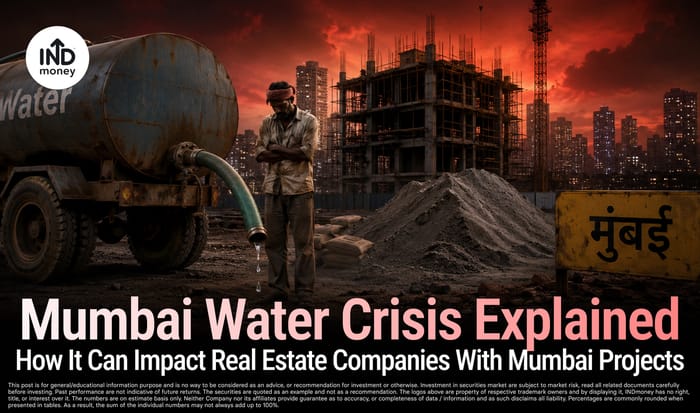
The key trigger is that BMC has suspended water supply to construction sites and stopped new temporary water connections for construction activity. This means the issue is no longer limited to household water cuts. It can now affect real estate execution in Mumbai.
Construction sites need water every day. It is required for concrete work, curing, plastering, dust control, cleaning and basic labour use. If water supply becomes uncertain, developers may have to depend more on tankers or alternative sources. That can increase costs and create project-level execution risk.
This does not mean all Mumbai real estate stocks will immediately get affected. But companies with active projects inside Mumbai need closer tracking.
What Is Happening In Mumbai?
Mumbai’s water stock in the seven lakes that supply the city has fallen to very low levels. The city was already under a 10% water cut. Now, BMC has announced stricter measures to conserve water.
The restrictions include stopping water supply to construction sites, suspending new temporary construction water connections, limiting water supply to swimming pools, and imposing a higher cut on industrial and commercial users.
For residents, this is a water availability issue. For businesses, it is a cost and operations issue. For real estate companies, it can become an execution issue.
The timing is also important. Mumbai’s real estate market has seen strong demand over the last few years, especially in premium housing, redevelopment projects and high-rise residential towers. If water availability becomes a repeated concern, investors may start looking beyond sales numbers and focus more on execution risk.
Why Construction Sites Need Water
Real estate construction cannot move smoothly without regular water supply.
Water is needed for mixing concrete, curing concrete, masonry, plastering, floor work, dust control, cleaning and worker facilities. Curing is especially important because concrete needs water after casting to gain strength properly.
So, when municipal water supply to construction sites is stopped, developers cannot simply ignore the issue. They need alternative arrangements.
These alternatives may include private tankers, recycled water, borewell water, treated sewage water or water sourced from other approved channels. But each option has its own limitation.
Tankers can become expensive during shortage periods. Borewell supply may not be available everywhere. Recycled water requires proper site infrastructure. And if many construction sites try to arrange private water at the same time, supply pressure can increase.
This is why the water crisis can affect real estate companies even if the restriction is temporary.
Why This Becomes An Investor Issue
For investors, the Mumbai water crisis matters because it can affect three important things: cost, timeline and buyer confidence.
The first impact is cost. If developers need to depend more on private tankers, construction water costs can rise. In premium projects, this may not destroy margins, but it can still increase project-level expenses.
The second impact is timeline. If water availability becomes irregular, construction work may slow down. This matters more for projects that are in early construction or active construction stages. Projects close to completion may be less affected.
The third impact is buyer sentiment. Mumbai homebuyers already pay very high prices. If water scarcity becomes a recurring concern, buyers may start asking more questions about water storage, tanker dependence, society maintenance cost, rainwater harvesting and sewage treatment plants.
This is the deeper investor angle. Mumbai real estate is no longer only about location, brand and luxury. Water security can become an important project-level factor.
Real Estate Companies With Mumbai And MMR Exposure
Not every real estate company will be affected in the same way. The impact will depend on how much exposure the company has to Mumbai, whether the project is inside BMC limits, and what stage of construction the project is in.
| Company | Mumbai/MMR Exposure | Why Investors Should Watch |
| Oberoi Realty | Strong Mumbai focus with projects across areas such as Goregaon, Borivali, Mulund, Worli, Andheri, Juhu and Thane | Higher sensitivity because the company is Mumbai-centric. Premium pricing may protect margins, but active construction projects can face execution pressure. |
| Lodha / Macrotech Developers | Large presence across Mumbai, Thane and wider MMR | Scale and execution strength help, but a large number of active projects means water availability needs monitoring. |
| Godrej Properties | Has projects in Mumbai and MMR locations such as Kandivali, Vikhroli, Chembur and nearby markets | Medium impact because the company has Mumbai exposure but is also diversified across other Indian cities. |
| Sunteck Realty | Mumbai and MMR-focused portfolio, including BKC, Goregaon, Mira Road, Kalyan, Vasai and Naigaon | Medium to high impact. Projects inside BMC limits may be more directly affected than projects in outer MMR. |
| Raymond Realty | MMR-focused real estate exposure, with projects in Thane, Bandra and BKC | Medium to high impact. Thane may face a different local water situation, but Bandra and BKC projects are more directly linked to Mumbai civic conditions. |
This table should not be read as a stock recommendation. It only shows where investors may need to track water-related execution risk more closely.
Which Developers May Be More Sensitive?
The impact will differ across real estate companies. Investors should focus on four factors:
- Project location: Projects inside BMC limits may be more directly affected by BMC restrictions. Projects in Thane, Kalyan, Vasai, Naigaon or other MMR areas may face different local conditions.
- Stage of construction: Completed or near-handover projects may see limited impact. Early-stage or active construction projects need more water daily and may be more sensitive if restrictions continue.
- Developer strength: Larger developers may manage this better because they have stronger vendor networks, better planning and more ability to absorb short-term cost increases.
So, the key question is not just which company has Mumbai exposure. It is which company has active Mumbai projects and how well it can manage water availability at the site level.
Will This Impact Mumbai Property Prices?
The water crisis may not immediately reduce Mumbai property prices.
Mumbai real estate prices are driven by many strong factors, including limited land supply, redevelopment demand, income levels, premium housing demand and location preference. These factors do not disappear because of one temporary water restriction.
But the crisis can change how buyers evaluate projects. Earlier, many buyers focused mainly on location, builder brand, carpet area, amenities and connectivity. Going forward, water infrastructure may become more important.
Buyers may start asking:
- Does the project have enough water storage?
- How dependent is the society on tankers?
- Is recycled water used for gardening and flushing?
- What can happen to maintenance costs during a water shortage?
These questions matter because water shortage can directly affect daily living experience. In a premium housing market like Mumbai, buyers expect reliability, not just luxury.
Why This Matters More For Premium Developers
Premium developers sell homes at higher prices. Their buyers usually expect better amenities, faster delivery and stronger infrastructure. That creates both a risk and an opportunity.
The risk is that any delay or infrastructure issue can affect buyer confidence. If a premium project faces construction delays because of water constraints, investors may question execution quality.
The opportunity is that stronger developers can use water management as a brand advantage. A developer with better recycling systems, better storage, lower tanker dependence and stronger planning can stand out.
In the long run, water security can become part of the premium real estate story.
A premium home is not only about a better lobby, sea view or clubhouse. It is also about whether the project can handle the pressure of urban infrastructure.
What Investors Should Track Next
Investors should first track reservoir levels and monsoon recovery. If rains improve and lake levels recover, the immediate pressure may reduce.
Second, investors should track whether BMC continues or removes restrictions on construction site water supply. A short-term restriction may have limited impact. A longer restriction can increase execution pressure.
Third, tanker prices and tanker availability need to be watched. If construction sites become more dependent on tankers and tanker supply is tight, project costs can rise.
Fourth, investors should watch management commentary from Mumbai-focused developers. If companies start mentioning water availability, higher site costs or delay risk in updates, the issue may become more material.
Fifth, investors should track whether developers are investing more in recycled water and site-level water management. This can become an important differentiator over time.
Author’s Take
The Mumbai water crisis is not yet a full earnings risk for real estate companies. But it is a warning sign.
The bigger issue is not whether developers can arrange water for a few weeks. The bigger issue is whether Mumbai’s urban infrastructure can keep supporting higher real estate density.
Mumbai is adding more premium towers, redevelopment projects, gated communities and commercial spaces. But if water supply remains under pressure, execution quality and project-level infrastructure will become more important.
For investors, the companies to watch are those with large active projects inside Mumbai. But the better companies may be the ones that can manage this risk through stronger planning, better water systems and better execution control.
The simple takeaway is this: Mumbai real estate will remain valuable because land is scarce and demand is strong. But going forward, water security can become an important factor in how investors and homebuyers judge real estate companies.