

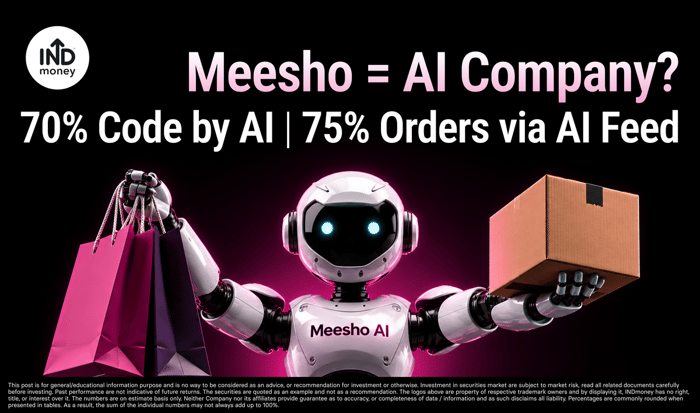
- AI Is Writing 70% of Meesho’s Code. But What Does That Really Mean?
- The AI Systems Behind Every Order
- The Cost Challenge Behind Meesho’s AI Push
- Meesho’s Share Is Gaining Momentum Again
- What Could Go Wrong With AI Growth
- What This Actually Means for Investors
Most people see Meesho as that app where small-town India buys affordable kurtas and daily-use stuff. And honestly, that’s not wrong. But if you slow down and really read their Q4 FY26 shareholder letter, you start noticing something deeper.
Meesho isn’t just adding AI as a feature on top. It feels like they are rebuilding the entire company around AI from the ground up. And the scale they’re talking about puts them in a very different league for an Indian e-commerce player.
That said, big claims don’t always match reality. So instead of getting carried away, let’s break this down properly. What’s real, what’s unclear, and where the risks lie.
AI Is Writing 70% of Meesho’s Code. But What Does That Really Mean?
CEO Vidit Aatrey shared that more than 70% of Meesho’s code is now written by AI. To give you context, Google is around 75%, Snap is about 65%, and Microsoft was roughly 20 to 30% in early 2025.
So yes, on paper, this sounds huge. An Indian company operating at levels close to Google? That definitely grabs attention.
But, at some places, this could just mean basic auto-complete or repetitive code. At others, it might include complex logic and decision-making. Without that clarity, the number sounds impressive, but it’s hard to compare properly.
What we can look at is output. Meesho says the number of experiments on its platform doubled year-on-year in Q4. Also, features that earlier took weeks are now getting built in days.
The AI Systems Behind Every Order
The “70% AI code” headline is catchy. But the real story is these AI systems they say are already running live. Each one is solving a very India-specific problem.
- PRISM (recommendation engine): This system processes over 400 trillion signals using 100+ models. Meesho says more than 75% of orders now come from AI-curated feeds, meaning users don’t even search, they just scroll and buy. Conversion (people actually buying) improved by about 15%. Inside PRISM, there’s engine called Trendpulse, which picks up local trends early, like wedding shopping in Rajasthan or festival demand in Tamil Nadu.
- Vaani (voice shopping): This lets users shop using their voice in their own language. In just one month, it got 1.5 million users. Conversion improved by 22% for those using it, and 79% said it made shopping easier.
- It even works on weak internet since speech processing happens on the device. For a country like India, where many people prefer speaking over typing, this could be big, though it’s still early days.
- GeoIndia LLM (address intelligence): This converts vague addresses like “near the blue water tank” into exact delivery locations. Meesho says accuracy improved by 20 percentage points and misroute costs dropped by 5%. This system also reduced last-mile delivery mistakes by 50% across their network.
- TrustMesh (fraud and quality control): It monitors 166 million listings in real time, blocked 9 million risky transactions, and reduced return-to-origin (failed deliveries) by over 10%.
- Chorus (customer support AI): This handles 62% of customer queries without human help, processed 19 million calls, and reduced support costs by 23%.
Put together, this is a strong AI stack. But, these are management claims that still need to prove themselves over time.
The Cost Challenge Behind Meesho’s AI Push
Here’s something most people miss. Running all this AI is expensive. If Meesho relied fully on standard cloud services, the cost would probably kill margins, especially when the average order value is just around ₹250.
So over the last four years, they built their own system called BharatMLStack. They claim it runs 60 to 70% cheaper than typical cloud solutions while handling massive workloads like 6.4 trillion inferences (basically AI decisions or predictions).
This piece is critical. Because this is what connects AI hype to actual profitability.
Faster code leads to more AI systems. > More AI systems improve conversion, logistics, and support.
But BharatMLStack is what makes all of this economically possible. Without it, the AI story looks exciting, but doesn’t make financial sense.
Meesho’s Share Is Gaining Momentum Again
Meesho listed in December 2025 at ₹162.5, a 46% premium over its IPO price of ₹111. The stock quickly went up to ₹254.4. After that, it corrected about 22% from the peak. But interestingly, in the last 30 days, it has jumped nearly 34%.
Data from INDmoney shows investment activity in Meesho shares went up 307% between April 7 and May 7, 2026, compared to the previous month. Search interest also rose by 83%. Clearly, the Q4 results have brought fresh attention from investors.
What Could Go Wrong With AI Growth
The AI narrative sounds exciting. But the financials tell a more grounded story.
Contribution margin (profit after variable costs) dropped to 3.5% in FY26 from 4.9% in FY25. Yes, Q4 improved slightly to 4.0%, but the yearly trend is still down. Adjusted EBITDA (a profitability measure) went from -0.4% to -2.8% of NMV (net merchandise value, total value of goods sold on the platform). Free cash flow (cash left after operating and capital expenses) shifted from +₹591 crore to -₹633 crore.
They do have ₹6,750 crore in cash, so no immediate risk. But the direction of cash burn is something you can’t ignore.
There’s also a big tax issue. During the last quarter, Income Tax Authorities have raised demands of about ₹2,072 crore across two years (FY23 and FY24). Though the management is confident of a favorable outcome, but the size of this number matters.
And then there’s competition. Flipkart and Amazon are not sitting idle. They are building their own AI capabilities, too. Meesho’s data advantage is real today, but it won’t last forever if competitors catch up faster.
What This Actually Means for Investors
One genuinely useful thing in the shareholder letter was cohort-level profitability data.
- Users acquired before FY24 (57.5% of business) are slightly profitable at +0.4%
- FY25 users (17.1%) are slightly negative at -0.4%
- FY26 users (25.4%) are deeply negative at -7.5%
What does this tell you? The core business is close to profitability when users mature over time. The losses you see today are largely because the company is spending to acquire new users.
So what should you watch going forward?
- Contribution margin trend, especially after Q4 improvement
- Adoption of Vaani, which can expand the user base
- Server costs as a percentage of NMV, which dropped slightly from 2.0% to 1.8%
- And most importantly, how quickly new user cohorts move toward breakeven
That last point matters the most.
Because if new users start becoming profitable faster, it tells you the AI investments are actually working. And honestly, that single metric says more than all the flashy AI numbers combined.