

- One Commodity Is at the Centre of Everything
- Why This May Not Last Long
- What a Prepared Investor and Consumer Does
- Final Word
Global tensions escalated sharply over the weekend, sending crude oil prices jumping nearly 7% in a single day to ~$77 per barrel.
Most of the conversation since then has been about stock markets. Sensex fell. Nifty tumbled. Portfolios turned red. That story is real and important.
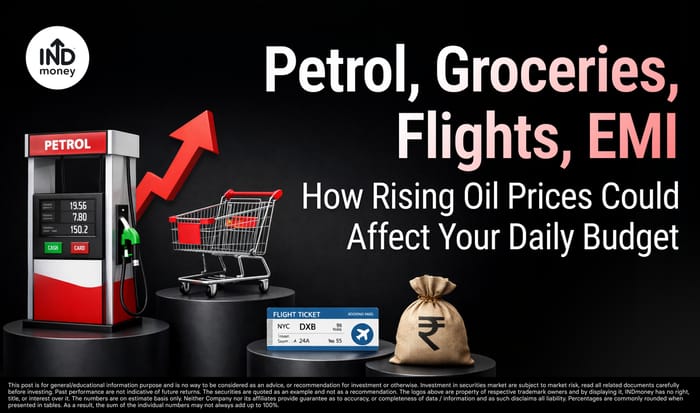
But there is a quieter story that hits closer to home. When crude oil prices rise, the impact does not stay inside financial markets. It travels. Into petrol pumps. Into grocery stores. Into airline pricing desks. And eventually, into your home loan EMI. In this blog, we connect those dots, so you know exactly what to watch and what not to worry about.
One Commodity Is at the Centre of Everything
When global uncertainty spikes, the first thing markets watch is crude oil. And today, Brent crude opened over 5% up to $76.04 per barrel on fears of supply disruption in the Middle East, also touched a day high of $80.6 per barrel.
India imports nearly 85% of its crude oil needs. That single fact is why a crisis thousands of kilometres away lands so directly in your everyday budget.
One commodity. Multiple ripple effects. Here is how they play out.
1) Your Petrol and Diesel Bill
India's domestic fuel prices do not move the moment crude spikes. There is a lag. The government manages this through state-owned oil companies and can use tools like excise duty cuts to absorb the shock temporarily.
If the situation stabilises over the coming days or weeks, which many energy analysts believe is likely, you may not see any change at the pump at all.
But if crude stays elevated for an extended period, the pressure eventually builds up to a point where it becomes difficult to absorb. The important context here: the US Energy Information Administration forecasts Brent crude to average $58 per barrel for the full year 2026, significantly below today's spike. What that tells you is simple: if the forecast holds, prices are expected to come down from here over the coming months, which means the pressure on your fuel bill may be temporary rather than permanent.
2) Your Grocery and Kitchen Budget
This connection is indirect but very real.
Everything that reaches your local grocery store, vegetables, grains, packaged goods, travels on trucks that run on diesel. When diesel prices rise, transportation costs rise. Those costs do not disappear. They get passed on, quietly, in slightly higher prices at your neighbourhood store.
This is not a crisis. It is how inflation quietly builds over weeks when fuel costs stay elevated. One price rise feeds the next. Worth keeping in mind when you notice your monthly grocery bill creeping upward.
Also Read: Sensex, Nifty 50 Down Today: What Is Happening and What to Do Now
3) Your Flight Ticket
Aviation Turbine Fuel, or ATF, is directly derived from crude oil and makes up one of the largest operating costs for any airline. When crude spikes sharply, airlines feel it almost immediately.
Airlines cannot absorb a sustained cost increase indefinitely. If crude remains elevated for several weeks, you are likely to see it reflected in domestic and international ticket prices, with international routes typically adjusting faster. If the situation resolves quickly, as many experts believe it will, this pressure eases just as fast.
4) Your EMI and the Cost of Borrowing
This is the most indirect impact, but it carries the most long-term weight.
Higher crude pushes up inflation. When inflation rises, the Reserve Bank of India, India's central bank that controls interest rates, faces pressure to keep rates higher for longer. Higher interest rates mean that home loans, car loans, and personal loans become more expensive over time.
Your current EMI does not change today. But if you are planning a large loan in the coming months, the interest rate environment is worth watching.
Why This May Not Last Long
Here is the context that matters most.
OPEC Plus, the group of major oil-producing nations, announced on Sunday that it would increase oil production by 206,000 barrels a day starting April. This is a direct signal that the world's largest producers are moving to cushion the price spike.
Beyond that, the broader supply picture remains well-stocked. The US Energy Information Administration forecasts that strong global oil production growth will result in significant inventory builds through 2026, causing crude oil prices to fall, with Brent spot prices expected to average $58 per barrel for the year.
India also has more supply options today than it has ever had. India now sources crude from 41 suppliers, up from 27 a few years ago, giving it meaningful flexibility to manage short-term disruptions without a structural supply crisis.
Today's spike is real. But the conditions that could sustain it for months are being actively worked against by markets, producers, and governments alike.
What a Prepared Investor and Consumer Does
This is not the moment for big decisions driven by fear. It is the moment for calm awareness.
A few practical things worth doing right now:
- Take a look at your monthly budget and identify where costs could inch upward over the next few weeks, fuel, groceries, and travel being the most likely areas.
- If you have a large loan or home purchase planned, keep an eye on how this situation develops over the coming weeks before finalising.
- As an investor, stay the course. Do not make large portfolio moves based on a single day's news. Every major geopolitical shock in modern history has eventually settled, and markets have recovered.
- And remember, while today's headlines are loud, the underlying data from energy agencies and central banks suggests this is a disruption, not a breakdown.
Final Word
A spike in crude oil prices thousands of kilometres away may feel distant and abstract. But as you have seen, it travels quietly into the most ordinary parts of your life. Your fuel tank. Your vegetable prices. Your travel plans. Your borrowing costs.
The reassuring part is that the world is not sitting still. Major oil producers have already moved to increase supply. Long-term forecasts remain well below today's price levels. And India, more than ever before, has the supply diversity and policy tools to manage short-term shocks without lasting damage.
Stay informed. Stay calm. And the next time a global headline crosses your screen, you will know exactly where to look and what it actually means for you.
Disclaimer
Investments in the securities market are subject to market risks. Read all the related documents carefully before investing. The securities are quoted as an example and not as a recommendation. This is nowhere to be considered as advice, recommendation, or solicitation of an offer to buy or sell or subscribe for securities. INDStocks SIP / Mini Save is a SIP feature that enables Customer(s) to save a fixed amount on a daily basis to invest in Indian stocks. INDstocks Private Limited (formerly known as INDmoney Private Limited) 616, Level 6, Suncity Success Tower, Sector 65, Gurugram, 122005, SEBI Stock Broking Registration No: INZ000305337, Trading and Clearing Member of NSE (90267, M70042) and BSE, BSE StarMF (6779), SEBI Depository Participant Reg. No. IN-DP-690-2022, Depository Participant ID: CDSL 12095500, Research Analyst Registration No. INH000018948 BSE RA Enlistment No. 6428. Refer to https://indstocks.com/pricing?type=indian-stocks; https://www.indstocks.com/page/indian-stocks-sip-terms-and-condition for further details.