

- What HFCL Actually Does
- The Moat Nobody Talks About: Europe’s Anti-Dumping Exemption
- BharatNet: Connecting India’s Villages with Indian Tech
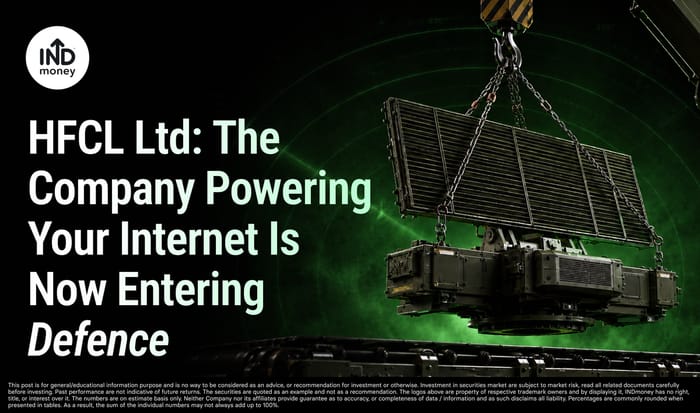
- The Defence Pivot: From Cables to Drones and Radars
- Is HFCL a good investment? What the Numbers Really Say
- What Should Investors Watch Going Forward
- What Really Stands Out
Every time you stream a movie, send money through UPI, or jump on a video call, your data moves through super-thin glass wires called optical fiber cables. There is a good chance those cables were made by a company you may not even recognize: HFCL Ltd.
HFCL supplies this core fiber infrastructure to telecom giants like Reliance Jio, Bharti Airtel, and BSNL. That gap between how important a company is and how little people talk about it is exactly why HFCL is worth understanding. The company recently reached its highest-ever order book of ₹21,206 crore. Its stock jumped ~18% in the last 5 days, hitting ₹146.8, a fresh 52-week high. In just 30 days, the stock has almost doubled, delivering 98.50% returns.
This blog is here to help you understand what HFCL really does, where its strengths come from, and why it is slowly turning into a defence tech player.
What HFCL Actually Does
HFCL covers the full journey of digital connectivity. It starts by making the raw optical fiber (basically the glass), turns it into cables, builds telecom equipment like 5G routers and Wi-Fi systems, and then actually installs these networks on the ground.
But the company is no longer just about telecom. Through its subsidiary HTL Ltd and recent acquisitions, HFCL now makes specialized aerospace cables, electronic fuzes (devices that control when a shell explodes), and drone detection radars.
Now here’s where things get more interesting.
Two key numbers to remember: HFCL’s order book is at ₹21,206 crore (which is more than 4x of revenue generated in FY26), and 58% of it comes from exports. That export share matters because it shows HFCL is not just dependent on Indian government projects. Global clients are also placing long-term bets on the company.
The Moat Nobody Talks About: Europe’s Anti-Dumping Exemption
This is probably the most overlooked advantage in HFCL’s story, but it actually tells you a lot about the business. In 2024, the European Commission imposed anti-dumping duties (extra taxes to prevent unfairly cheap imports) on Indian optical fiber cable companies. Almost every Indian company was affected. Except HFCL. After investigating, the European Commission concluded that HFCL was not selling below fair prices. So the company was completely exempted.
What does this mean? When HFCL sells cables in Europe, it does not have to pay extra tariffs. Its competitors do. Think of it like this: everyone else is paying a toll to enter the market, but HFCL has a permanent free pass. In a business where pricing is everything, that is a big advantage.
This edge showed up clearly in March 2026 when HFCL secured a $1.1 billion (₹10,159 crore) global optical fiber contract. It is the largest order in the company’s history and runs till 2030, giving strong visibility on future revenue.
Now, to be fair, HFCL is not the largest player. Sterlite Technologies (STL) has a bigger global footprint. But STL does not have this European advantage. In a low-margin business, even a small tariff edge can decide who wins large contracts. This is a structural advantage, not a temporary one.
BharatNet: Connecting India’s Villages with Indian Tech
While HFCL is building a strong global presence, its role within India is just as important. India is rolling out BharatNet Phase III, a ₹65,000 crore initiative to bring high-speed internet to rural areas. HFCL is right in the middle of this. Its consortium has won contracts worth over ₹8,100 crore across regions like Punjab and Uttar Pradesh. But the real story is not just laying cables. It is what runs on top of them.
Earlier, routers (devices that direct internet traffic) were mostly imported from Western companies, especially after Chinese vendors were restricted due to security concerns. HFCL changed that.
In January 2026, the company started deploying its own India-made IP/MPLS routers for BSNL’s network. These are fully designed and manufactured by HFCL, not just rebranded imports.
Why does this matter?
- For the country: less dependence on foreign tech, better security
- For HFCL: higher profit margins since it is selling its own product
This innovation even won it the Fierce Network Innovation Award, which is well respected in telecom circles.
The Defence Pivot: From Cables to Drones and Radars
This is where things get interesting and where many investors are still catching up. HFCL is no longer just a cable company.
Through its subsidiaries, it is building a defence electronics business:
- Electronic fuzes for artillery, where India earlier relied heavily on imports
- Drone detection radars
- Thermal weapon sights (devices that help soldiers see using heat, especially at night)
- Multi-mode hand grenades using technology from DRDO
Its subsidiary HTL also makes wire harnesses (complex cable systems inside military vehicles and aircraft like the T-72 tank).
On top of that, HFCL is entering aerospace manufacturing with an export order book of ₹1,930 crore. Combined with defence, its total order book here is about ₹2,230 crore. Management expects defence revenue to reach ₹500-600 crore by FY27, from just ₹76.7 crore in FY26.
Is HFCL a good investment? What the Numbers Really Say
All these developments have not gone unnoticed by the market. HFCL’s stock has seen a sharp rally. It is trading around ₹145 today, up ~18% in the last 5 days and at a new high. In the past month alone, the stock has delivered 98.5% returns. If someone had invested ₹1 lakh in this company a month ago, it would have turned into ₹1.98 lakh.
This is not just price movement. Investor behavior is also shifting.
Data from INDmoney shows:
- Investment activity in HFCL at INDmoney rose 316.67% in the last 30 days
- Search interest jumped 219%
So more people are not just buying the stock, they are actively researching it.
But here’s where things need a closer look.
HFCL’s current P/E (price-to-earnings ratio, a way to measure how expensive a stock is compared to its profits) is 66x. The industry average is 14.8x. That means HFCL is trading at roughly 4 times the industry valuation.
Yes, the company has growth triggers: export contracts, defence expansion, and BharatNet. But the market has already priced in a lot of that optimism. So the honest takeaway is simple: the business story is strong, but the stock is not cheap. Anyone buying now is betting that execution goes almost perfectly.
What Should Investors Watch Going Forward
Three things really matter from here:
1. AI and Data Center Demand
AI systems need huge amounts of data movement, which means more fiber. A single AI data center rack needs about 36 times more fiber than a normal one. HFCL is expanding capacity to 42.36 million fiber kilometers by June 2026. This is a tailwind for the whole sector, including STL, but it adds another growth layer.
2. Defence Revenue Execution
The big question is not orders, it is execution. Can HFCL convert its ₹2,230 crore defence order book into real revenue with good margins? Keep an eye on quarterly numbers and progress on the Andhra Pradesh facility.
3. Promoter Skin in the Game
Promoters plan to invest ₹555 crore through convertible warrants priced at ₹74 per share. Most of this will fund a backward integration plant (making their own raw material instead of buying it). This helps reduce costs and protect margins. When promoters put their own money in, it is usually worth noticing.
What Really Stands Out
HFCL is a reminder that some of the most important companies are the ones you rarely notice. In a market obsessed with apps and AI platforms, it is easy to ignore the companies building the foundation underneath. HFCL is one of those builders. It lays the fiber that carries your data, builds the routers that manage your internet, and is now stepping into defence with radars and drone systems.
Whether it turns into a great investment depends on how well the company handles a ₹21,206 crore order book across telecom, exports, and defence at the same time. That is not easy for a mid-sized company. But even if you never buy the stock, understanding a company like HFCL makes you a sharper investor. And in the long run, that kind of understanding compounds far better than chasing the next hot stock.