

- What Does HEG Do?
- What Is Changing In The HEG Demerger?
- What Will HEG Shareholders Receive?
- Why Is HEG Demerging Its Business?
- What Will HEG Graphite Limited Represent?
- What Will The Remaining HEG Business Focus On?
- Can The HEG Demerger Unlock Value?
- What Should HEG Investors Watch After The Demerger?
- Author’s Take
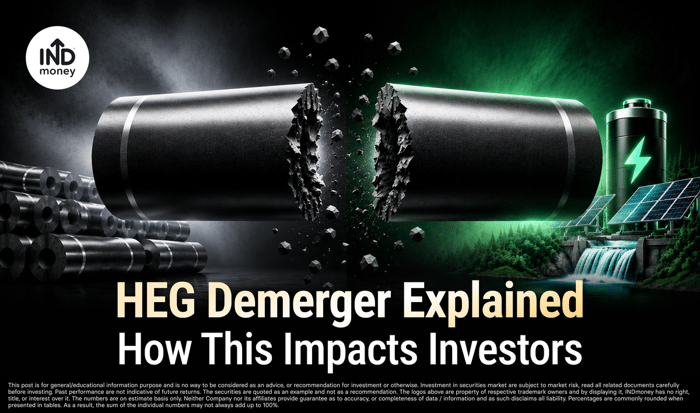
HEG investors are set to see a major restructuring of their investment as the company separates its graphite electrode business into a separate entity.
The company has received approval for a composite scheme of arrangement under which HEG Graphite Limited will be created as a separate entity housing the graphite electrode business, while the remaining HEG entity will focus on businesses related to advanced materials, battery materials, energy storage and power assets.
The scheme will become effective from September 1, 2026, while September 7, 2026 has been fixed as the record date to determine shareholders eligible for receiving shares under the demerger benefits.
At first glance, this looks like a simple demerger where shareholders receive an additional share. However, the bigger question for investors is not just what shares they receive, but whether separating these businesses can unlock more value than keeping them together.
To understand this, investors first need to understand what HEG does today and what exactly is changing.
What Does HEG Do?
HEG is primarily known for its graphite electrode business, which remains the core of the company's operations.
Graphite electrodes are critical inputs used in electric arc furnaces for steel production. As global steel production gradually shifts towards electric arc furnace-based manufacturing, demand for graphite electrodes remains closely linked with the steel cycle.
However, over the years, HEG has expanded beyond its traditional graphite electrode business. The company has been building exposure to newer areas such as advanced materials, battery materials, energy storage and renewable power assets.
This means HEG today is a combination of two very different businesses.
The graphite electrode business is a mature industrial business where earnings depend on global steel demand, electrode prices, capacity utilisation and raw material costs.
On the other hand, businesses such as battery materials and energy storage are growth-oriented businesses where the company is investing today with the expectation of future scale and profitability.
The upcoming restructuring aims to separate these two different investment stories.
What Is Changing In The HEG Demerger?
The restructuring is not just a standalone demerger. It is a composite scheme involving two major changes.
First, HEG's graphite electrode business will be transferred into a separate company called HEG Graphite Limited.
Second, Bhilwara Energy Limited will be merged into HEG as part of the restructuring process.
After the scheme becomes effective, the existing HEG entity will continue with businesses focused on advanced materials, battery-related opportunities and energy assets. The company has also proposed changing the name of the existing HEG entity to HEG Advanced Materials Limited, while HEG Graphite Limited is proposed to be renamed as HEG Limited, subject to approvals.
In simple terms, HEG is separating its traditional graphite business from its newer growth businesses.
What Will HEG Shareholders Receive?
Under the demerger arrangement, shareholders holding HEG shares on the record date will receive one share of HEG Graphite Limited for every one HEG share held.
For example, if an investor currently owns 100 HEG shares, after the demerger they will continue to own shares of the remaining HEG entity and will additionally receive 100 shares of HEG Graphite Limited, which will represent the graphite electrode business.
However, investors should not assume that their investment automatically doubles because the number of shares increases.
Before the demerger, one HEG share represented ownership in all businesses together. After the restructuring, the value of these businesses will be divided between two separate companies, and the market will assign independent valuations to both.
The real question is: Will the combined market value of HEG Graphite and the remaining HEG entity be higher than the value of HEG before the demerger?
That is what will determine whether the restructuring creates value for shareholders.
Why Is HEG Demerging Its Business?
The biggest reason behind the restructuring is that the two businesses have different financial profiles. The graphite electrode business is cyclical. Its performance depends heavily on global steel production, pricing environment and operating efficiency.
A strong steel cycle can improve profitability, but weaker demand or lower electrode prices can impact earnings.
The advanced materials and energy businesses, meanwhile, require significant investments before they can generate meaningful returns.
By separating these businesses, investors may get better visibility into each company's earnings potential. The graphite business can now be valued based on factors such as:
| Factor | Why Investors Should Track It |
| Graphite electrode prices | Direct impact on revenue and margins |
| Global steel demand | Determines overall demand environment |
| Capacity utilisation | Impacts operating leverage |
| Raw material costs | Influences profitability |
The remaining HEG business can be evaluated based on its ability to scale newer businesses and generate returns from investments.
What Will HEG Graphite Limited Represent?
HEG Graphite will essentially become a focused graphite electrode company.
The investment case for this business will largely depend on whether HEG can maintain its competitive position in the global graphite electrode market.
Investors will need to track whether demand from electric arc furnace-based steel production continues to support the industry, whether pricing remains favourable and whether the company can maintain healthy margins.
The advantage after the demerger is that investors will be able to evaluate this business separately instead of valuing it along with unrelated growth businesses.
What Will The Remaining HEG Business Focus On?
The remaining HEG entity will represent the company's growth-oriented businesses. The company has been building capabilities in areas such as battery anode materials, energy storage solutions and renewable energy assets.
These businesses are linked to long-term themes such as electric vehicles, energy transition and increasing demand for storage solutions. However, unlike the graphite business, these segments are still in the scaling phase.
For investors, the key question will be whether HEG can successfully convert these investments into commercial businesses.
The journey will involve moving from capacity creation to customer approvals, commercial orders, revenue growth and finally sustainable profitability.
Can The HEG Demerger Unlock Value?
The biggest potential benefit of the demerger is valuation clarity. Before the restructuring, investors were valuing a company that combined a cyclical industrial business with future growth businesses.
After the separation, investors can assign different valuations to both companies. HEG Graphite can be valued based on its current earnings, cash flows and position in the graphite electrode market.
The remaining HEG entity can be valued based on future growth opportunities in advanced materials, battery businesses and energy assets.
This does not guarantee value creation, but it removes one major challenge investors faced earlier: understanding the true value of different businesses under one company.
What Should HEG Investors Watch After The Demerger?
The first important factor will be the successful listing of HEG Graphite Limited and how the market values the new entity.
Beyond that, investors should track whether the graphite business can maintain profitability through industry cycles.
For the remaining HEG entity, the focus will be on execution. The company needs to demonstrate that investments in battery materials, energy storage and renewable assets can generate attractive returns.
Ultimately, the success of the restructuring will depend on capital allocation and whether both businesses can create value independently.
Author’s Take
The HEG demerger creates two different investment opportunities from one company. HEG Graphite will represent a mature industrial business with established operations and exposure to the global steel cycle.
The remaining HEG entity will represent a higher-growth opportunity around advanced materials and energy transition themes, but with greater execution risk.
For investors, the important point is that a demerger itself does not create value. It only creates the possibility of better value discovery.
The final outcome will depend on whether both companies can execute well, generate strong returns on capital and justify the valuations investors assign after the restructuring.