

- What Exactly Did Flipkart Announce?
- Why Now? Understanding the Size of the Opportunity
- Meet the Challenger: What Flipkart Brings to the Table
- Why Swiggy and Zomato Aren't Easy to Disrupt
- So, Is This Actually a Threat?
- What Should Investors Actually Watch?
- Where Does This Leave Swiggy and Zomato?
Swiggy's shares fell as much as 7% on July 24, 2026, while Zomato's parent company, Eternal, dropped over 3%, wiping out crores of market value.
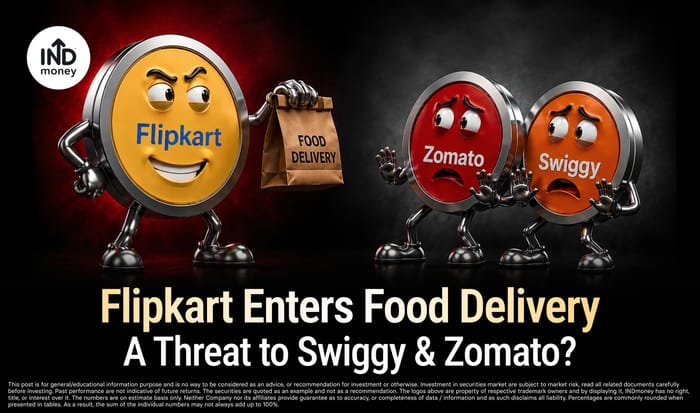
The share price reaction itself wasn't unusual. What caught investors' attention was the reason behind it. Flipkart hadn't launched a food delivery service or taken away any customers. Its Group CEO, Kalyan Krishnamurthy, had simply told Moneycontrol that the company plans to enter food delivery "in the coming weeks."
That was enough to shake confidence in two companies that have spent years building what looked like a strong duopoly.
So, was the market right to worry, or did investors react too quickly? Let's look at the bigger picture.
What Exactly Did Flipkart Announce?
Krishnamurthy said Flipkart will begin with a small pilot, most likely in Bengaluru. The idea is to test the service, understand customer feedback, and expand only if the model works. It's the same approach Flipkart followed with Flipkart Minutes: start in one city, learn, and then scale.
A broader rollout could happen between late 2026 and early 2027, depending on how the pilot performs. Reports also suggest Flipkart is deciding whether to offer food delivery through its main app or launch a separate app. It is also evaluating how ONDC, the government-backed open commerce network, could support the rollout.
This isn't a completely new idea. Flipkart had explored food delivery through ONDC about two years ago, but those plans didn't move ahead. This time, though, the company appears more serious.
Why Now? Understanding the Size of the Opportunity
The answer becomes clearer when you look at how fast the market is growing.
In 2023, India's online food delivery market was worth around ₹63,000 crore, or about $7.3 billion, according to brokerage estimates. At that time, analysts expected the market to grow to around $17-21 billion (₹1.5-1.8 lakh crore) by 2028.
Today, the market is already estimated at about $9 billion (₹86,400 crore), and Jefferies believes it could reach nearly $25 billion (₹2.4 lakh crore) by FY30. In other words, the opportunity has become even larger than expected.
There's another, less obvious reason Flipkart is entering food delivery now. Quick commerce, the 10-minute grocery delivery model pioneered by Zepto in late 2021 and later followed by Blinkit and Swiggy Instamart, has blurred the line between grocery and food delivery. Once a company has built dark stores, delivery fleets, and a habit of instant delivery among customers, food becomes a natural extension rather than a giant leap. That's exactly the capability Flipkart has been building with Flipkart Minutes.
Meet the Challenger: What Flipkart Brings to the Table
Flipkart isn't entering this market from scratch. It already has a few major strengths.
Scale: Flipkart reportedly has around 85 million daily active users on its e-commerce platform. That's a huge base of customers who already shop on the app and trust the platform.
Logistics: Through Ekart and Flipkart Minutes, the company already operates one of India's largest delivery networks. That means it doesn't have to build everything from the ground up like a new startup.
Capital: Flipkart is backed by Walmart, giving it access to deep financial resources. In food delivery, where companies often spend heavily on discounts to attract customers, having the ability to invest patiently can make a big difference.
Think of it like a new restaurant opening next to two popular restaurants, except this new one already has millions of people walking past its doors every day.
Why Swiggy and Zomato Aren't Easy to Disrupt
Even so, scale and money alone don't guarantee success. Swiggy and Zomato have built strong positions over many years.
Both businesses are still growing. In Q1 FY27, Zomato's food delivery business reported a net order value of ₹10,769 crore, up 20.1% year-on-year. Swiggy Q1 results are still awaited, in Q4, it reported a gross order value of ₹9,005 crore, up 22.6%, while order volumes grew 19% and monthly transacting users reached 18.3 million. Since the companies report different operating metrics, these numbers should be viewed as broadly comparable rather than a direct comparison.
The market share battle has also become more stable. By late 2025, Zomato held around 57.3% of the food delivery market by order value, while Swiggy had about 42.7%, according to ET.
Both companies also have room to respond if competition increases. As per reports, their take rates, the percentage of each order that the platform keeps, are around 24.4% for Eternal and 21.9% for Swiggy. These are among the highest globally and well above Meituan's 16.1%. That gives both companies some flexibility to lower commissions or offer discounts if competition becomes more intense.
Rapido's experience offers a useful reference point. India's bike-taxi giant launched its food delivery app, Ownly, as a pilot in select Bengaluru neighbourhoods in August 2025 before expanding it across the city in March 2026. Its approach is quite different: restaurants pay zero commission, while customers pay a flat delivery fee.
The company has reportedly onboarded around 20,000 restaurant partners in Bengaluru alone and says it plans to expand to 10 cities, including Delhi NCR, Mumbai, Hyderabad, Pune, and Chennai. That's meaningful progress for a new challenger.
At the same time, one important piece of the puzzle is still missing. Rapido hasn't publicly shared its daily or monthly order volumes, so we don't know whether it has meaningfully taken business away from Swiggy or Zomato, if at all. Nearly a year after entering the market, the Swiggy-Zomato duopoly is still intact. That's the benchmark Flipkart will ultimately have to beat too.
So, Is This Actually a Threat?
The answer isn't black and white.
The case for real disruption: Flipkart is a very different challenger from Rapido. It brings a much larger existing user base, a more mature logistics network through Ekart, and Walmart's deep financial backing. If any new entrant has the ingredients to genuinely dent the Swiggy-Zomato duopoly over the next few years, Flipkart is one of the strongest contenders.
The case for caution: At the moment, Flipkart is still planning to start the pilot stage in just one city, with no confirmed timeline for a wider rollout. Food delivery is also a very different operational challenge from e-commerce or even grocery delivery. It requires real-time restaurant partnerships, hot food to be delivered within tight time windows, and customer trust that is earned one order at a time. Rapido's experience shows that even a well-funded and well-known company can take time to make a meaningful impact against Swiggy and Zomato.
What could change this picture: Watch how quickly Flipkart expands beyond its first pilot city, how aggressively it uses discounts to attract customers, and whether it offers food delivery through its main shopping app (which brings higher visibility and cross-selling opportunities) or through a separate app (which is more focused but starts with a smaller base of daily users). Each decision will indicate how serious Flipkart is about building this business.
What Should Investors Actually Watch?
If you own, or are thinking about buying, Swiggy or Eternal shares, these are the developments that matter most:
- Pilot performance: Watch how the Bengaluru pilot performs and whether Flipkart expands quickly or takes a gradual approach, as it did with Flipkart Minutes.
- Discounting: Keep an eye on pricing. Heavy discounts could put pressure on Swiggy's and Zomato's profit margins much sooner than market share.
- Management commentary: Listen to what both companies say during their upcoming quarterly earnings calls. Management commentary often gives a clearer picture of competition than headlines do.
- Margins versus market share: Even if Flipkart doesn't take a large share of the market immediately, stronger competition could force Swiggy and Zomato to spend more on discounts, marketing, and customer retention, affecting profitability.
Where Does This Leave Swiggy and Zomato?
Swiggy and Zomato didn't fall because Flipkart had already proven it could succeed in food delivery. They fell because investors suddenly had to factor in a new source of uncertainty.
That difference matters. A well-funded competitor doesn't automatically break an existing duopoly. Rapido's experience shows how difficult this market can be. But it can make the business more competitive and more expensive for existing players, especially if companies have to spend more to keep customers.
For now, investors should pay less attention to the headline and more attention to what happens next. The Bengaluru pilot will reveal far more than the announcement itself.